A painting series is a group of separate works an artist makes from one idea. Each one is its own painting with its own surface, and none is a copy of another, so you can own one and never see the rest. The word turns up on several of our artwork pages. Two paintings in this catalogue that carry the same title show how going back to one idea works in practice.
One wind, painted twice
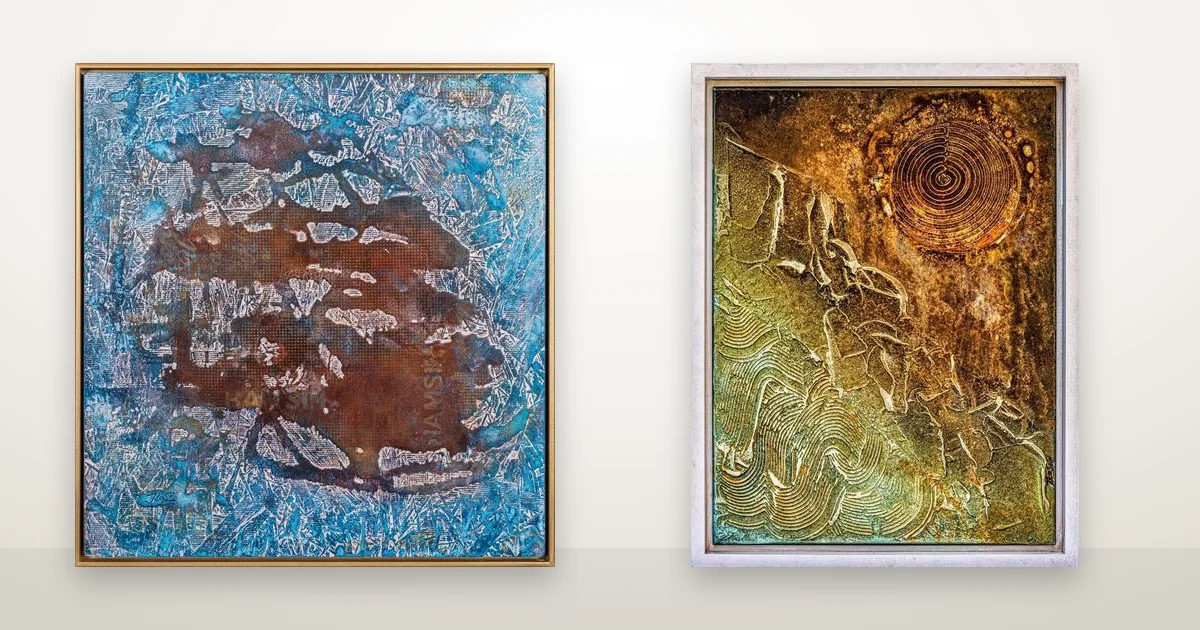
Khamsin, chamsin and hamsin are the same Arabic word for a dry, hot, sandy wind that crosses Egypt and the Levant. Sergei Troshin has used it as a title twice, and both paintings are set at the Dead Sea.
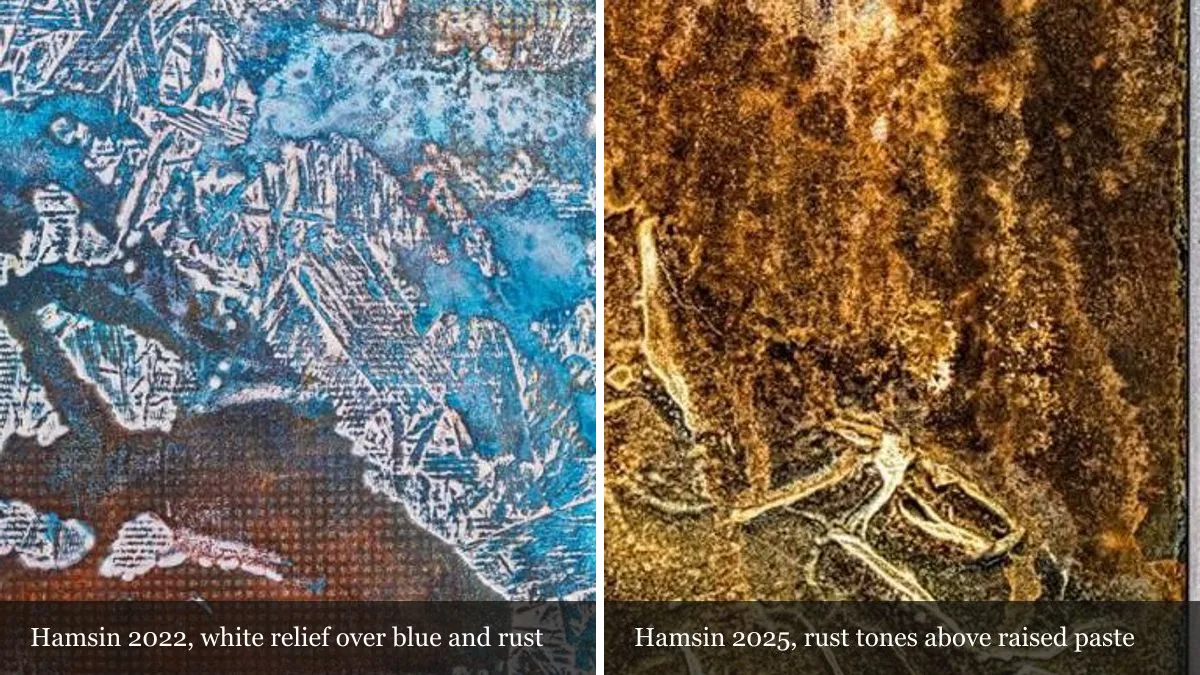
Hamsin (2022) is a 24 by 24 inch wooden board worked in blue natural dye, acrylic and resin. A rust-brown mass sits in the middle of a blue field, and in the catalogue photograph you can make out the word itself inside the rust. The artist's note tells of an evening when a sandstorm hid the sun and frightened a visitor:
“The air turned a dirty burgundy color, and a group of puzzled landsmen visibly grew around the tourist.”
Sergei Troshin, on Hamsin (2022)
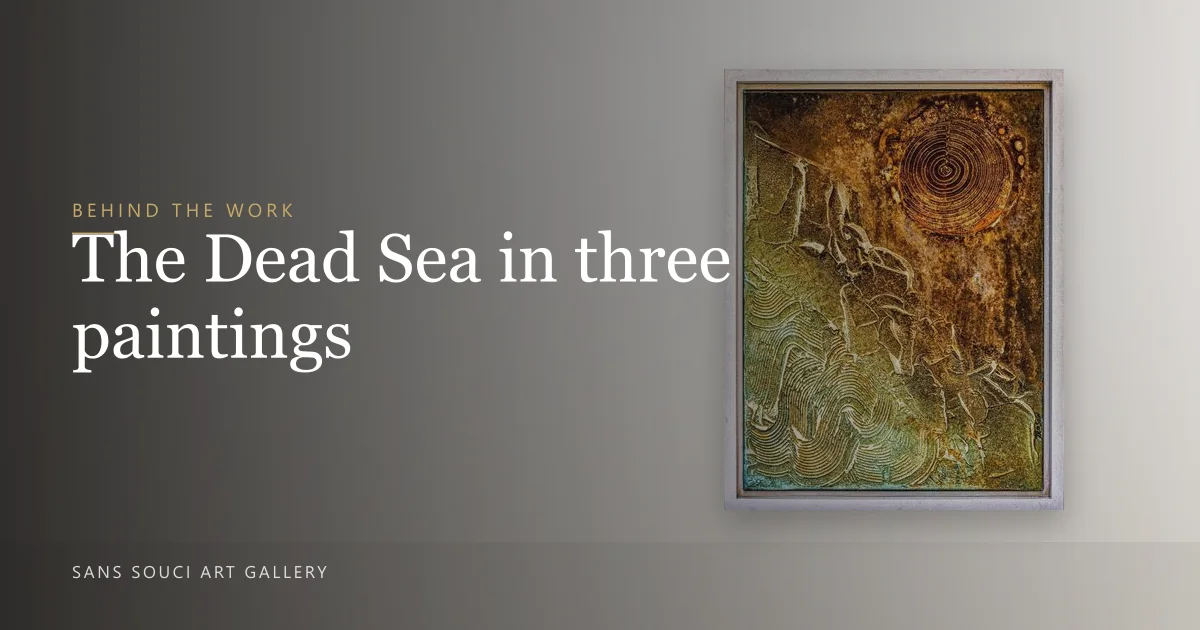
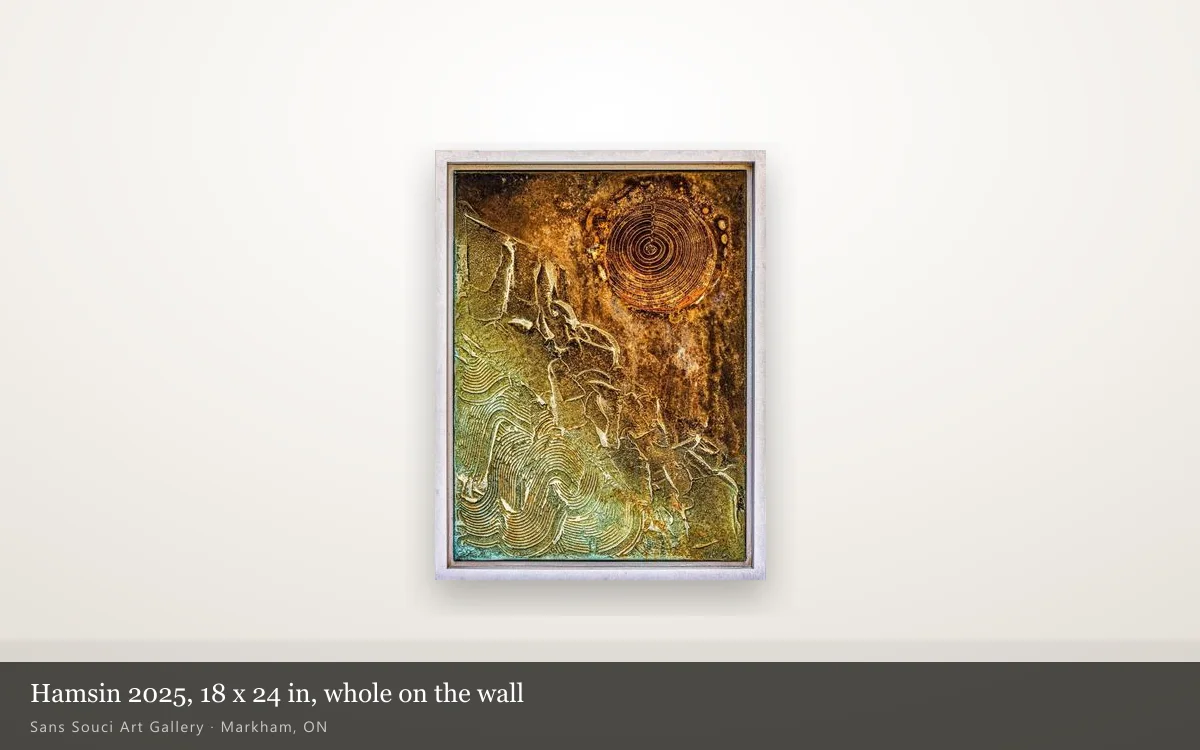
Hamsin (2025) is an 18 by 24 inch canvas in mixed media. The blue has gone. Rust and gold take over, raised paste covers the lower half in curving ridges, and a concentric spiral sits in the upper right. This time the note stays inside the storm:
“In this scene, the oppressive desert wind renders the sky and sun invisible, leaving behind an overwhelming sense of disorientation and unease.”
Sergei Troshin, on Hamsin (2025)
Three years separate them. The earlier note ends with the air clearing and the water coming back into view, and the later one offers no such relief. Colour, support, size and materials were all decided again, and the subject is what held.
Why an artist goes back to one subject
One painting can only show one state of a thing. Claude Monet's Haystacks are the best-known case: twenty-five canvases begun near the end of summer in 1890 and continued through the following spring, repeating stacks of harvested wheat to show how light and atmosphere differ by hour, season and weather. You can't see that comparison on any one canvas. It only exists across the group.
A series can also work through an idea instead of a view. The note on Treasure Behind the Wall II starts from a pattern emerging under layers of wallpaper and then turns to people: “I'm thinking of people as multilayered beings, much like the walls in my series.” The artist uses the word himself there, and the numeral in the title marks this wall as one of several.
A series and an edition are different things
If you're buying, this is the distinction that matters. Tate's glossary entry on editions describes an edition as a copy or replica of a work made from a master, most often a run of identical prints from one printing surface. Works in a series have no shared master, so no two of them are the same picture.
| Question | Series | Edition |
|---|---|---|
| What repeats? | An idea, a subject or a way of working | The image itself |
| What is it made from? | A fresh start each time | One master, such as a printing plate |
| Two side by side | Different pictures | Identical impressions |
| How many? | It can grow: Hamsin came back after three years | Modern prints are usually limited to a stated number |
Every piece here is one of a kind, including the ones that belong to a group. We went through prints and reproductions separately in original, print or reproduction.
How works are related in this catalogue
The word covers more than one arrangement, and you can see four of them on our own pages.
- Some works are numbered. Decorative Composition 1 is one of four painted in 2020, each with its own palette. They don't share a format either: Composition 4 is a 24 inch square on hardboard and Composition 2 is on canvas.
- Some are objects painted as a run. The page for Wine Glass (I) points out that the pattern never repeats from one glass to the next, and the three round side tables go from dark brown through rust to pastel.
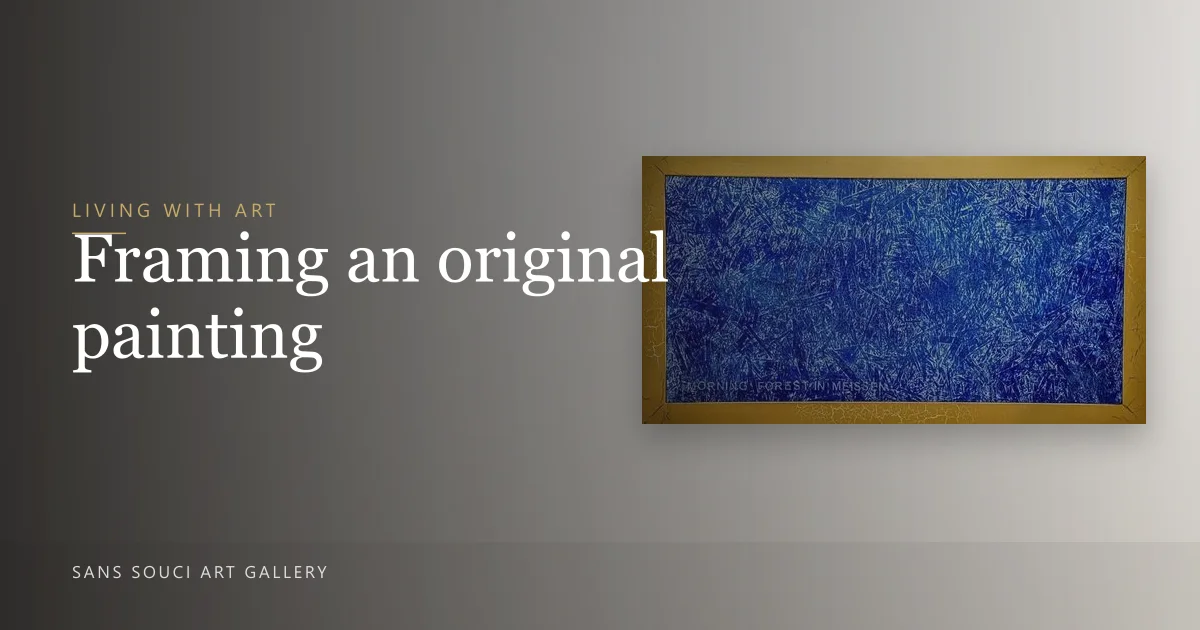
- One work can be a second take on another. The note on Morning Forest in Meißen (2023) closes with the words “Another version of Morgenwald in Meißen”, and at 52 by 28 inches it has a very different shape from the four-foot square of the 2022 work.
- Others share a place and not a title. Sunset at the Dead Sea goes with both Hamsins by subject, and we read the three of them together in the Dead Sea in three paintings.
What to ask about a work that belongs to a group
A few questions are worth putting to any gallery when a painting turns out to have relatives.
- Which other works is it related to? Naming the title in your message is enough to start the conversation.
- Are any of them still available? On this site each artwork page shows its own status, so check them one at a time.
- Would two of them hang well together? Compare measurements before colour, as we set out in hanging two or three together. The two Hamsins can both stand 24 inches high, while their widths differ by six.
- What if the one you wanted has sold? Our sold pages say “there is often related work from the same series, and Sergei Troshin takes commissions”, and how commissions work explains what a commission needs to start.
- How will you tell it apart in your own records? When two works share a title, write down the year and the size with it. We looked at this in what a title tells you.
Both Hamsins are listed as available today. To ask about either one or to arrange a viewing, write to us.