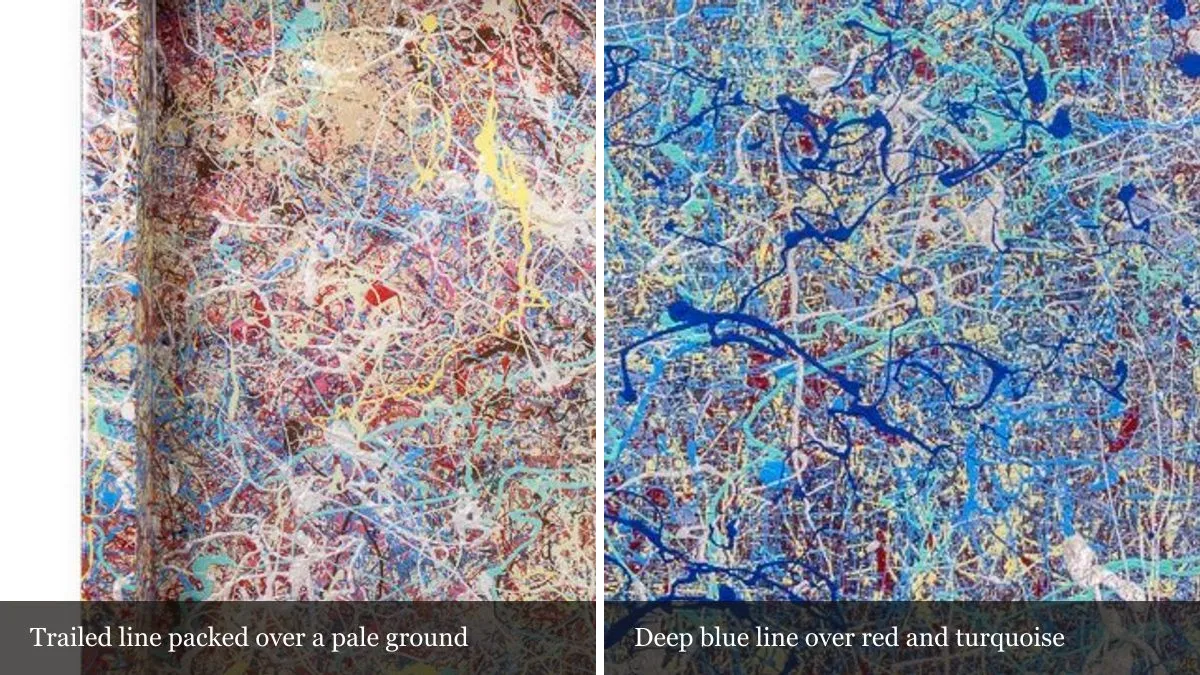
Stand a foot away from Transience and you are looking at individual lines of paint, trailed one over another until almost none of the ground underneath is left showing. Step back across the room and those lines merge into one overall tone. The painting is 12 × 16 in. The same holds for most of the small paintings in this catalogue: the detail is the picture, and the detail only exists at close range.
What does a small painting actually ask for?
A small painting asks for a short viewing distance, and that one requirement decides everything else. Before the wall, the frame or the lighting, settle the question of where you will be standing when you look at it. A piece that lives at arm’s length belongs where people pass close by or sit close by, not on the far wall of an open room.
The Canadian Conservation Institute opens its note on the structure of paintings with a sentence worth keeping in mind while you look: “Paintings are not merely painted surfaces. Paintings are complex, three-dimensional structures composed of a variety of materials combined in an infinite number of ways.” On a four-foot canvas you can read that structure from the sofa. On a 12-inch board you cannot read it from anywhere except close up.
The small end of this catalogue, counted
Sixty-one pages make up the catalogue. Thirteen of them are furniture and home accents, which leaves 48 works that hang on a wall. Sixteen of those 48 — exactly one in three — have no side longer than 16 inches. The catalogue runs a long way past them: its largest piece, Under Media Cobweb, is 60 × 80 in and covers roughly thirty times the wall area of an 11 × 14.
The sixteen are not spread evenly across sizes. They sit in two tight clusters, and the clusters line up with two different constructions.
| The small end | How many | What the materials line names | The face |
|---|---|---|---|
| 11 × 14 in | 7 works | Five name acrylic on canvas; two say only mixed media, with no support named | Open paint, no clear coat named |
| 12 × 16 in | 8 works | All eight name a wooden board sealed with resin | Hard, glossy, reflective |
| 16 × 10 in | 1 work (Improvisation) | Acrylic, canvas, sealed with resin | The only small canvas with a poured coat |
There is a second pattern, and it is the one that decides viewing distance. We looked again at the photograph of every one of the sixteen. Thirteen are built the same way: line trailed and flicked over a ground, laid down enough times that very little bare ground survives. Three work the opposite way, with a few open loops on a plain field. If you are drawn to the thirteen, you are drawn to work that has to be seen from close up.
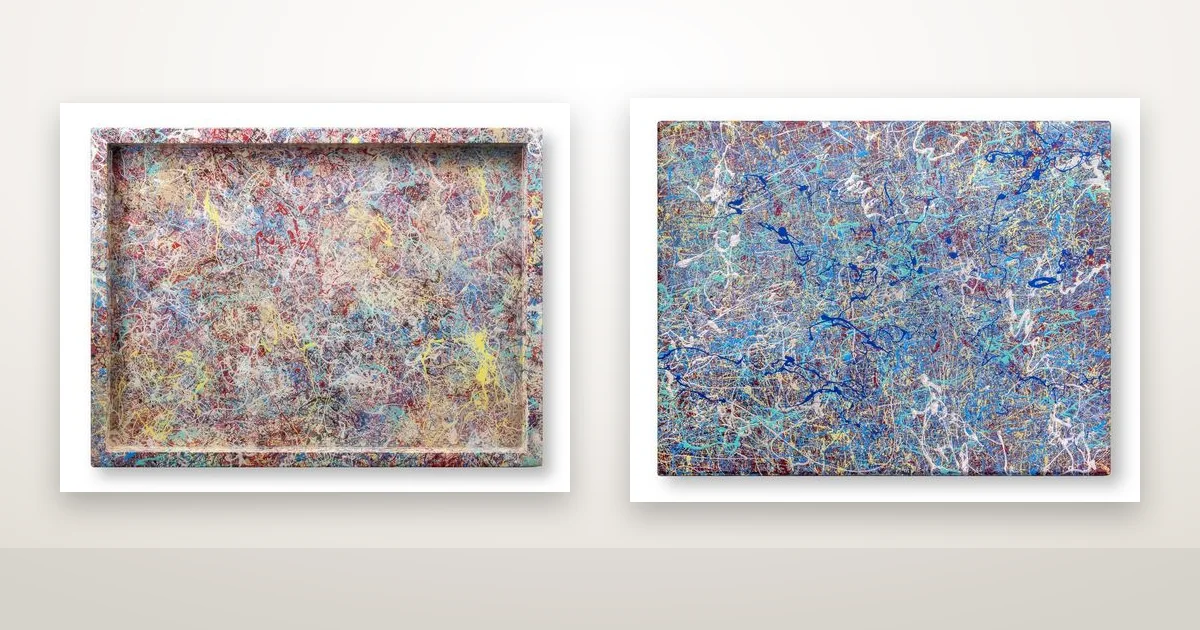
Transience and Blue, White, at arm’s length
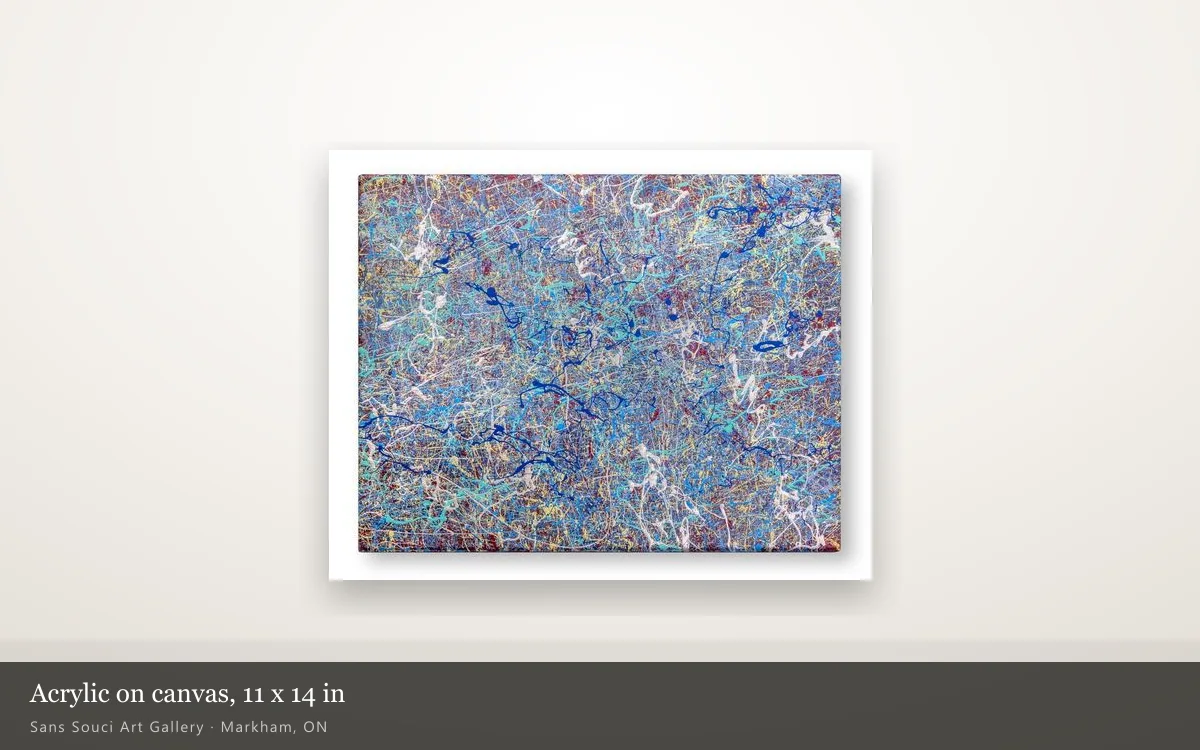
Two works, almost the same size, show what changes underneath that similarity. Transience is acrylic on a wooden board sealed with resin, 12 × 16 in, completed in 2020. Blue, White is acrylic on canvas, 11 × 14 in, completed in 2019. Both are dense trailed line. The difference is the face.
Transience carries a poured coat. The artist’s own note on that page describes how it was built: “Every layer of my abstract lines is sealed with a coat of crystal clear epoxy. Sometimes they are up to ten floating layers there.” That is why the colour sits deep and why the surface throws light back at you. In the photograph the painted area sits inside a raised painted edge that carries the same trailed line, so the depth is visible at the rim as well as in the picture.
Blue, White has no clear coat named on its materials line. Deep blue and turquoise sit over a red-brown ground that still shows through the thinner passages. Nothing is between your eye and the paint, so the colour reads matte, and the surface takes light rather than returning it.
That difference is worth more at this size than at four feet. A reflected window or ceiling lamp does not shrink to match the painting. The same reflected shape covers a much larger share of a 12 × 16 face than of a four-foot one, so a glossy small piece is fussier about which wall it goes on than a glossy large one. The care instructions differ too: our page for Blue, White asks you to keep it away from radiators and humidity and dust it with a dry, soft cloth, while the resin face on Transience is hard but scratches like any gloss surface, and prolonged sun is what ages a clear coat.
Where a small work earns its wall
It earns it wherever the normal viewing distance is short: a hallway, the turn of a stair, the wall beside a reading chair, above a desk, a narrow pier of wall between two doors, the stretch beside a bed. Our own page for Blue, White puts it plainly — an intimate size that works on a shelf, in a narrow stretch of wall, or as one of a small group rather than alone across a room. The page for Transience gives it a little more room: enough presence to hold a section of wall on its own above a console, a desk or a bedside.
From the far side of a large open room, or high above a fireplace under a tall ceiling, the lines have already merged by the time anyone looks, and the piece reads as a single patch of colour on a lot of wall.
Lighting follows from the same requirement. CCI’s note on track lighting assumes “a typical adult eye level of 160 cm” and puts the beam at 60° to the horizontal, with the fixture set out from the wall by D = (H − 160) × 0.577 in centimetres. For a three-metre ceiling that is 81 cm. Two further lines from the same note apply directly to this kind of surface: “a small increase in the distance will drastically reduce the light level”, and angles greater than 60° “will accentuate surface detail and texture”. On a dense trailed surface that accentuation is the point, as long as you are lighting the work and not putting a bright reflection where your eye goes.
Small is not less work
The artist’s note on Transience says: “This painting is a result of a long, detailed, artistic process! Every line and dot is a hard, but joyful hand-painted piece of work! As many lines, as many days of work!” Up to ten poured layers went over those lines, and a poured coat has to cure before the next one can go on. A 12 × 16 in built that way takes the days that note describes.
The rest follows the same rule as every other work here. Each one is unique, there is no print or reproduction of it, and it leaves the studio with a Certificate of Authenticity signed by the artist. Prices are shared on request, for every size.
Before you choose a small one
- Measure the distance, not just the wall. Work out how far away you will usually be standing, then judge the piece from that distance when you come to see it. If the spot is across a room, look at the larger pieces on the artworks listing instead.
- Check what is opposite it. A window or a ceiling fixture facing a resin face will put a reflection in the middle of the picture. Facing a blank wall, the same piece is easy.
- Decide alone or in a group early. Two or three small works read as one object on the wall and need a common line and an even gap — we set that out in hanging two or three together.
- Ask about weight and fixing. No page here publishes a weight, and a sealed board and a canvas of the same size do not weigh the same. Ask us before you buy the hook.
- Scale the wall, not the room. If you are weighing a small piece against a large one for the same space, choosing the right scale for a wall has the clearance rule and the tape-measure test.
Both works in this note can be seen in person in Markham, by appointment, which is the only way to settle the distance question for yourself. Ask us about either one and we will tell you what the photographs cannot: how the surface behaves when you walk past it.