Of the sixty-one works in this catalogue, exactly one carries the word framed in its materials line. The other sixty do not. That is a decision rather than an omission, and framing an original painting is one of the few things a new collector is expected to have an opinion about and almost never gets told anything useful about.
Does an original painting need a frame?
No, not as a rule. A frame does three jobs: it protects the outer edge of the painting, it holds glazing away from the paint surface when glazing is warranted, and it puts a visual border between the work and your wall. A painting on rigid board with finished edges and a sealed face has already solved the first two.
So the useful question is which of those three jobs is still open on the piece in front of you. On a work on paper, all three are open. On a resin-sealed board whose edges the artist painted, none of them are, and a frame begins to take something away instead of adding.
What a frame physically touches
The front of the painting. The lip that holds a work in place, called the rabbet, overlaps the outer margin of the painted face all the way round. The Canadian Conservation Institute is direct about the consequences in its note on framing a painting: the paint surface must never come into direct contact with the rabbet, and simply padding the rabbet is only appropriate where there is no raised impasto along the painting's edges.
That is worth knowing here, because raised surface is normal in this work rather than exceptional. Wax paste, collage, poured resin and layered line work all sit proud of the board.
The one framed piece, and what its frame is doing
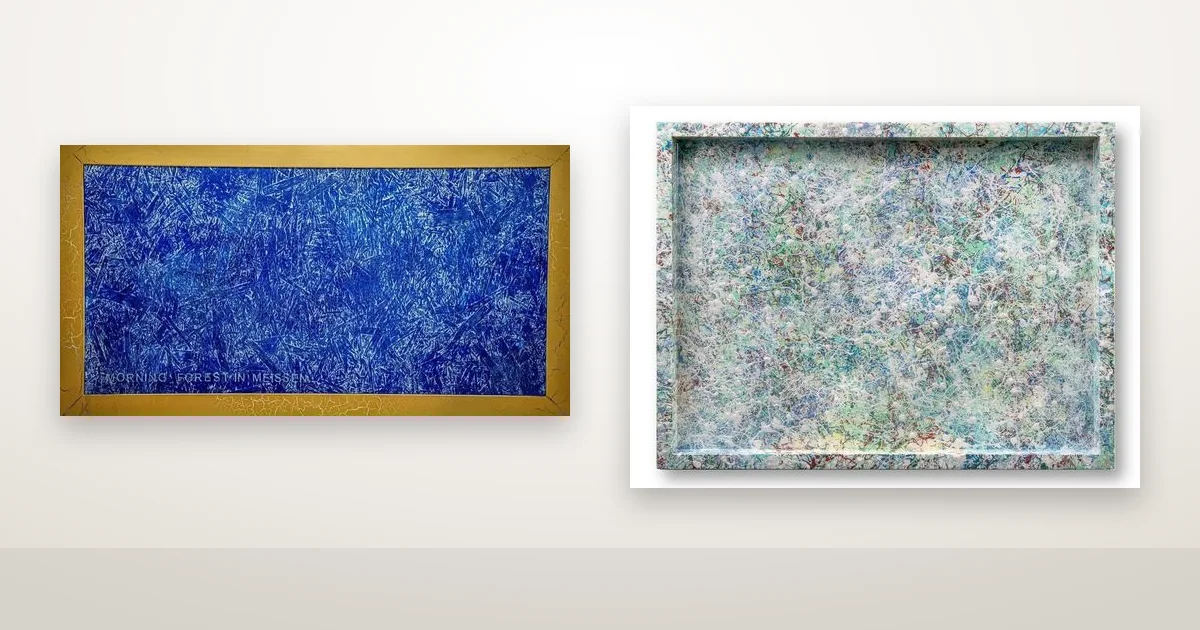
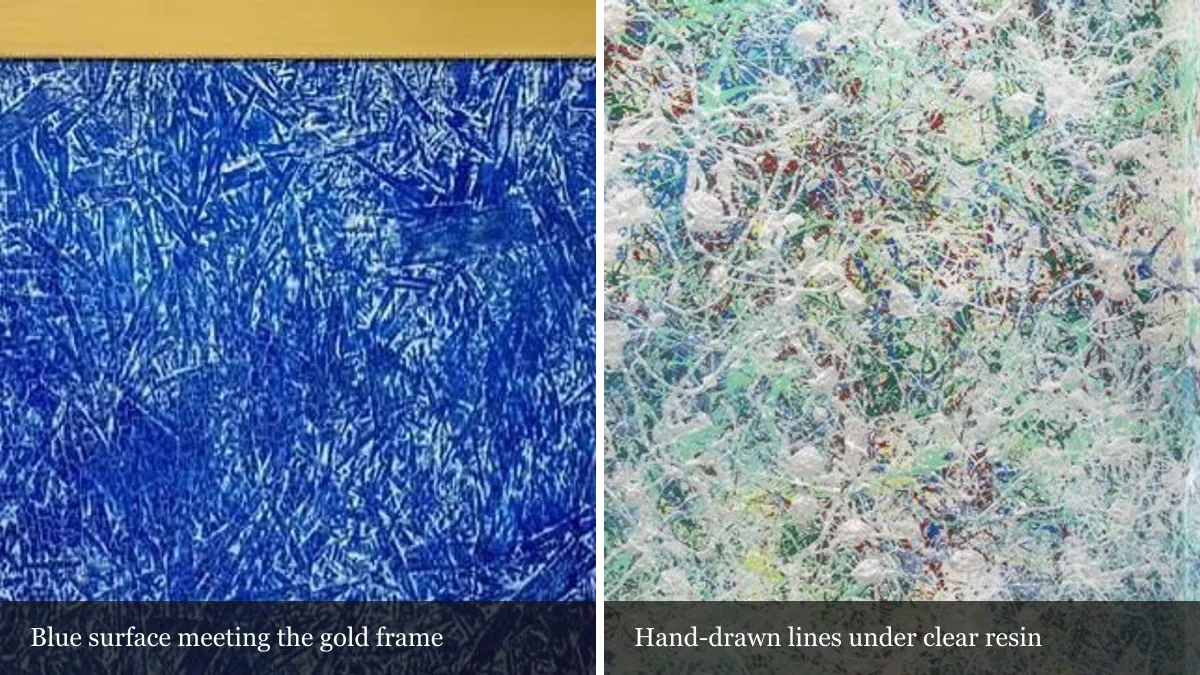
Morning Forest in Meißen (2023) is the exception. Its materials line reads “acrylic, natural dyes, resin, wax paste, and diamond dust on wooden board (framed)”, and the work measures 52 by 28 inches. At that width, on board, a frame is doing structural work rather than decorative work: it stiffens the span and it takes the knocks that would otherwise land on the outer inch of the painting.
We should be careful about what we claim. The site records that this piece is framed; it does not record why, and we are not going to invent the artist's reasoning. What we can say is what a frame does for a work of that size and surface — and 52 inches across, on rigid board carrying wax paste and diamond dust, is exactly the case where one earns its place.
When a frame would cover the painting
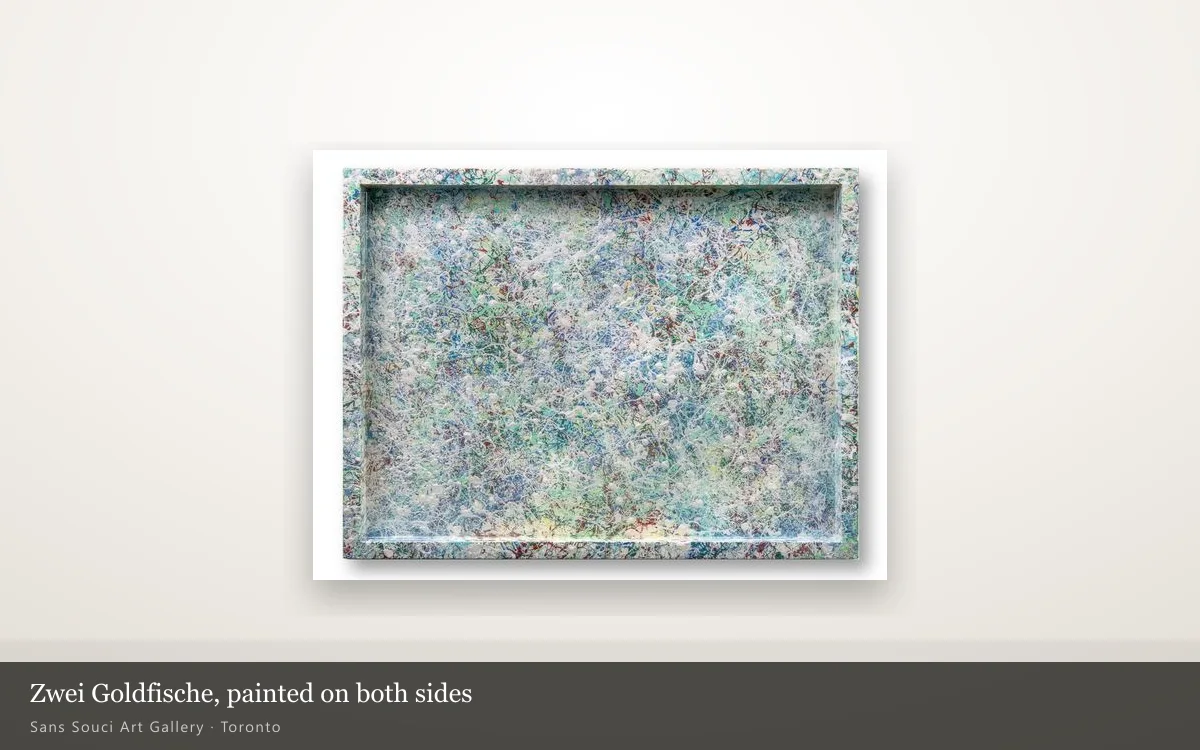
Zwei Goldfische is 12 by 16 inches, acrylic on wooden board sealed with resin, and its materials line ends with three words that settle the question: “Two sides painted”. In the catalogue photograph the dense white and green line work does not stop at a border — it carries out over the outer edge of the board. A rabbet placed there would rest on finished paint and hide it.
The artist's own note on the piece explains what that edge cost: “Every line and dot is a hard, but joyful hand-painted piece of work! As many lines, as many days of work! Every layer of my abstract lines is sealed with a coat of crystal clear epoxy. Sometimes they are up to ten floating layers there.”
Three works in the catalogue carry that same “two sides painted” note: Zwei Goldfische, White and Golden Night. All three are 12 by 16 inches, all three date from 2020, all three are sealed with resin, and two of them have already sold. They sit together in Abstract Variations.
Which works ask for a frame, and which do not
| What you are holding | What a frame would add | Our answer |
|---|---|---|
| Acrylic on paper | Rigidity, glazing, and a barrier against handling | Frame it |
| Canvas with raw, unpainted edges | A finished outer line where the tacking edge shows | Optional — a preference, not a need |
| Board with painted or sealed edges | Nothing; the rabbet lands on finished paint | Leave it unframed |
| A face poured with resin | A second reflective layer over one that already reflects | Leave it, or use a frame that stands clear of the face |
| A large, heavy board | Rigidity across the span, and edge protection in transit | Worth asking about |
Should you put glass over a resin face?
Usually not. A poured resin coat cures to a hard, glass-like film, which is why it behaves like glazing without the glass: it already protects what is underneath and it already reflects. Adding glazing hands you two reflective surfaces to position against the light in a room instead of one.
If glazing is genuinely wanted, the same rule applies as at the rabbet — the glass or acrylic must never touch the paint, so the framing has to carry a spacer that holds it clear. The conservation guidance reserves glazing for particularly fragile surfaces and for rooms with wide humidity swings, not as a default. For most pieces, where the work hangs relative to the window does more than glass will, which is the subject of where to hang a textured piece.
The one work here that genuinely asks for a frame
The Power of the Abstract (2022) is the only piece in the catalogue made on paper: acrylic on paper, sealed with resin, 40 by 60 cm. Paper is the lightest support used here. Even sealed, it has no rigidity of its own and it holds a crease permanently, so a frame is doing something that careful hanging cannot replace. The CCI publishes a separate note on framing works of art on paper, and it is worth reading before you hand the piece to a framer.
If you decide to frame
- Measure the work, not the photograph. Each artwork page gives the real dimensions in inches and centimetres.
- Tell the framer whether the edges are painted before any rabbet width is chosen. That one sentence prevents the most common mistake.
- Ask how the face will be kept off the rabbet — padding where the edge is sound, a spacer where the surface is raised.
- Keep glass off a sealed face unless there is a reason for it, and never let glazing rest on the paint.
- On paper, hinging and mounting are a conservation question rather than a hardware-store one. The CCI note above covers it.
- Framed or not, the rest of the routine does not change — it is in how to look after an original.
Where that leaves you
One piece here arrives framed and the rest do not, and none of them needs a frame in order to hang. If you are weighing it up for a particular work, it is a decision better made in front of the piece than from a photograph, because what settles it is the edge, and an edge is easier to read in person. Viewings are by appointment at the gallery in Markham, and we are glad to talk through materials, framing, or how a work will sit in your space. Ask us about a piece and we will tell you exactly what its edges are like.