A visitor once picked up a postcard from the counter and asked whether it was the actual painting or a picture of it. It was the second — the gallery's own printed handout. The real piece, three inches deep at its thickest ridge, was hanging six feet away on the wall behind her. The mix-up is an easy one to make, because online listings blur "original", "print" and "reproduction" into one loose word: art. The three words describe three different objects, and knowing which one is in front of you changes what you are actually paying for.
What actually makes a piece an original?
An original is the one physical object the artist's hand built — there is no second copy anywhere, and nothing else carries the same brushwork, the same poured resin, the same weight. Every piece at Sans Souci is built this way, and it is stated plainly on the page: nothing here is a print or a reproduction.
That single-object status is also what a Certificate of Authenticity exists to record — a signed document tying one specific piece to Sergei Troshin, not a claim about a print run, because there is no run to describe. Every artwork page on this site carries the same structured line, the kind search engines and buyers can both check: unique original, one of one, no edition attached to it.
That also means an original cannot be replaced. If a piece is damaged or lost, there is no second impression to fall back on and no printer to run again — which is one reason insurers ask for a description and photographs of the actual object rather than a model number, and why the certificate that travels with it matters more as the years pass.
What is a print, then, and how is a reproduction different?
A print is its own artwork, made by transferring an image from one surface to another — etching, lithograph, screenprint, or a digital giclée — often in a numbered run where the artist is still directly involved in producing each impression. A reproduction is something else: a photograph of an already-finished painting, turned into a poster or a canvas print, made without the artist touching the copy at all.
The distinction matters because both get sold as "art" online, and neither behaves like the object Sergei Troshin actually built. Tate's own glossary defines a print as an impression made by transfer from one surface to another — a process, not a photograph. A reproduction skips that process entirely; it is a copy of a copy, and it is exactly the category the gallery's no-online-checkout policy is built to keep out.
A number on a print — 12/50, or an artist's proof marked A/P — is not a flaw. It says the edition is finite and the impression in your hands is one of a known, limited set. What it is not is a claim to be the only one. When a listing does not say original, print, or reproduction anywhere, that silence is worth a direct question before anything else.
Why depth and texture cannot survive a photograph
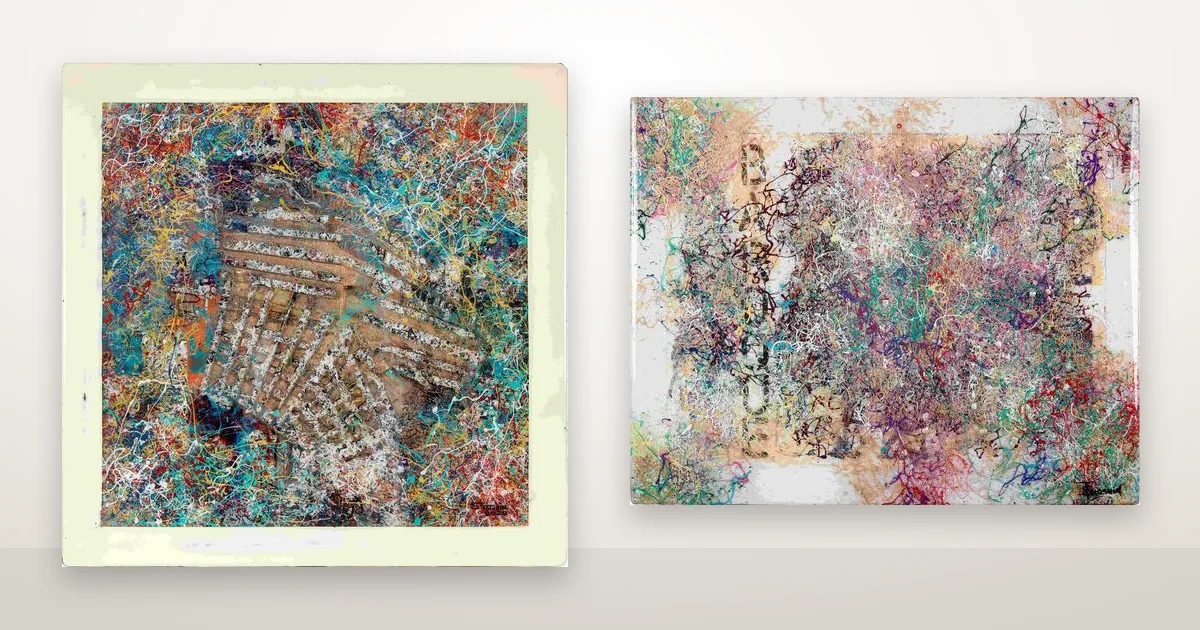
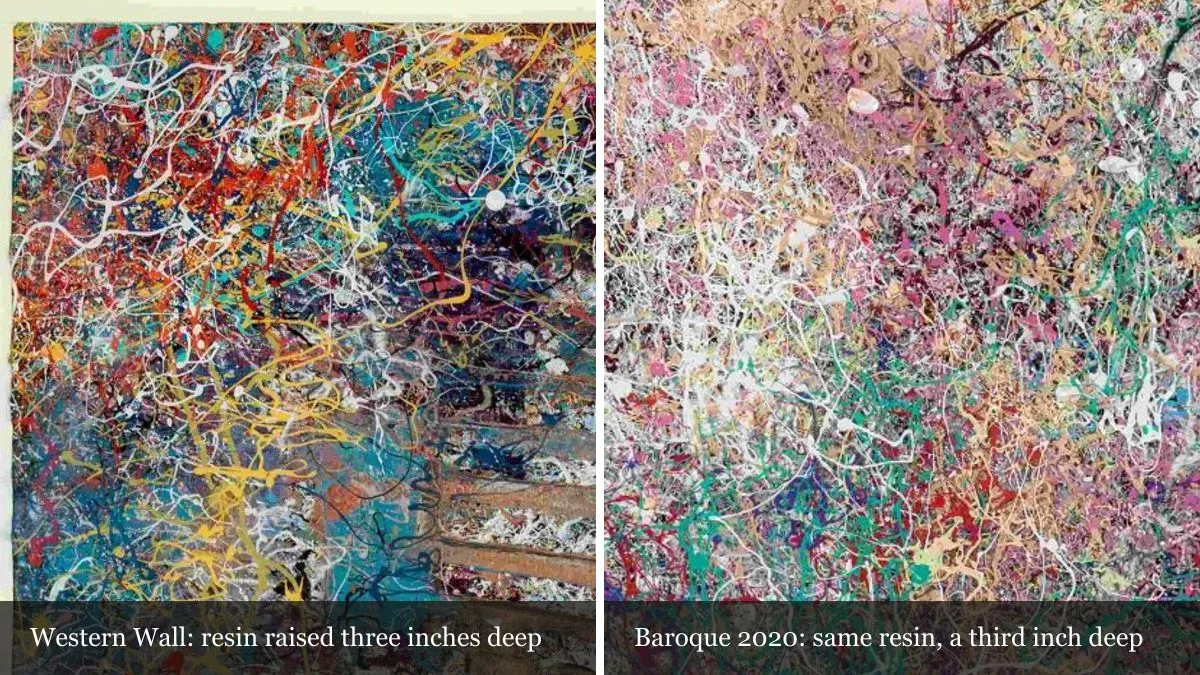
A photograph flattens everything into one plane, so a print or reproduction of a textured piece loses the one part a camera cannot record: how thick the surface actually is, and how light moves across it as you walk past. Two Sans Souci originals, built from the same materials in the same year, show how differently that plays out.
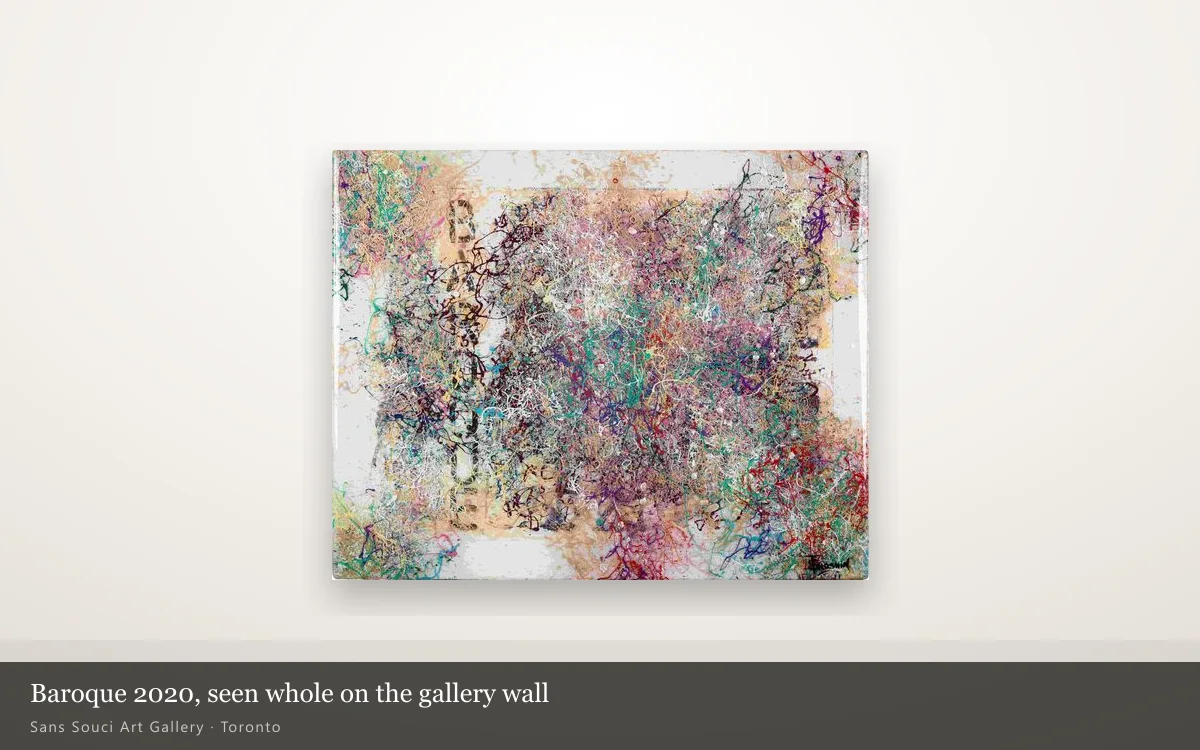
Western Wall is built up to three inches deep on fibreboard — acrylic and resin worked into a relief you can read with your fingers before you read it with your eyes. The artist's own note on the piece describes touching "its stones that are a witness of the ages," a line about the working process itself, the kind of detail a flat print has no way to carry. Baroque 2020, worked in the same acrylic-and-resin combination on the same kind of support, sits at roughly a third of an inch — a resin sheen over hand-drawn line work rather than a built-up relief. A poured resin coat cures to a hard, glass-like film that deepens whatever is underneath it; Tate's glossary entry on resin explains why that finish behaves the way it does. Ten times the depth, same materials, same year, two very different objects to actually stand in front of.
| Western Wall | Baroque 2020 | |
|---|---|---|
| Status | Available | Sold |
| Depth | 3 in (7.6 cm) | 0.3 in (0.8 cm) |
| Size | 24 × 24 in | 20 × 16 in |
| Surface | Built-up relief under resin | Flat resin sheen over line work |
Neither depth survives being turned into a print. A photograph of Western Wall can show its colour and its outline, but not the shadow its own ridge casts on itself in the late afternoon — and that shadow is a real part of what the piece is. Even the photographs on this page are one fixed angle under one fixed light; they are useful for deciding whether to come and look, not a substitute for standing in front of the object itself.
What to actually ask before you buy
Three short questions separate an original from everything sold alongside it online, and a gallery that only sells originals should be able to answer all three without hesitation:
- Is this the artist's own hand, or a copy of something he already finished?
- Does it come with a signed Certificate of Authenticity, or only an invoice?
- Is there a second copy anywhere, numbered or otherwise?
None of the three questions requires any background in art. They are about the object, not the taste, and a straight answer to all three is the difference between paying for a painting and paying for a picture of one.
Every piece in the Artworks collection is one of one, the way Western Wall and Baroque 2020 both are. See one in person in Markham by appointment, or get in touch to ask which pieces are still available.