Nothing in this catalogue was made as a set. Across all sixty-one artwork pages the words diptych, triptych and pair do not appear once. Every piece here is a one-off, made on its own. So hanging two or three together is something you compose after the fact — and what makes a group look deliberate rather than accidental is measurable, which is good news if you are planning one.
What makes two works look deliberate together
Repetition of one measurable thing. The same outside dimensions, the same support, the same finish, or simply the same gap repeated. Colour and subject are what most people reach for first, and they are the least reliable: two paintings that share a blue can still read as an accident if one is twice the height of the other.
This catalogue happens to make that easy. Forty-seven of the sixty-one pages state a size, and the sizes repeat: eight works measure 12 × 16 in, seven measure 11 × 14 in, six measure 16 × 20 in, five measure 24 × 24 in, three measure 18 × 24 in and three are four feet square. On seven pages the site says so itself — the smallest works carry the line that the piece “works on a shelf, in a narrow stretch of wall, or hung as one of a small group rather than alone across a room”. Spring Thoughts is one of those seven.
The group this catalogue already contains
The collection called Abstract Variations holds seven works, and every one of them measures 12 × 16 in, is built on wooden board sealed with resin, and was completed in 2020. Five of the seven carry the artist’s note word for word identical — the same paragraph on five different pages, because it describes the method rather than the picture:
“This painting is a result of a long, detailed, artistic process! Every line and dot is a hard, but joyful hand-painted piece of work! As many lines, as many days of work! Every layer of my abstract lines is sealed with a coat of crystal clear epoxy. Sometimes they are up to ten floating layers there.” — Sergei Troshin
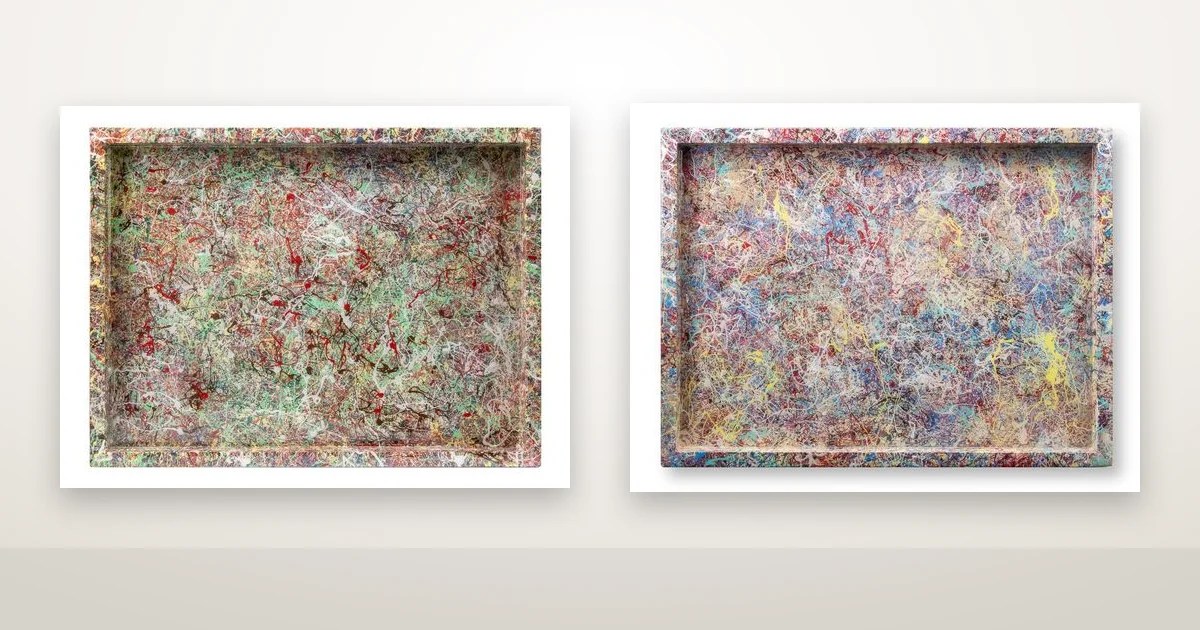
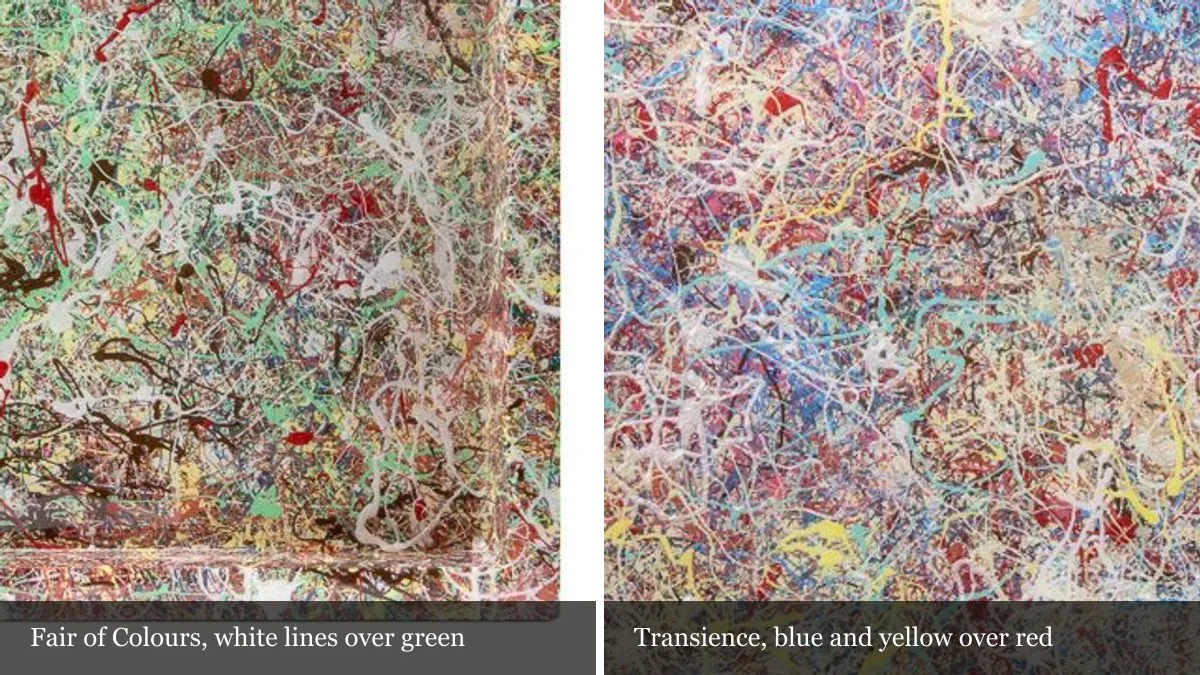
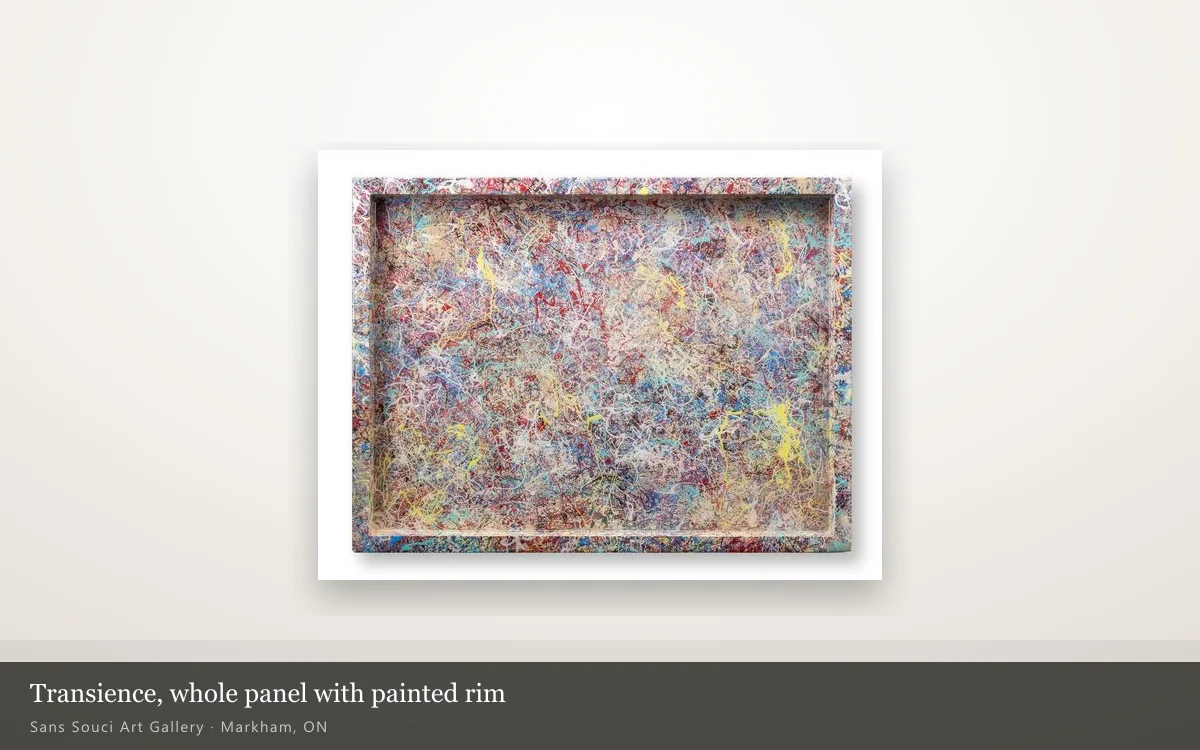
Same size, same support, same finish, same year, same note. That is a group by every property you can measure, and the site never calls it one. Three of the seven are currently on the site as available: Fair of Colours, Transience and Zwei Goldfische. The other four have sold, and the badge on each page is the only place that status is current.
Fair of Colours and Transience are worth looking at side by side. Both photograph as deep panels with a raised rim, and on both the drizzled line runs over that rim and down the side, so both stand off the wall rather than sitting flat against it. Neither page publishes a depth figure, so that is one to ask about if the shadow matters to you. What differs is the palette: red, green, white and ochre on one, blue, red, yellow and white over a pinkish ground on the other. Hung together, the difference between them is colour — the object, the method and the finish are the same.
The gap, the top line and the centre line
When two works are the same height, the top line, the bottom line and the centre line are the same line, and the only decision left is the gap. When the heights differ you have to choose which line to honour, and the choice is visible from across the room. Decide it on paper before you touch a drill.
| A real combination from this catalogue | Sizes as published | What lines up on its own | What you still have to decide |
|---|---|---|---|
| Fair of Colours + Transience | 12 × 16 in each | Top, bottom and centre, all at once | The gap, and that both hang the same way round |
| Fair of Colours + Transience + Zwei Goldfische | Three at 12 × 16 in | The same, in a row of three | Total width: three panels plus two gaps, over furniture at least that wide |
| Hamsin (2022) + Hamsin (2025) | 24 × 24 in and 18 × 24 in | If the 2025 piece hangs as its page reads it, both stand 24 in high | The width difference: one square, one narrower, so the gap carries it |
| A 12 × 16 in panel + Over The Horizon | 16 in high beside a 24 in square | Nothing | Centre line or top line. Centred, the square runs 4 in above and below. Top-aligned, its bottom edge sits 8 in lower |
One rule holds for the gap: it has to be clearly narrower than the works themselves. Two twelve-inch panels with a twelve-inch space between them read as two paintings sharing a wall; the same pair at three or four inches reads as one shape. Once they read as one shape, that whole rectangle — both panels plus the gap — is what the wall and the furniture below have to accommodate. We sized a single piece to a wall in choosing a size for a wall you cannot re-measure; for a group, measure the rectangle.
Three things to settle before you drill
A single painting forgives a lot. A group does not: three fixings, three heights and three loads have to agree. Three questions these pages cannot answer, and all three take us a minute.
- Which number is the height. Every page prints two numbers, and the sentence underneath reads the first as the width. We compared that sentence with the photograph on each page: on twenty-one of the forty-three works where both exist, the photograph is the other way round. On an abstract surface that is often not a mistake — the piece can genuinely hang either way — but a row of three needs that decided before the holes, not after.
- Weight. Not one of the sixty-one pages publishes a weight. For one small panel it rarely matters; for three fixings into the same stretch of drywall, each has to be rated on its own.
- How each piece hangs. No page records the hardware — wire, D-rings or a cleat. Two panels of identical size hang at different heights from the same pair of hooks if one is strung with a wire and the other is not, because the hook line is not the top edge. That is the detail that spoils an otherwise careful group.
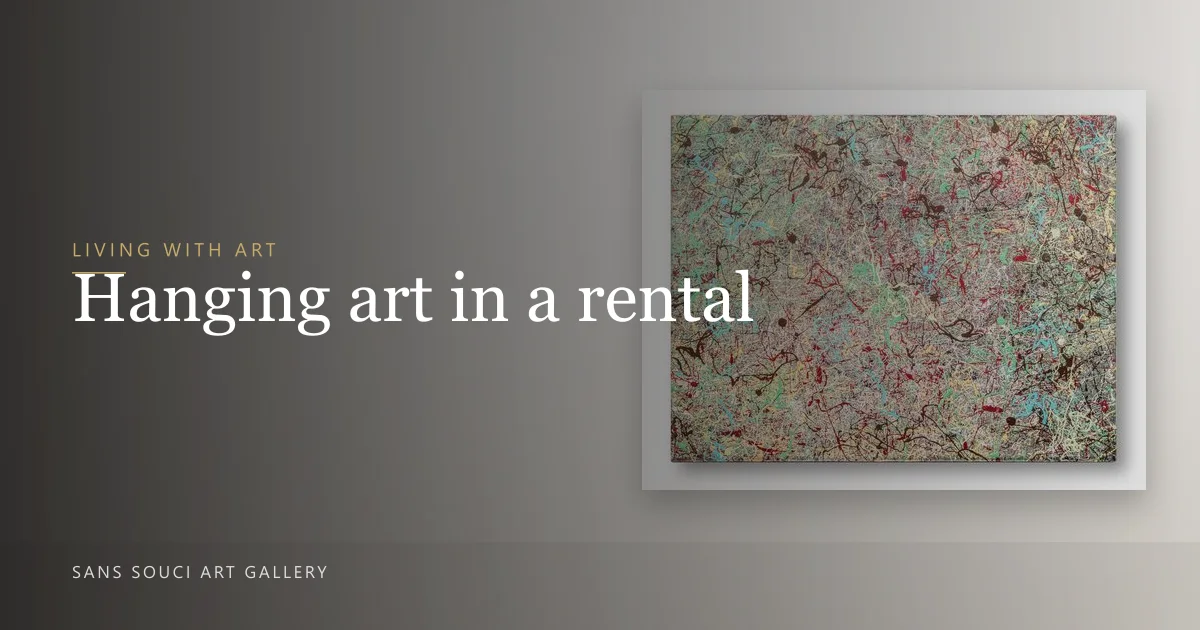
The wall decides the fixing, not the painting. The Canadian Conservation Institute’s storage and display guidelines for paintings sets out what suits what: picture hangers for plywood; wall plugs, screws, threaded hooks or bolts for brick, plaster, stone and poured concrete; anchors, threaded hooks or eyelets for hollow-core walls. The same note argues for a picture rail or track near the ceiling, for two reasons that matter more to a group than to a single piece — “versatility in positioning on display” and “no need for making and patching holes in the wall each time paintings are changed”. If you expect the group to grow, or you are renting, that is the answer; we went through the rental case in hanging art in a rental.
One place to avoid is also where small groups most often end up. CCI is explicit that paintings should not hang “in areas where they might be brushed against or touched by passers-by (e.g. in narrow corridors or in stairwells)”. A row of three at shoulder height along a hallway is exactly that.
Lighting two or three at once
One fixture aimed at the middle of a group lights the middle. The outer works fall off, and on a resin face the falloff is not subtle — the lit piece throws a bright reflection back at you while its neighbour goes flat. Light the group, not the centre of it.
CCI’s note on track lighting gives the geometry in numbers. The beam should meet the work at 60° to the horizontal; the distance from the wall to the fixture is D = (H − 160) × 0.577, in centimetres, where H is the ceiling height. A three-metre ceiling puts the track 81 cm out from the wall. For large works, add at least another 30 cm so the top of the piece is not sitting under the lamp. And where you want to keep re-aiming as the group changes, CCI recommends a double track 60 to 90 cm apart as the most flexible arrangement.
Every work in Abstract Variations is sealed with resin, so a group drawn from it is a set of reflective faces that all behave the same way — easier to light than a mixed wall. More on that surface in where to hang a textured piece and in why a painting looks different at 9am and 6pm.
When a pair is worse than one piece alone
Three cases. When the second work is chosen to fill a space rather than because you want it — a group makes that obvious, not less. When one piece already holds the wall on its own, as a four-foot square does, a neighbour competes with it instead of supporting it. And when the two surfaces behave differently under one lamp: a sealed resin face and a bare canvas cannot both be lit well by a single fixture. There is also no hurry. A group built one piece at a time, each addition measured against what is already up, is easier to get right than one bought in an afternoon.
If you are working out a wall, tell us the wall — its width, what sits under it, and where the light comes from — and we will give you the true height, the weight and the hanging hardware of any piece before you commit to it. Everything is in Markham and can be seen by appointment: get in touch.