Sixty-one originals are catalogued here. Three of them describe the same place. The Dead Sea appears by name in the artist’s own text on Sunset at the Dead Sea, on Hamsin (2022) and on Hamsin (2025) — and nowhere else in the catalogue. Three paintings, made across four years, holding on to one stretch of coast and one kind of weather.
Which paintings are the Dead Sea works?
Three, and all three are currently available. Sunset at the Dead Sea and Hamsin (2022) were made in the same period, on wood, with natural dye. Hamsin (2025) is a later and smaller work, in mixed media on canvas. Nothing else here names the place, the mountain or the wind.
A caution before we go further. The site does not label these three a series, and neither does the artist. The word “series” appears in exactly one description in the whole catalogue, and there it refers to a different group of paintings, about walls. We are grouping them here because their descriptions point at one place, not because a label exists. That distinction is the same care we apply to reading a catalogue by year: what the pages state and what a reader infers are two different things, and only one of them is checkable.
What is a hamsin, and why is it spelled two ways here?
A hamsin is a hot, dry, sand-carrying wind. The title on the 2022 painting spells it Hamsin; the artist’s own description on that same page spells it khamsin. Both are standard. The encyclopaedia entry for the wind lists khamsin, chamsin and hamsin as the same Arabic word, meaning “fifty”.
The rest of that entry is worth knowing before you stand in front of either Hamsin. The storm passes over an area for several hours, carrying sand and dust from the deserts at speeds of up to 140 km/h, and humidity in the affected area drops below five per cent. In the southern Levant it arrives as an oppressive front: high temperatures, enough dust to cut visibility, strong wind at night.
That detail settles something in the 2022 painting. The artist recounts a visitor asking him, in his telling, “Is this the end of the world?” — and gives his own reply: “Calm down! This is a khamsin with a sandstorm. It will soon pass!” The event in the painting has a duration. It is measured in hours, and it ends.
The heat: what he describes, and what can be checked
The artist writes about the conditions rather than about the view. On Hamsin (2022): “I enjoyed the melting air and overheated seawater. Strange conditions, but it was paradise for me!” He describes the sun “settling down for the night somewhere beyond Mount Masada”, and the sea shimmering under it.
Those are memories rather than measurements, but they are not exaggerations either. The Dead Sea sits roughly 440 metres below sea level, which makes its shores the lowest land on Earth, and the top layer of the water has been recorded swinging between 19 and 37 °C. Water at body temperature, in a basin that far below sea level, is close to what “melting air and overheated seawater” describes.
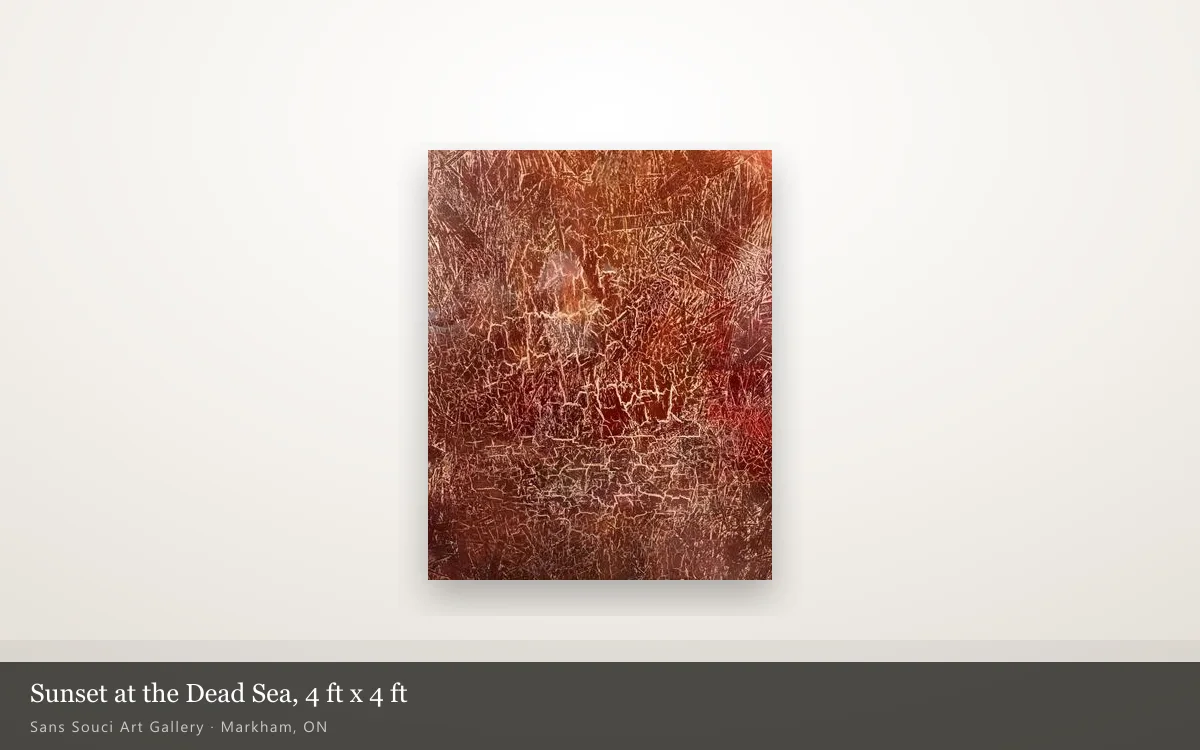
Sunset at the Dead Sea takes the same hour and gives it entirely to colour. In the artist’s words, when the sun settles into the mountain, “the surrounding landscape is filled with wine-red colors until it is utterly inebriated with crimson”. Standing in front of the work, that is what has happened to the picture: there is no sun drawn in it and no horizon line. The whole four-foot square is the light.
What changed between the early works and 2025
The place stayed and the weather took over. Both early paintings hold a continuous field of warm colour. The 2025 work breaks that field up, and the artist says why: the wind “renders the sky and sun invisible, leaving behind an overwhelming sense of disorientation and unease”.
| Sunset at the Dead Sea | Hamsin (2022) | Hamsin (2025) | |
|---|---|---|---|
| Year on the page | 2021 in the description, 2022 in the title | 2022 | 2025 |
| Materials as stated | Natural dye, acrylic, resin on wood | Blue natural dye, acrylic, resin on wooden board | Mixed media on canvas |
| Support | Wood | Wooden board | Canvas |
| Clear coat named | Resin, named in the line | Resin, named in the line | None named |
| Size published | 4 ft x 4 ft | 24 x 24 in | 18 x 24 in |
| Colour that holds the field | Wine-red and crimson | Blue, with rust through the middle | Rust, with gold |
| Status | Available | Available | Available |
One line in that table needs a word of explanation. Sunset at the Dead Sea carries 2022 in its title while its own description says it was completed in 2021. We count the description year, and we say so rather than quietly picking one.
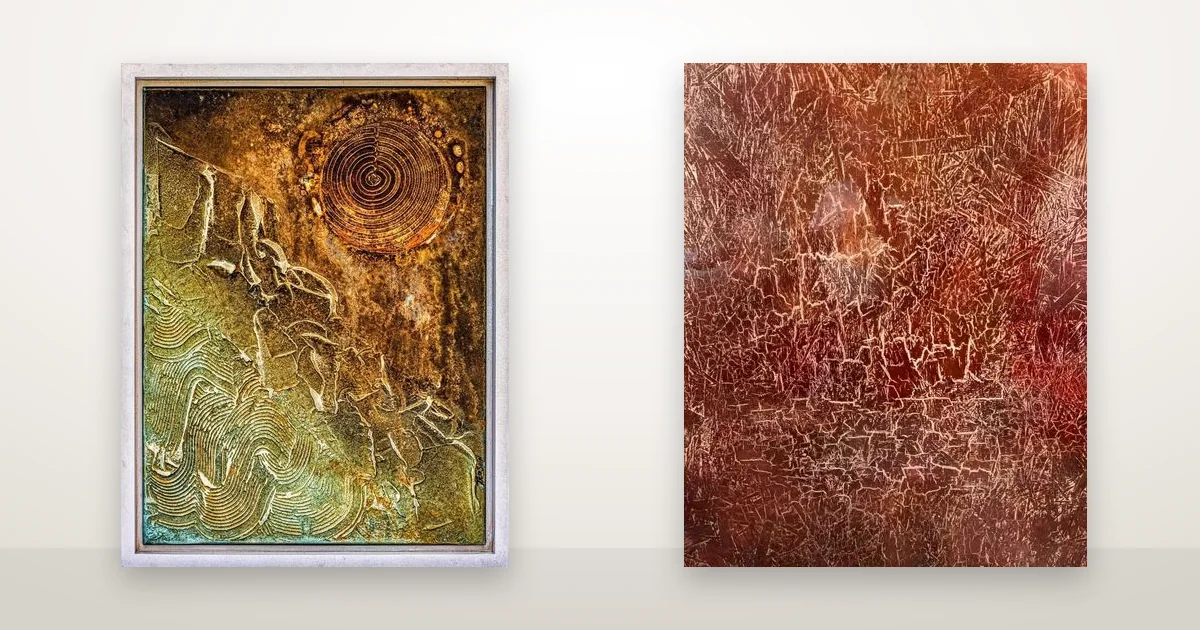
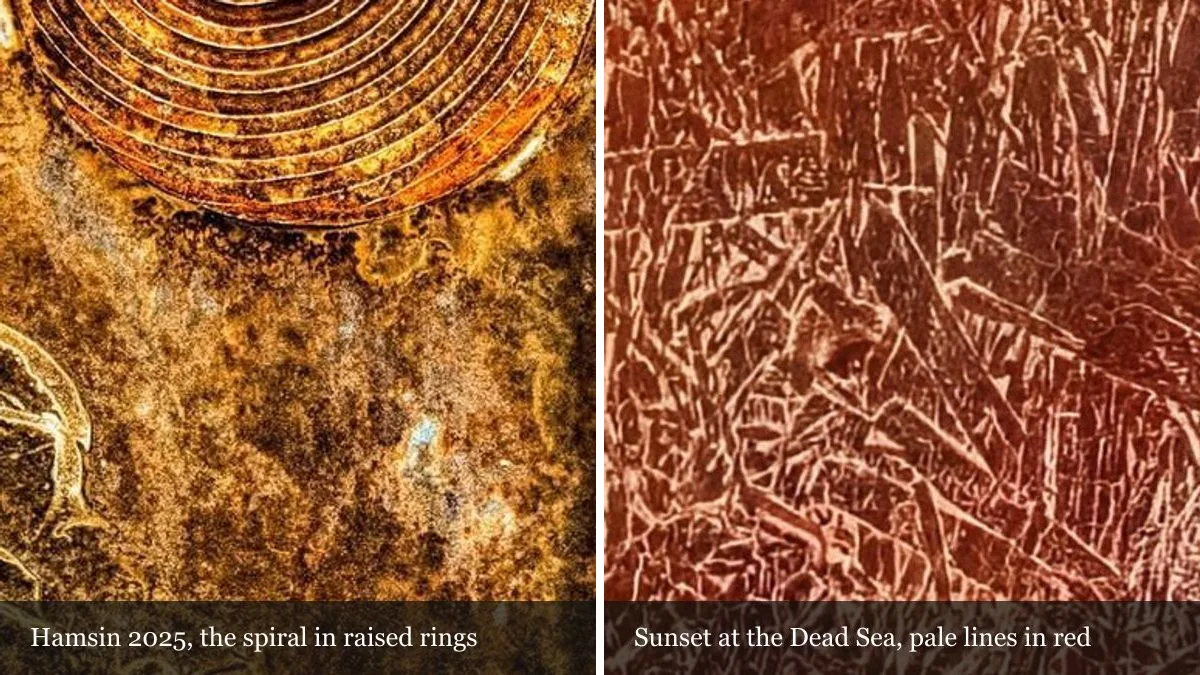
The visible change is in how the surface is organised. In the 2025 painting a single ordered shape sits near the top: a concentric spiral, built in raised rings you can read from across the room. Everything around it is granular and broken — shard-like marks, ridged ripple contours through the lower half, and a thin green-blue trace surviving along the bottom edge. The artist calls that spiral a hint at “cyclical forces or the endless struggle to find order in the chaos”. It is the only closed form in the picture; everything else is open, broken marking.
Rust: a word in the description, not in the materials line
Rust is worth being precise about, because it can mean two different things. The word appears in three of the sixty-one artist descriptions here — Hamsin (2025), Traces of the Forgotten and Whisper, all three from 2025. It appears in none of the sixty-one materials lines. Neither does the word oxide.
So for Hamsin (2025) the honest position is this. The materials line reads “Mixed media on canvas” and stops. The description talks about “rich textures, golden pastes, and the evocative hues of rust”, and about “the metallic sheen of gold”. Whether there is real metal in that surface, or whether the rust is a rust-coloured paste, is not written down anywhere on this site. It changes how the work should be looked after, so ask us before you buy and we will get the answer from the artist instead of guessing at it. Only two works in the whole catalogue name metal in a materials line, and neither of them is a Dead Sea painting.
What each of these asks of a wall
Short answer: the two early works are dyed and resin-faced, so they want indirect light and a wall the sun never reaches; the 2025 canvas is smaller, carries no clear coat on its page, and is the easiest of the three to place. In more detail:
- Light. Colour made with dye behaves differently from colour made with modern acrylic. The Canadian Conservation Institute’s note on light, ultraviolet and infrared places most plant-derived dyes in its high-sensitivity band, while many modern pigments sit at the permanent end of the same table. We are not saying either painting will fade. We are saying a dyed surface is the wrong thing to hang opposite a south window, and that this applies to any dyed work on wood.
- Size and fixing. Four feet square on wood is a heavy object and needs a fixing that reaches something structural. The 24-inch board is a smaller job on a solid wall. The 18 by 24 inch canvas is the one that fits a hallway or a stairwell.
- Reflection. Resin is named on both early pages. A poured resin face returns light the way glazing does, so it wants a lamp to the side rather than a downlight directly above it.
- Cleaning. No page records how any of these three should be cleaned. The habit that covers all of them: a dry, soft brush, and nothing wet on a raised surface.
If you want to know how much of a painting a catalogue photograph leaves out, these three are a fair test. The spiral in Hamsin (2025) is a physical relief; the pale marks in Sunset at the Dead Sea are cut into the colour rather than laid on top of it. Neither carries to a screen. You can browse them in the artworks collection, read how the artist works on his page, or see how we read what an abstract painting is actually about.
All three are available as we write this, and all three can be seen in Markham by appointment. If you would like to stand in front of them, or you have a question this page has left unanswered, write to us and we will answer it plainly.