
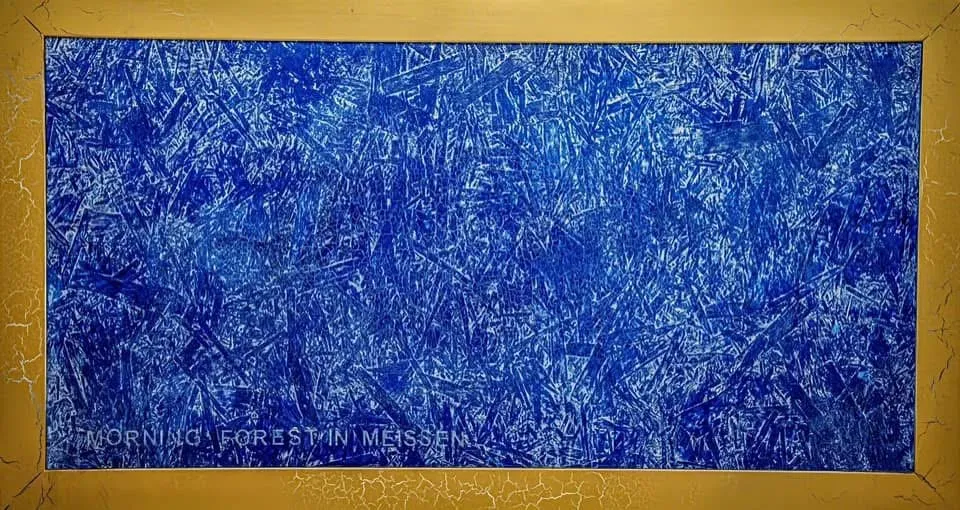
Morning Forest in Meißen (2023) — Acrylic, natural dyes, resin, wax paste, and diamond dust on wooden board (framed) by Sergei Troshin

Morning Forest in Meißen (2023)

Artist: Sergei Troshin
Country: Canada
Born: 1960
Acrylic, natural dyes, resin, wax paste, and diamond dust on wooden board (framed)
52" x 28"

Description:

Augustus the Strong is remembered not only as a powerful ruler but also as a great patron of the arts, architecture, and fine interiors. During his pursuit of the Polish crown, he supported alchemists in the hope of finding a way to produce gold. Instead, Johann Friedrich Böttger developed the first European hard-paste porcelain, giving birth to the famous Meißen porcelain manufactory and transforming the town into a world-renowned centre of porcelain production. Inspired by the deep blue of Meißen porcelain, the landscapes of Saxon Switzerland, and Böttger's remarkable achievement, I sought to capture the spirit of this place through layered textures, natural dyes, and subtle touches of gold. During my years as a student at the University of Jena in Thuringia, I had the opportunity to travel through eastern Germany. Saxon Switzerland and Meißen left an unforgettable impression on me, like landscapes from a fairy tale. That is why this place has remained so special to me ever since. (Another version of Morgenwald in Meißen.)

Available — this original is currently for sale.

If you wish to purchase a work of art, please contact us or call +1 (416) 919-8331.

About this piece

Morning Forest in Meißen (2023) is an original, one-of-a-kind work by Sergei Troshin, born 1960, based in Canada. It is made with acrylic, natural dyes, resin, wax paste, and diamond dust on wooden board (framed) and measures 52 × 28 in (132.1 × 71.1 cm). It was completed in 2023. There is only one — nothing here is a print or a reproduction.

Materials and finish

The work is built on wooden board. A wooden board is rigid, which is what lets a thick, poured surface stay flat over time.

Wax paste — Wax paste is built up in ridges that stand off the surface, so the piece catches light differently as you move past it or as the day changes. It is the part of a painting a photograph cannot carry. Tate’s glossary entry on impasto explains the term in more detail.

Diamond dust — Diamond dust is a fine glitter of ground glass or crystal scattered into a wet layer. It reads as plain texture in daylight and only sparks when a light source hits it at an angle.

Natural dyes — Natural dyes sink into the support instead of sitting on top of it, which is why the colour looks like it belongs to the wood rather than being painted onto it.

Resin — A poured resin coat cures to a hard, glass-like film. It deepens the colour underneath the way water darkens a stone, seals the surface, and gives the work a reflective face that behaves like glazing without the glass. Tate’s glossary entry on resin explains the term in more detail.

Acrylic — Acrylic dries quickly and stays flexible, which lets layers be laid over one another in a single session and scraped back while still workable. Tate’s glossary entry on acrylic paint explains the term in more detail.

Size and scale

The piece measures 52 × 28 in (132.1 × 71.1 cm). It reads as a horizontal piece, and this is a statement size — plan for a full wall, and measure the doorways and stair turns on the way to it.

Looking after it

The resin face is hard but it scratches like any gloss surface. Dust it with a dry, soft cloth — no solvents, no household cleaners, nothing abrasive.

Keep it out of long hours of direct sun. Prolonged UV is what ages a clear coat, and a wall that gets full afternoon light is the one place to avoid.

The raised passages are the fragile part. Dust around them rather than pressing a cloth into them, and keep the piece away from direct heat.

Dyed passages are light-sensitive in the way any dye is; steady indirect light keeps them true for far longer than a sunlit wall.

Room conditions matter more than anything else: stable temperature, stable humidity, no direct sun. The American Institute for Conservation publishes plain-language guidance on caring for artwork at home.

Further reading

We write about how these surfaces are made and how to live with them in Notes on Art. Relevant to this piece:

  • Mixed Media, Without the Jargon — What mixed media actually means in plain terms, seen up close in two Sans Souci originals that combine collage, resin, and diamond dust on one surface.
  • How to Look After an Original — The short, honest list for living with an original at home — what actually protects it, and why a resin face and a raw texture need different care.

Buying, viewing and delivery

Every artwork leaves the studio with a Certificate of Authenticity, signed and sealed by the artist. Prices are shared on request — there is no online checkout, because each piece is one of a kind and we would rather answer your questions first. Pieces can be viewed in person in Markham by appointment, and we are happy to talk through materials, framing or how a work will sit in your space. Shipping is quoted per piece and packed individually so the work travels safely. Ask about this piece.

Morning Forest in Meißen (2023) — detail view 1
× Morning Forest in Meißen (2023) — Acrylic, natural dyes, resin, wax paste, and diamond dust on wooden board (framed) by Sergei Troshin