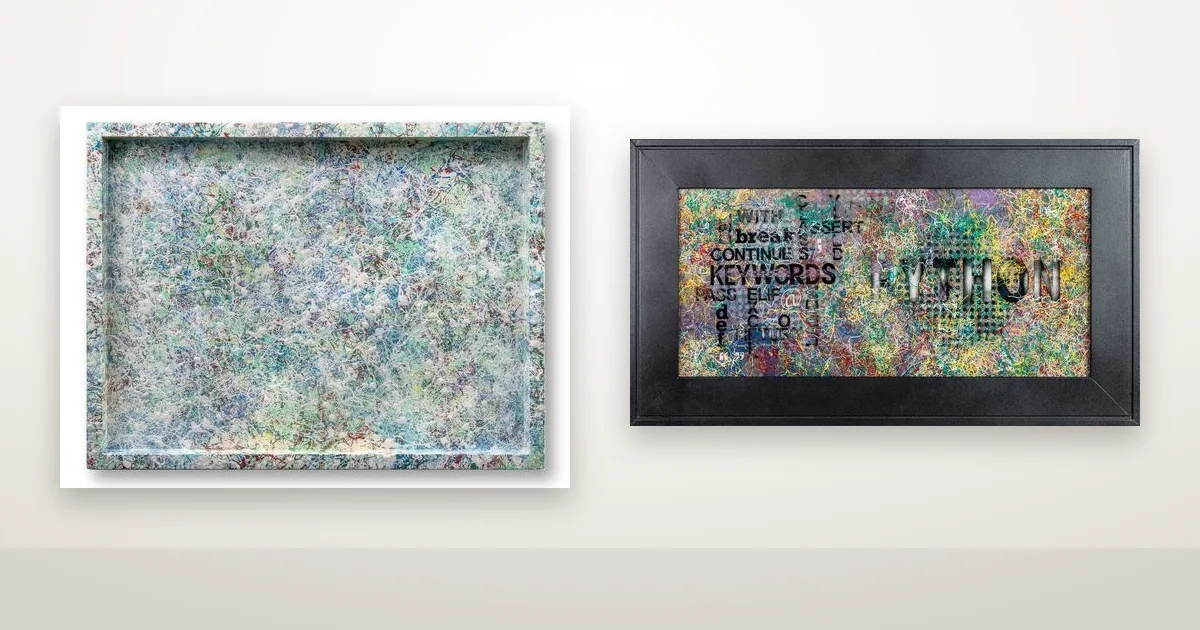
Two works in this catalogue are called Zwei Goldfische and Fluently Python. One is German for “two goldfish”. The other names a programming language, and the artist’s own note on it begins: “What is this about? It’s about nothing!” Both are dense fields of tangled, layered line. If you are trying to work out how much a painting title tells you before you write to us about a piece, these two are the pair to look at.
What a title is, and what it is not
A title is the name an artist gives a finished work so that it can be spoken about, listed and found again. It is not a description of what you will see, not a promise about the subject, and not the thing that identifies the object. Read it as a pointer to what the artist had in mind, not as a caption.
Object ID, the standard the International Council of Museums built with police forces, customs agencies, the art trade and the insurance industry, records an object under nine categories: type of object, materials and techniques, measurement, inscriptions and markings, distinguishing features, title, subject, date or period, and maker. Title is one of the nine, and subject is a different one. The standard keeps them apart, and the sixty-one pages on this site show why.
Three languages across sixty-one works
Most titles here are in English. Two are German, two carry an Arabic word in transliteration, and three name a movement or a period instead of a thing. None of it is decoration.
- German — two works. Zwei Goldfische (two goldfish) and Morgenwald in Meißen (morning forest in Meissen). A third, Morning Forest in Meißen, is English apart from the German spelling of the town. Sergei Troshin’s background is in German studies and linguistics, as his page sets out, and the note on that third work says he travelled through eastern Germany while a student at the University of Jena.
- An Arabic word — two works. Hamsin (2022) and Hamsin (2025). Khamsin, chamsin and hamsin are the same Arabic word, meaning “fifty”, for a dry, hot, sandy wind that blows across Egypt and the Levant. On the 2022 page the artist spells it “Khamsin” inside his own description while the title above reads Hamsin: one word, two transliterations, on a single page.
- A movement or a period — three works. DaDa 2020, Baroque 2020 and Renaissance 2020. Here the title does carry information. Tate describes dada as an art movement formed in Zurich during the First World War, satirical and nonsensical in nature; the artist’s note on DaDa 2020 answers to that in his own terms — “expressive nonsense, irrationality”.
Of the thirty-four artwork pages that carry a note in the artist’s own words, only two mention language at all. One of them is Fluently Python, where he writes: “I’m obsessed with languages and love the expression - ‘As many languages you know, that many times you are a human’.”
Zwei Goldfische: the title is not the subject
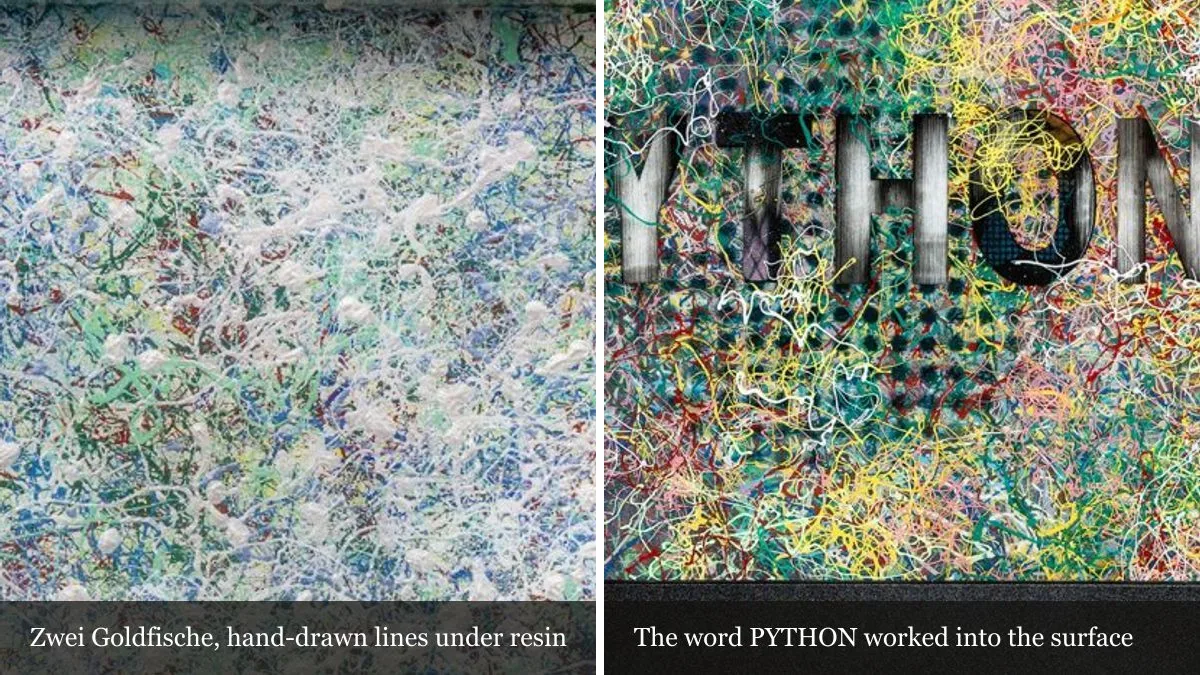
The description on that page never mentions a fish. It describes the making instead, and it is worth reading in full before you decide the title has let you down:
“This painting is a result of a long, detailed, artistic process! Every line and dot is a hard, but joyful hand-painted piece of work! As many lines, as many days of work! Every layer of my abstract lines is sealed with a coat of crystal clear epoxy. Sometimes they are up to ten floating layers there.” — Sergei Troshin
The title points somewhere. It does not describe what is on the board, and on an abstract surface it usually cannot. If the word abstract itself is doing unclear work for you, we unpicked it in what abstract art is not.
One line on that page is easy to miss: the materials line records “Two sides painted”. Exactly three of the sixty-one works carry it — Zwei Goldfische, White and Golden Night — and it is worth asking which two before you decide where a piece goes.
Fluently Python: the title is painted into the work
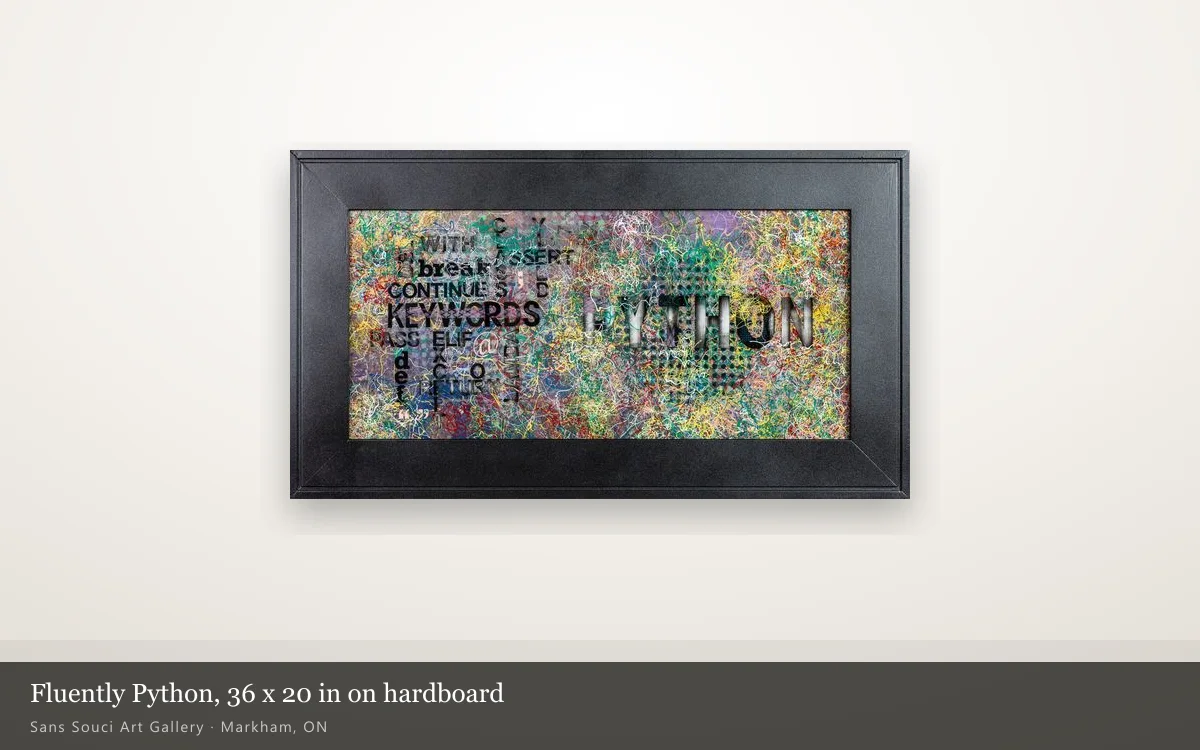
On this one the title is not only a name attached to the object. The photograph on its page shows PYTHON in large letters across the surface, and the word KEYWORDS set among break, continue, pass, elif, def, return, with, assert, except and lambda — the reserved words of the language itself, laid over the same tangle of coloured line. The title is part of the painting rather than a label on it.
This is exactly why Object ID keeps “inscriptions and markings” as a category separate from “title”. A word worked into a surface belongs to the object and cannot be changed. A title is a label attached to it, and a label can be translated, shortened or repeated.
Even so the artist declines to let the title stand as a subject: “What is this about? It’s about nothing! … Layer by layer! One labyrinth inside another! … I don’t ‘speak’ Python but this is all about Python right here.” Thirty-four of the sixty-one pages carry a note like that; twenty-seven carry none. When a title puzzles you, the page underneath it is the first place to look — and when the page says nothing, ask us rather than guess.
| What the page publishes | Zwei Goldfische | Fluently Python (2022) |
|---|---|---|
| Language of the title | German | English, naming a programming language |
| Title written on the surface | No | Yes — PYTHON and language keywords |
| Year printed in the title | None | 2022 |
| Year given in the description | 2020 | 2021 |
| Support | Wooden board | Hardboard |
| Clear coat | Sealed with resin | Sealed with epoxy |
| Size | 12 × 16 in (30.5 × 40.6 cm) | 36 × 20 in (91.4 × 50.8 cm) |
| What the artist’s note is about | The making. No fish named. | “It’s about nothing!” |
What a title cannot do
It cannot tell two works apart, and it is not a date of record. Four things in this catalogue show that, and all four are checkable on the pages themselves.
- One title, two paintings. Hamsin (2022) and Hamsin (2025) are different works: 24 × 24 in on wooden board against 18 × 24 in on canvas, three years apart, both still on the site. We compared them field by field in collecting one artist over years.
- One name, two languages, two paintings. Morgenwald in Meißen (2022) and Morning Forest in Meißen (2023) are not the same picture under two names. The 2022 page calls the work “Morning Forest in Meißen” in the artist’s own words; the 2023 page ends “(Another version of Morgenwald in Meißen.)” Where the blue in both came from is the subject of Meissen blue and Saxon forests.
- A bracketed year is a title, not a record. Fifteen of the sixty-one titles print a year; forty-six do not. On two pages the year in brackets and the completion year stated in the description below it are different — Fluently Python is one of them, titled 2022 and described as completed in 2021. If a date matters to you, for a certificate or an insurance record, ask us which year to use rather than reading it off the title.
- Thirteen are cataloguing labels rather than titles. Decorative Composition 1 to 4, Decorative Side Table 1 to 3, Hand-painted Wine Glass I to III, Hand-painted Tissue Box, and Untitled 1 and 2. “Untitled” is not a missing title; it is a decision not to steer you. Worth knowing on those two: the artist field reads Evgenia Troshin, as it does on The Way. The other fifty-eight pages read Sergei Troshin.
What does identify a work here is the rest of the page: the measurements, the materials line, the completion year, the Certificate of Authenticity signed by the artist that leaves the studio with it, and the code in the address of its page — the string after ?code=. No two works share a code. Two already share a title.
Using a title while you are looking
- Read the title after the work, not before it. It will tell you more once you have already looked.
- If the title is in a language you do not read, look for the artist’s note before assuming a subject. Twenty-seven pages have no note, and that silence is not a hint.
- If two works share a name, compare size, support and year — not the picture in your memory.
- Keep the code when you write to us about a piece. Two works can share a title; no two share a code.
Zwei Goldfische is one of the seven works in Abstract Variations; Fluently Python is one of the forty-one in Artworks. If a title has you guessing — or if you want to know which year we would put on a certificate for a particular piece — write to us and ask.