Drip painting means letting fluid paint fall or run onto a surface instead of pushing it there with a brush. The painter still chooses the colours, their order and how the hand moves, while gravity draws the line. Eleven of the 61 pages in our artworks catalogue use the words poured or dripped, and each of those marks records something you can learn to read.
Who started dripping paint
Most people think of Jackson Pollock first, though others got there before him. Wikipedia's entry on drip painting names Francis Picabia, André Masson and Max Ernst as experimenting with it in the first half of the twentieth century. Ernst swung a punctured bucket of paint over a canvas laid flat. The same entry credits Janet Sobel with pioneering the technique.
Pollock later used it almost exclusively. His studio floor was his main painting surface from 1946 to 1953, and his tools included sticks, hardened brushes and basting syringes. House and industrial paint is thinner than oil from a tube, so he kept large canvases horizontal to stop it running. Our own works use a different material, and we go through what it can do in acrylic paint, explained.
What the paint does on its way down
A falling thread of thick liquid tends to curl into coils when it lands. Engineers call that coiling instability. Brown University's account of a 2019 study explains how Roberto Zenit and his colleagues measured film of Pollock at work, then copied his movements with a syringe held over a moving canvas. Their paper in PLOS ONE puts his working height at about 5 to 25 centimetres. At any one height, the traces curled when the canvas moved slowly and straightened as it sped up.
That physics belongs to the paint and applies to any poured line, so three marks are worth finding on a surface.
A run tells you the surface wasn't flat
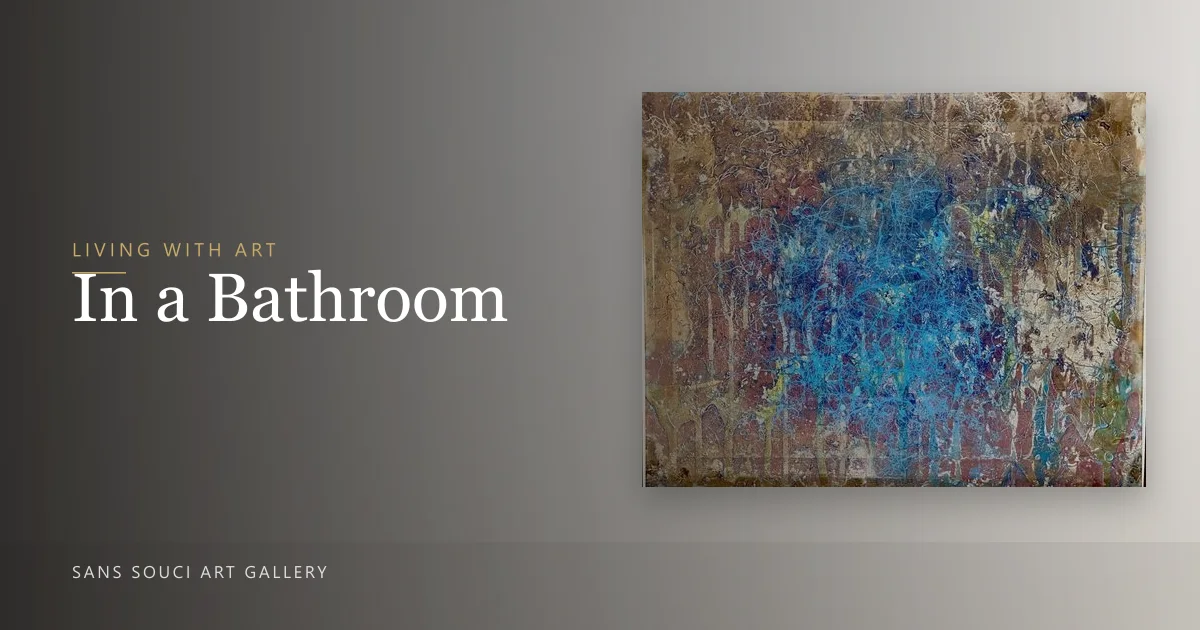
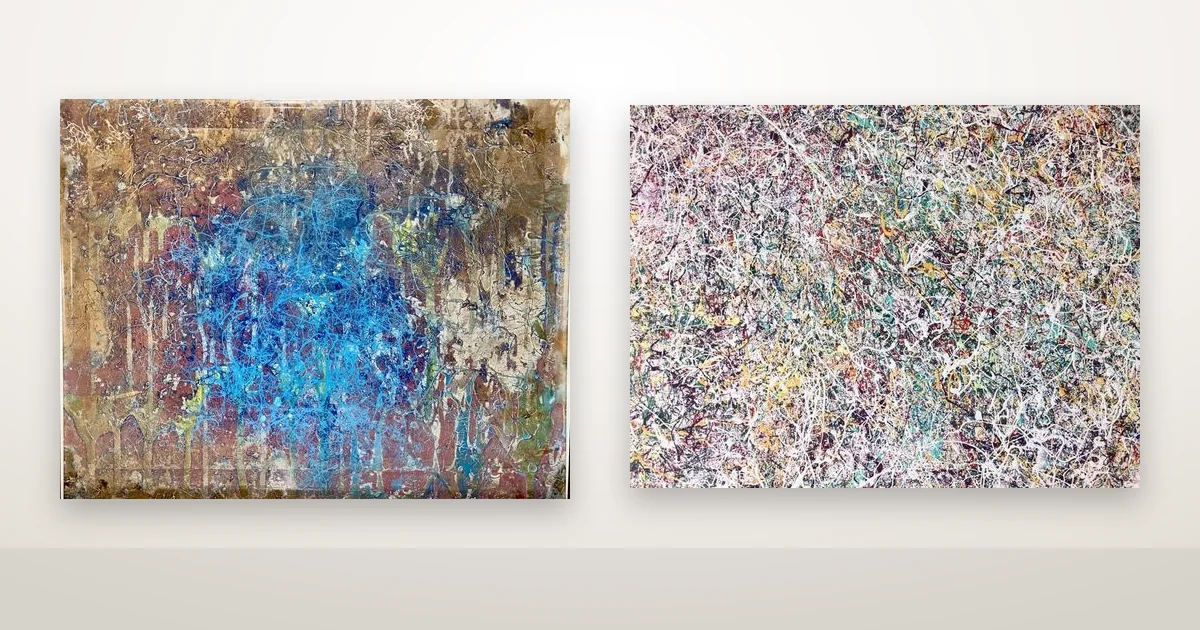
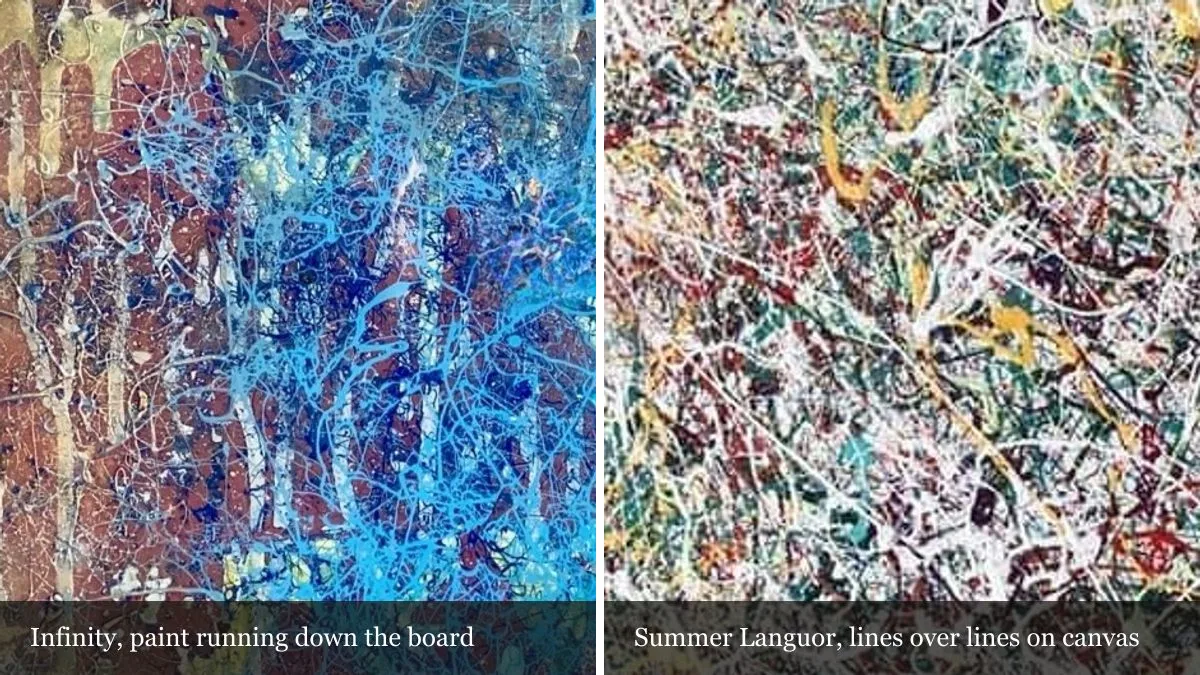
Wet paint only travels on its own when the surface under it tilts or stands upright. The page for Infinity (2024) describes brown, ochre and rust running down the board in vertical drips, with a burst of bright blue lines in the centre. Look at the detail above: the pale runs all go one way, and the blue lines go every way. Those are two different behaviours on one board. We used the same clue in which way up an abstract painting goes.
A tight loop can mean a slow hand
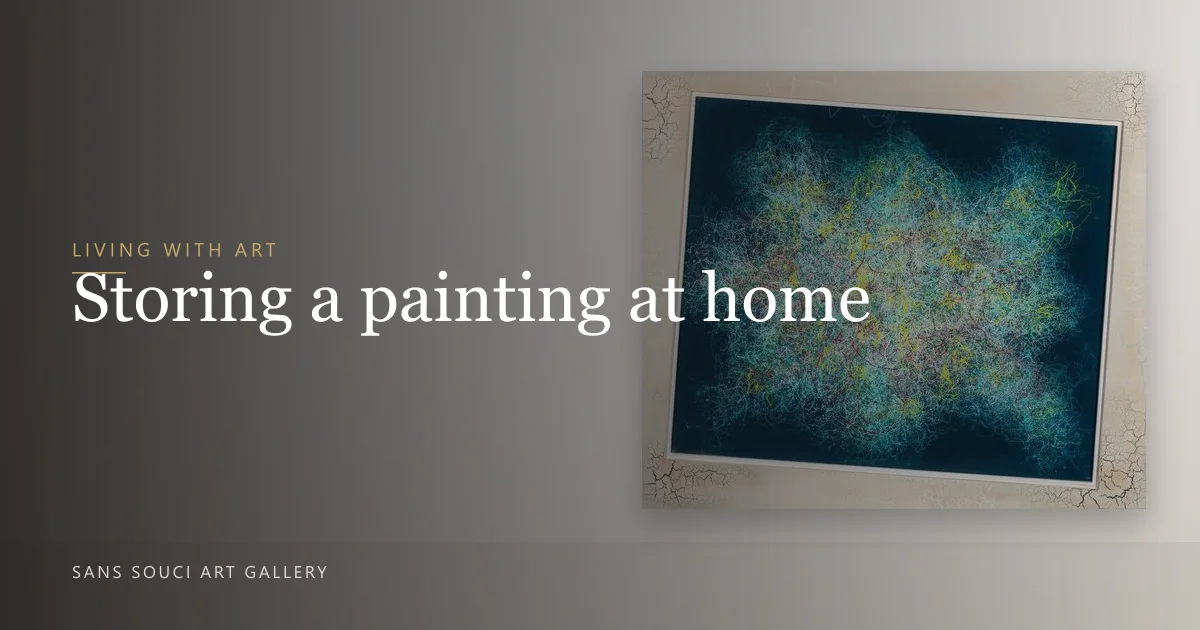
Slow movement gives a falling thread time to curl, and more height makes curling more likely. A loop may also be plain intention, since a hand can draw a circle in the air. Joy (2019), now sold, has loops of white, cream, yellow, teal and pink poured so thickly over a black ground that the black only shows in small gaps.
A long clean line points to speed
When the hand moves faster than the thread can curl, the paint lands as a stretch of line. You can find one in the catalogue photograph of Summer Languor (2020), where a white stroke crosses the upper left on a long diagonal. Zenit suggests that too many tight curls could count against a drip painting being a real Pollock. That test applies to one painter's habits only, and for anyone else a loop is simply a choice.
Sergei Troshin describes his own approach on the page for Summer Languor:
“I didn't paint it: I was making a piece of paint lace, spinning it, weaving it.”
Sergei Troshin, on Summer Languor
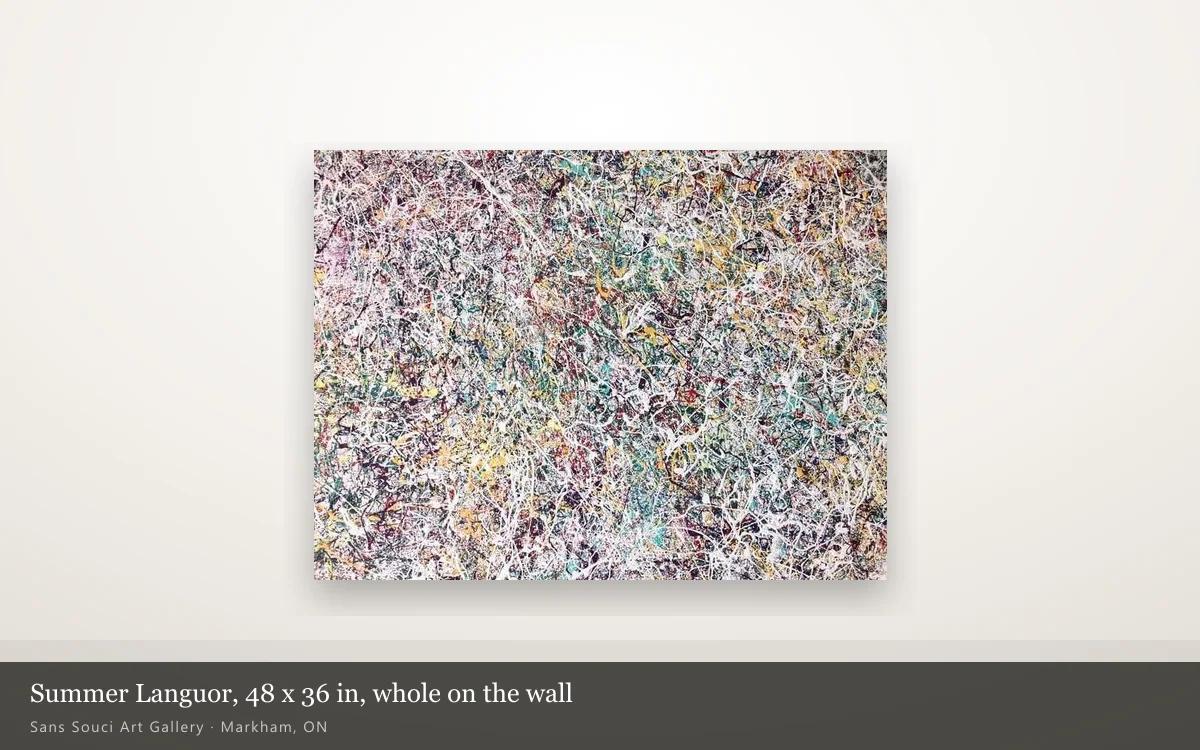
Lace is a fair word for what you see on this canvas. Line sits on line across all 48 by 36 inches, and no single stroke carries the picture.
Two dripped surfaces side by side
Both works come from poured or dripped paint, and they ask very different things of the person looking.
| What to compare | Infinity | Summer Languor |
|---|---|---|
| Support and size | Board, 16 x 20 in | Canvas, 48 x 36 in |
| Materials | Acrylic, resin seal | Acrylic |
| Direction of the paint | Downward runs, then lines every way | Lines every way, edge to edge |
| Where your eye goes | The blue burst in the centre | Across the whole field |
| Status | Available | Available |
Resin changes how a dripped surface reads. On Infinity, the page says the seal gives the blue a glossy depth against the matte-looking browns. We explain why in what a resin finish does in a room.
What to look for in front of one
A photograph flattens all of this, so a dripped painting repays a slow look in the room.
- Stand back until single lines disappear, then walk in until they return. The distance tells you how large a space the work needs.
- Follow one colour with your eye and note where it passes over another. That gives you the order of events, the same reading we set out in reading a layered surface.
- Check whether the marks share a direction. Runs that all go one way show which way the surface stood while the paint was wet.
- Move to the side and let the light rake across the surface. Raised paint throws small shadows, which is one thing a reproduction can't give you, as we cover in original, print or reproduction.
- See the same hand on a smaller object. The page for Wine Glass (I) shows fine dripped lines on a stem and bowl, with a pattern that never repeats from one glass to the next.
Infinity and Summer Languor are both listed as available today, and viewings are by appointment. To ask about either one or to arrange a visit, write to us.