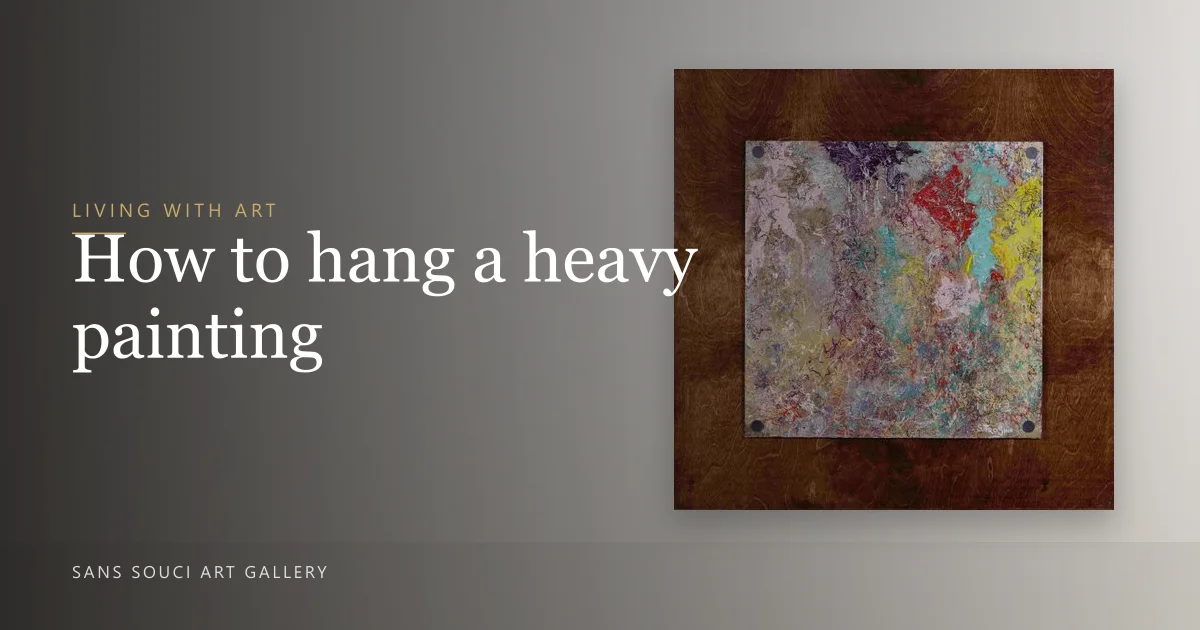
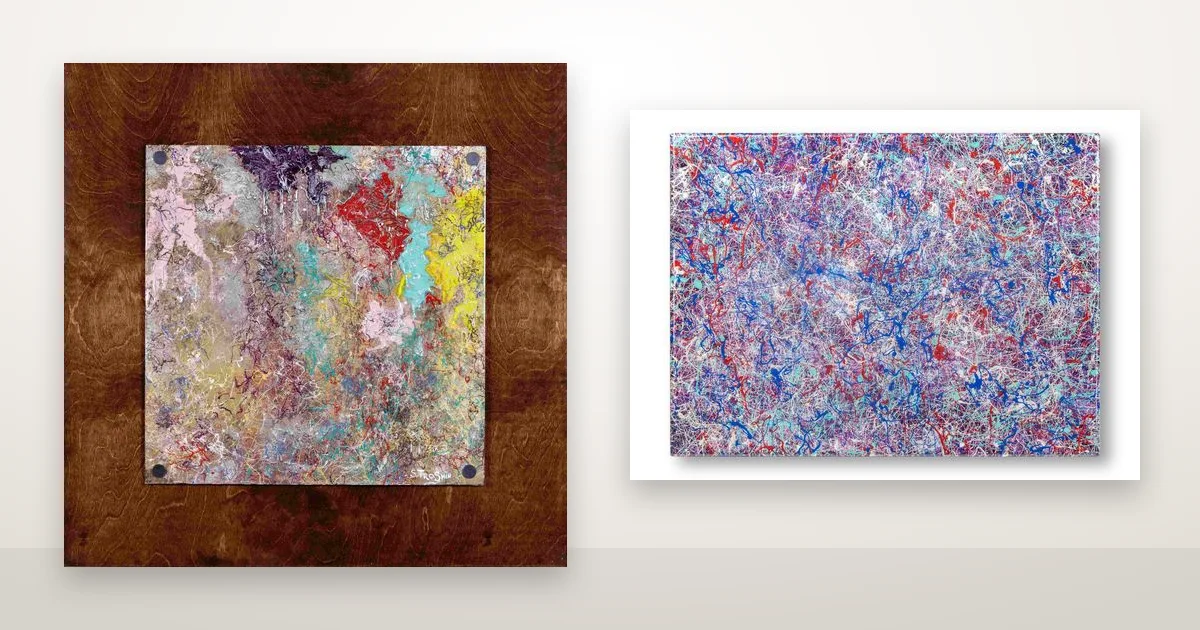
Walk past Fall Waltz in the late afternoon and the surface changes before you have crossed the room. A passage that looked flat and rust-brown from the doorway turns glassy, almost wet, once you are level with it. Improvisation, a much smaller piece nearby, does the same thing at a smaller scale. Both are finished the same way: acrylic sealed under a poured resin coat. What that coat actually does, and why the effect depends so much on where a piece hangs, is worth explaining properly rather than leaving it as a line on a wall label.
What does a resin finish actually do to a surface?
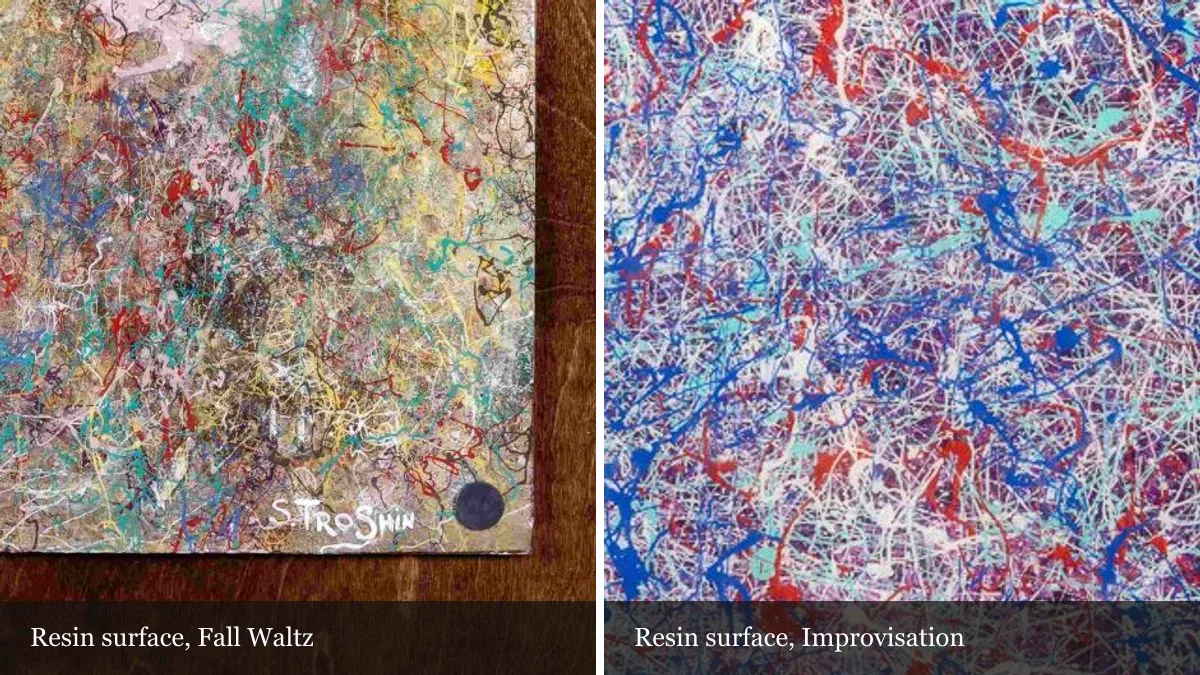
A poured resin coat cures into a hard, glass-like film over the paint. It deepens the colour underneath the way water darkens a stone, seals the surface, and gives it a reflective face — closer to glazing than to a coat of varnish. That reflectiveness is also why the same painting can look quiet in one light and almost lit from within in another.
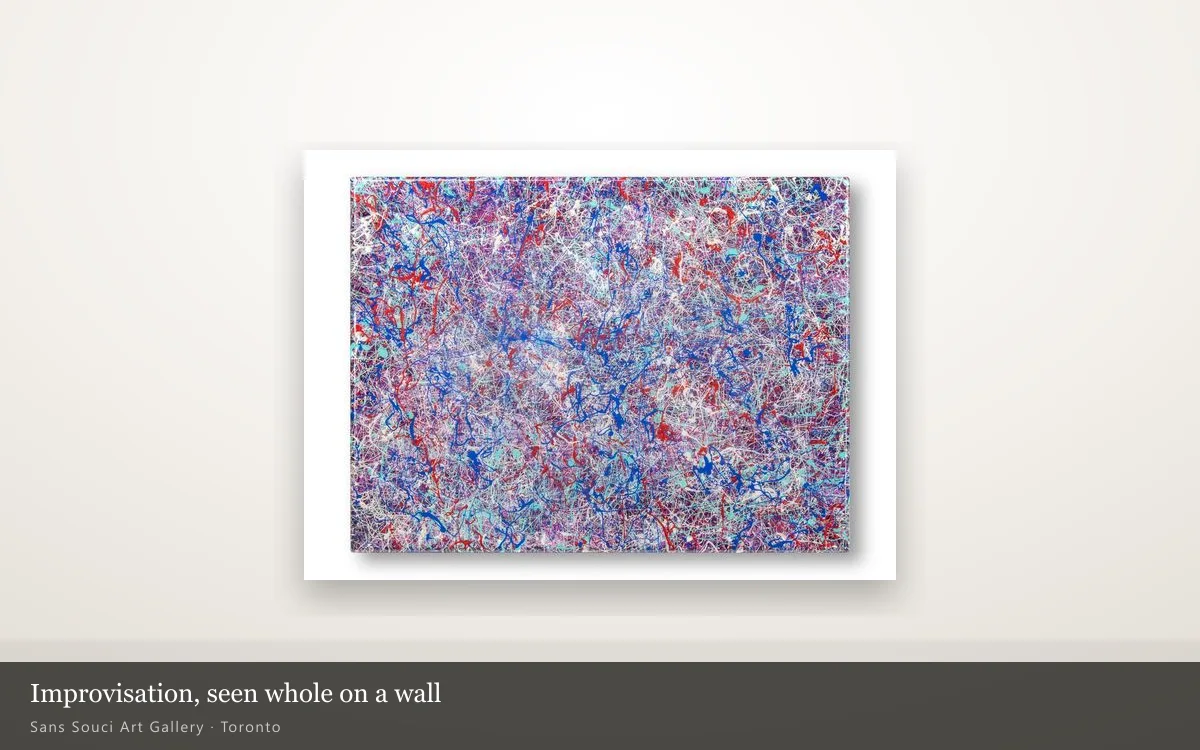
Fall Waltz is acrylic and resin on fiberboard, mounted on a stained and glazed wood panel, thirty-six inches square. Improvisation is a much smaller piece, sixteen by ten inches, acrylic on canvas sealed with resin. Different supports, very different scale, the same clear coat over the paint — and on both, the resin is doing the identical job: turning a matte pigment into something that catches and throws back light. Tate’s glossary entry on resin is a good short reference if the term is new to you.
This is different from texture, which is about what a surface does under raking light from the side — a ridge casts a shadow, a scraped passage catches light unevenly. Resin is about the surface itself acting like glass: it does not just sit on top of the paint, it becomes the thing the light hits first, and everything you see is the colour underneath it, seen through that hard, clear layer.
Two sizes, one finish — does scale change how it reads?
The chemistry does not change with scale, but the experience of it does. A thirty-six inch square piece on a rigid wood panel holds a reflection across most of its face at once — stand off to one side in a room with a window and you can watch a whole section of the painting go from matte to bright as you move. A small canvas piece asks you to get close before the same effect shows up, because there is simply less surface for the light to travel across.
| Fall Waltz | Improvisation | |
|---|---|---|
| Support | Fiberboard on a stained, glazed wood panel | Canvas, which flexes slightly with the resin over it |
| Size | 36 × 36 in (91.4 × 91.4 cm) | 16 × 10 in (40.6 × 25.4 cm) |
| Where it tends to hang | A sofa wall or dining wall, on its own | Above a desk, a console, or a bedside |
| How the resin reads at that scale | A moving reflection across a wide field, visible from across the room | A tighter, closer shine — noticed on approach rather than from a distance |
Neither is a better use of resin than the other. A large piece asks for a wall it can dominate, so the reflection has room to move as you cross it. A small one rewards a spot people pass close to on their way somewhere — a hallway, a landing, the wall beside a reading chair — because that is where its shine actually gets noticed.
Where should a resin-finished piece hang?
Away from direct sun, and not facing straight into a bright window. Prolonged sun exposure is what ages a clear coat over time, and a wall that gets full afternoon light is the one place to avoid regardless of how the piece looks there today. The American Institute for Conservation publishes plain-language guidance on caring for artwork at home, and stable light and humidity matter more for a resin surface than for almost anything else in a room.
Beyond conservation, there is a simpler, purely visual reason to think about placement: a gloss surface reflects whatever is directly opposite it. Hung across from a large uncovered window, a resin-finished piece can throw back a bright rectangle of sky instead of showing its own colour when the sun is high. A picture light angled down from above, rather than a flood aimed straight at the surface, avoids creating a hot spot that does the same thing on purpose. The goal is a room where the piece catches ambient light as you move through it, not one bright source bouncing straight back at whoever is standing in front of it.
Dust a resin surface with a dry, soft cloth only — no solvents, no household glass cleaner, nothing abrasive. The coat is hard, but it scratches like any gloss finish, and once it is textured it will hold dust and lose its reflective quality.
Both Fall Waltz and Improvisation are available, not sold or reserved, and the best way to understand what a resin finish does is to stand in front of one and take a few steps sideways. If either piece sounds right for your wall, or you would like to see more resin-finished originals from the Artworks collection, we wrote more about how these surfaces are built in Mixed Media, Without the Jargon. Get in touch and we will set up a time to view them in Toronto.