Can you hang a painting in a bathroom? In some bathrooms, yes, and in some, no, and the difference can be measured in a week. Two things decide it: how wet the air in that particular room gets and for how long, and what the surface of that particular painting is made of. This note gives the numbers conservators use, a reading you can take yourself, and two works from our catalogue that answer the question differently.
Three rooms that are all called a bathroom
Start by placing your own room in one of these rows. The sorting is ours; the 75% figure in it comes from the Canadian Conservation Institute and is explained in the next section.
| The room | What the air does | An original on its wall |
|---|---|---|
| Toilet and basin only, no bath or shower | Nothing makes steam. It behaves like a hallway. | Treat it as any other room in the house. |
| Bath or shower, with a fan or a window that clears the air afterwards | Humidity jumps during a shower and falls back when the fan has done its work. | Possible for some surfaces. Measure before you decide. |
| Shower with no window and a weak fan; the walls and mirror stay wet | The air sits above 75% relative humidity for long stretches, every day. | No. Hang a mirror there and put the painting outside the door. |
Most of the worry belongs to the third row, and most homes have at least one room from the first. If yours is the middle row, the rest of this note is for you.
What a shower does to the air, in numbers
It pushes the room towards damp, and damp has a definition. The Canadian Conservation Institute’s guide to incorrect relative humidity sets “the practical boundary for damp” at 75% relative humidity and names what damp does: mould, rapid corrosion of metals, and the more extreme kinds of mechanical damage. Mould, it says, attacks “skin, leather, textiles, paper, basketry, and occasionally wood, paint, and glass”. Canvas is a textile. Paper is on the list by name.
The same guide explains why the mirror fogs. Warm air holds more water than cool air, and it gives a worked example: air at 50% relative humidity, cooled by 10 °C, is at 100%, and “further cooling results in condensation on objects”. A mirror, a window and a tiled outside wall are the coolest things in the room, so the water lands there first. A fogged mirror tells you the air touching it has reached 100%.
From October to April in Ontario that matters more, because outside walls turn cold. CCI’s Note 10/3 on storing and displaying paintings is plain about it: “The inside surfaces of exterior walls can be cold in the winter. Unprotected artworks displayed on these walls will be prone to condensation damage.” Its remedy is a backing board and an airspace between the painting and the wall. In a bathroom, the simpler remedy is to choose an inside wall.
One fact works in your favour. A short spike does far less than a room that stays wet. The CCI guide points to an old canvas where the paint over the wooden stretcher bars never cracked, because the wood evened out daily swings in humidity for a day or two at a time. Materials take a while to follow the air, which is why the week of readings further down times how long the room stays wet and not only how high it peaks.
A sealed face and an open one
The two surfaces below would meet the same steam very differently.
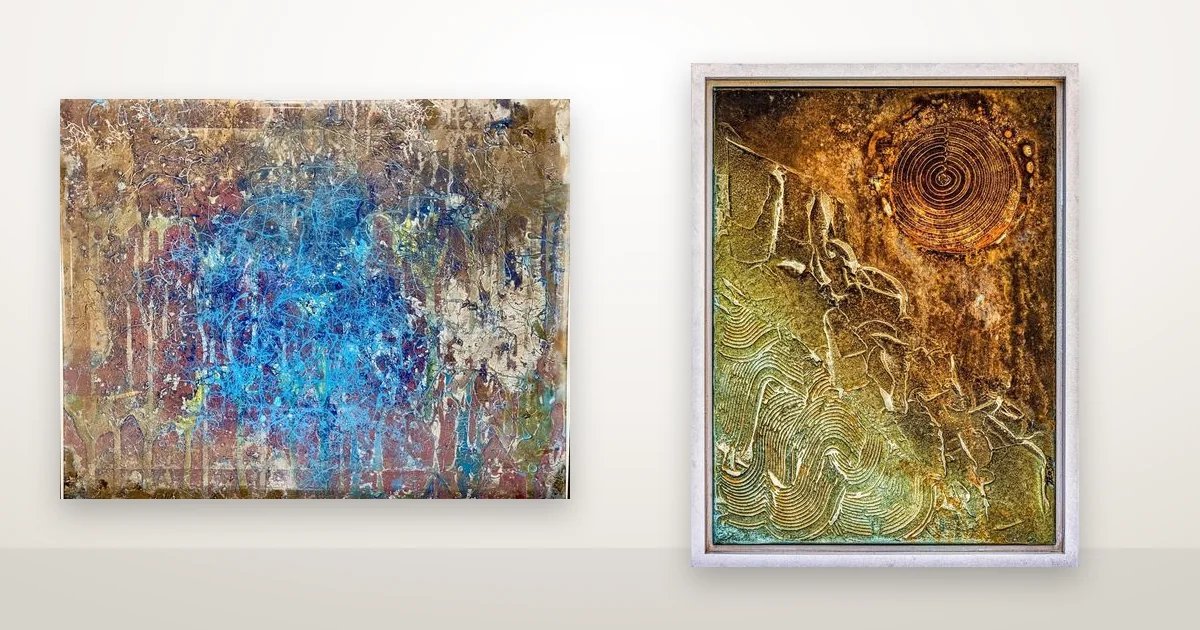
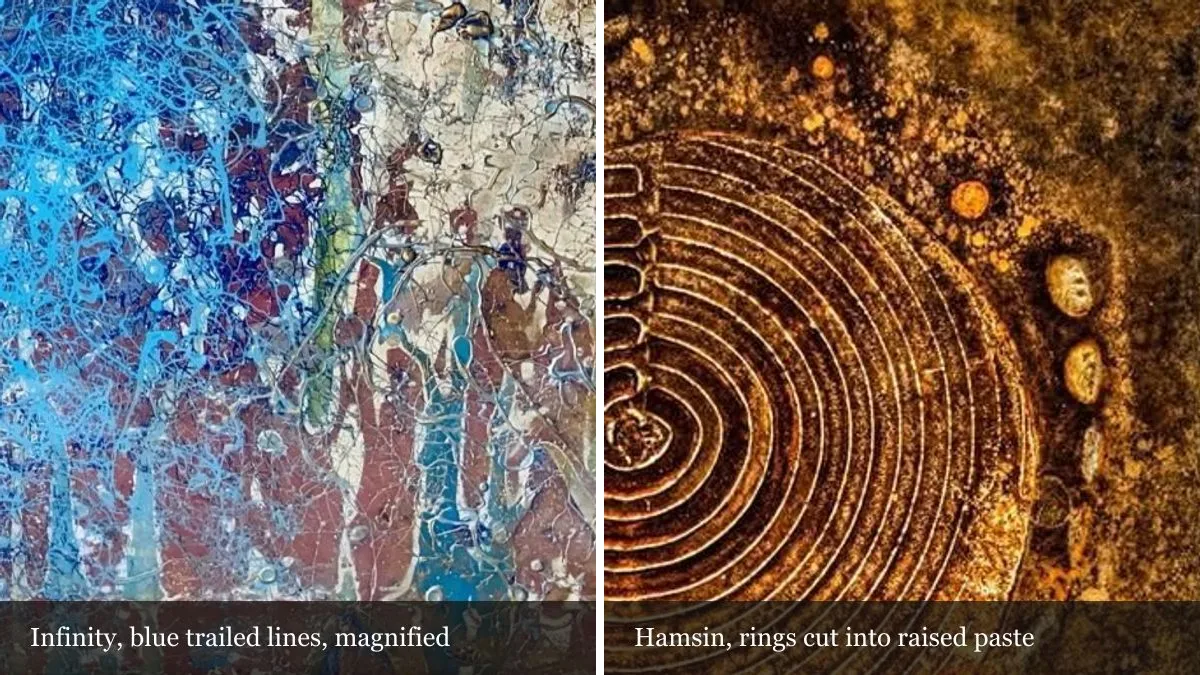
Infinity (2024) is acrylic on board, sealed with resin, 16 × 20 in. Its page records a “resin seal over the whole surface”. So the painted face sits under a hard clear coat, and water in the air does not touch the paint from the front. The board behind it is another matter. Wood is on CCI’s list above, so ask us what the board is and how its back and edges are finished. Where they are bare, humid air still reaches the board from behind.
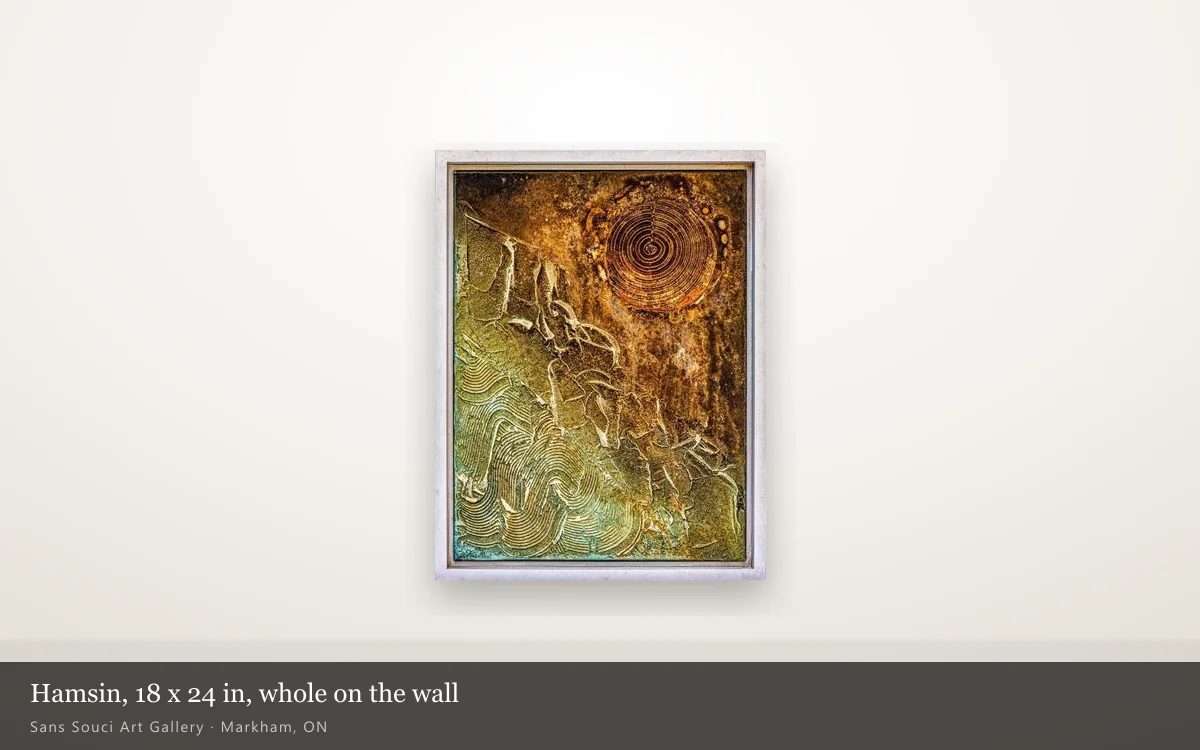
Hamsin (2025) is mixed media on canvas, 18 × 24 in. The artist describes its surface himself:
“…where I delve into the interplay of rich textures, golden pastes, and the evocative hues of rust.”
Sergei Troshin, on Hamsin
That is raised paste on fabric. The same CCI guide rates acrylic paintings on canvas among the paintings least troubled by ordinary swings in humidity. That rating covers swings only. It says nothing about damp, where the canvas itself is on the mould list. The painting is named after a dry desert wind, and a dry room is where we would hang it.
What to ask us before you decide
Before either work, or any other, goes near a shower, these are the questions to put to us.
- For any work on board or wood: what the board is, and whether the back and edges were coated.
- For textured mixed media: what the raised material is and what binds it.
- For a canvas: what it is stretched over or fixed to.
- For the hanging hardware: what the wire, hooks and fixings are made of, because metal corrodes quickly in damp.
One week with a hygrometer
A small digital hygrometer shows relative humidity as a percentage, and a week of readings will settle most of this.
- Stand or tape the hygrometer where the painting would hang. The far wall and the wall beside the shower are different places.
- Write down the reading before anyone has washed. That is your baseline.
- After the longest shower your household normally takes, with the door and fan used as they usually are, write down the peak.
- Check every ten minutes and note how long the reading takes to come back near the baseline.
- Repeat for a week, and include the morning when several people shower one after another.
- Each time, look at that wall and touch it. Note whether drops form on it, and where in the room they last longest.
Then read the notes against CCI’s boundary. A peak that passes 75% and is back near the baseline within the hour is a swing. A room that is still above 75% an hour later, or a wall that collects drops, is damp, and no original belongs on it. Where to draw the line between those two is our judgement; the 75% is the Institute’s. CCI adds that the damage rates “all climb rapidly” as humidity rises, so every bit of extra fan time counts.
If the reading says no
Then the painting goes on the wall you see from the bathroom door, or in the room with only a toilet and basin, and the shower room gets something that can be replaced. If the reading says yes, choose an inside wall, keep the work away from the shower itself, and leave a gap behind it so air can move. We have written before about the wall behind a painting and about what heated winter air does to it; a small work for a small wall is covered in what a small painting asks for.
If a work in the Artworks collection is one you want for a bathroom, tell us which piece and which of the three rooms it is, and ask how the back is finished and what the surface is made of. You can reach us through the contact page.