Yes, an abstract painting has a right way up, and the artist is the one who sets it. A landscape tells you where the sky is. An abstract work often does not, at least not at first glance, so the owner has to read the top from other signs: how the paint ran, where the name is, which way any letters read, and what is written on the back. Most works carry at least one of these. Below is how to find them, shown on works from our own catalogue.
Why the eye alone is not enough
It is tempting to turn a new painting on the floor until it looks right and hang it that way. Research says that works about half the time. In a study published in the journal i-Perception, the psychologist George Mather showed eighteen people with no art training forty modern paintings, some of them entirely abstract, at all four orientations, and asked them to pick the one that looked best or made most sense. You can read the full paper on PubMed Central.
The correct orientation was selected in 48% of trials on average, significantly above the 25% chance level, but well below perfect performance.
George Mather, Aesthetic judgement of orientation in modern art, 2012
So instinct helps, and it also gets the answer wrong about one time in two. The same paper opens with two paintings from Mark Rothko’s Black on Maroon series at the Tate. Rothko’s signature points to a horizontal hang, the works have been shown both ways over the years, and the paint dribbles on the canvas run in both directions. The paper adds a plain sentence that every owner should remember: the correct orientation is often specified on the back of the canvas.
Four clues the painting gives you
Check them in this order. The first ones take a few seconds and need no tools.
- Look for paint that ran. Wet paint runs downward. If long drips run in one direction across the work, that direction was down when the paint was wet.
- Find the signature. It is written to be read the right way up. On all six works in our catalogue whose page names where the signature sits, it is in a lower corner.
- Read any letters or print. Stencilled words, collaged newspaper or a handwritten line read left to right in one orientation only.
- Turn the work over. Look for an arrow, the word “top”, a title written along one edge, or a hanging fixing already in place.
If two of these agree, you have your answer. If they disagree, or there are none, ask the artist or the gallery before you hang it.
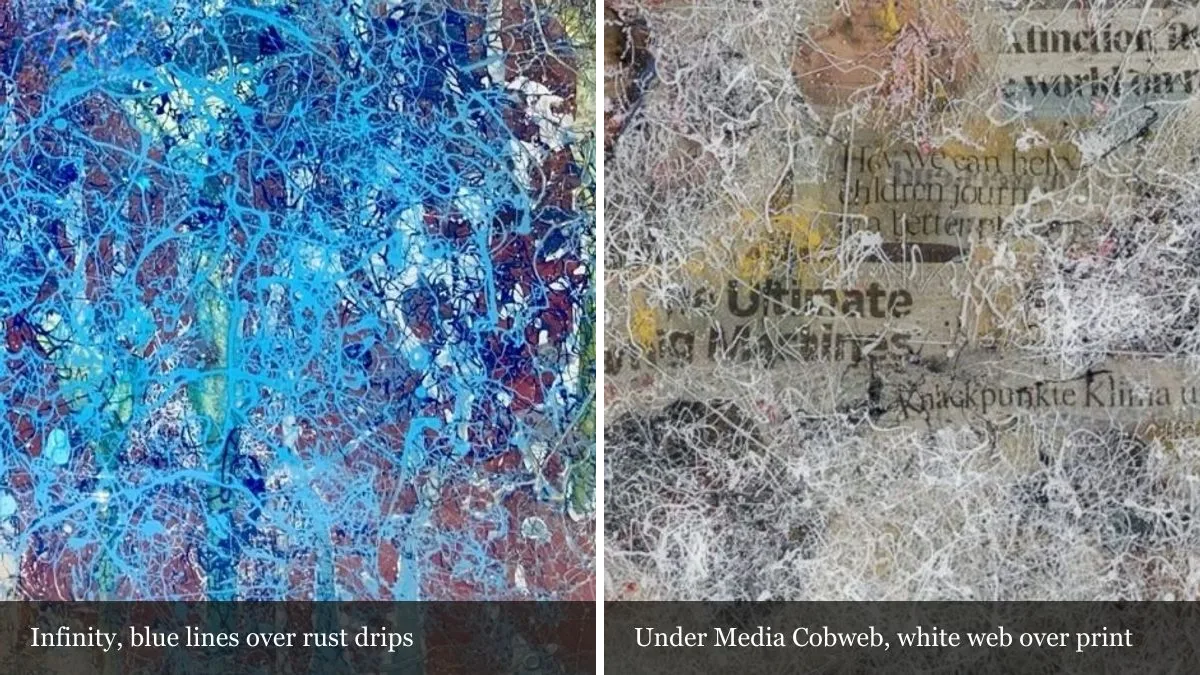
Infinity: the paint shows where down is
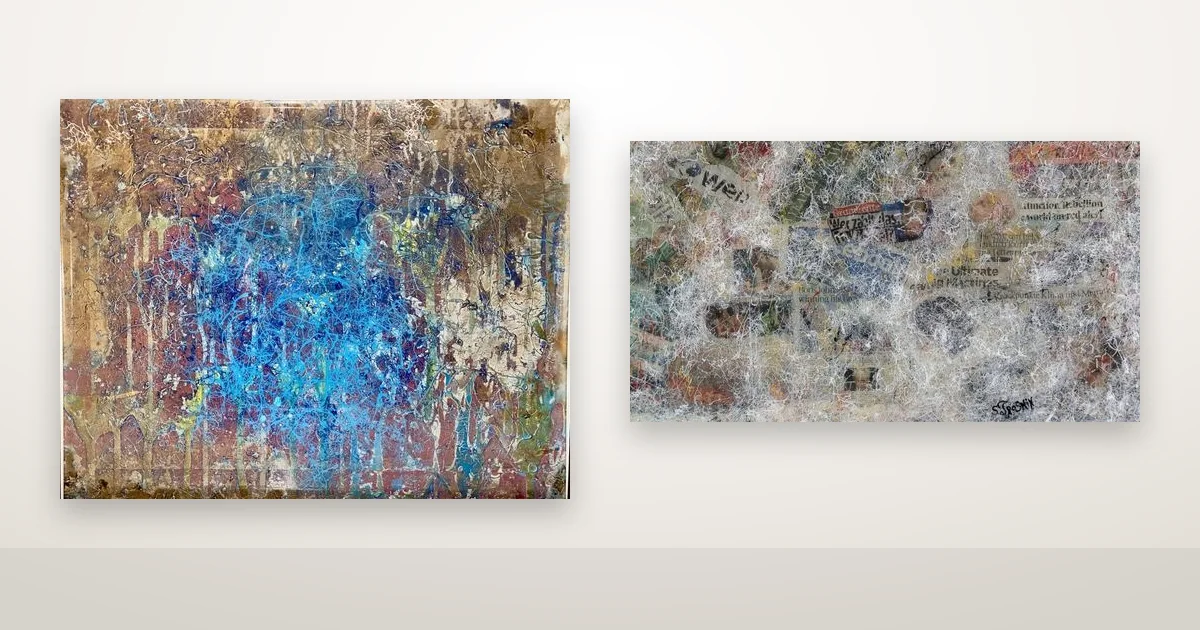
Infinity (2024, acrylic on board sealed with resin, 16 by 20 inches) answers the question with gravity. Its catalogue description puts it simply: earthy brown, ochre and rust run down the board in vertical drips, and a burst of bright blue lines fills the centre. Those drips are a record of the moment the paint was wet: they ran the way gravity pulled them.
Turn the board upside down and the drips would appear to climb from the bottom edge towards the top, paint running uphill. That is the clue doing its work. The tangle of blue lines in the centre gives no direction of its own. The rust and brown runs beneath it do.
You can check this before you ever see the work: in the catalogue photograph the drips run from top to bottom.
Under Media Cobweb: a name and a newspaper
Under Media Cobweb (2019, mixed media with collage, acrylic and resin, 60 by 80 inches) gives two clues at once. Newspaper and magazine cuttings in English and German are collaged across it, and headlines such as “Wer zahlt das” and “Ultimate” can still be read through a fine white web of poured acrylic. Printed words only read one way. Even where the web covers most of a line, the few letters that show are enough to tell top from bottom.
The second clue is the name. The work is signed in the lower right corner, which is where you can see it on the wall below. On a piece this size, roughly 1.5 by 2 metres, that settles the question before anyone lifts it.
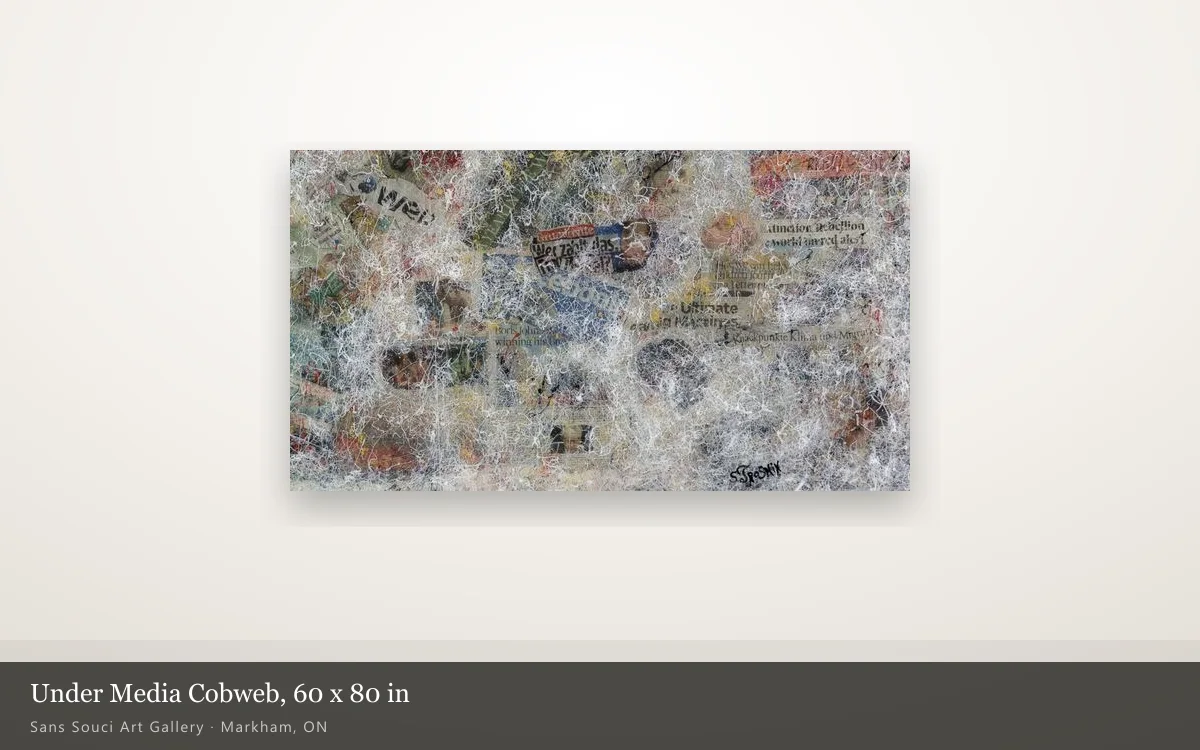
A work of this scale also makes the practical point. Turning a small canvas to try it another way takes a moment. Turning a wall-sized piece takes two people and a plan, which is one more reason to read the clues on the floor first. If you are hanging something large, our note on how to hang a heavy painting covers the fixing itself.
Four works, four ways to find the top
Across our catalogue the answer comes by a different route almost every time. Here are four works side by side.
| Work | What sets the top | Where to look |
|---|---|---|
| Infinity, 2024 | Paint that ran | Rust and brown drips running down the board |
| Under Media Cobweb, 2019 | Signature and print | Name in the lower right, headlines in English and German |
| Aspire to Inspire, 2020 | Stencilled words | ASPIRE TO INSPIRE along the top, TO EXPIRE at the lower right |
| Decorative Composition 1, 2020 | Signature | Signed in the lower right |
Aspire to Inspire is a panel cut with wavy, irregular edges, so even its outline gives no hint of a top. The black stencilled words do it all: one line along the top, one at the lower right, and a word set vertically between them. Decorative Composition 1, one of four Decorative Compositions painted in 2020, is a dense web of red, ochre and mint-green lines poured over a dark ground, with white threads laid on top. Its signature in the lower right is what fixes it. Titles can carry meaning too, as we wrote in what a title tells you, but a title on a label does not tell you which edge is the top.
When a work could hang more than one way
The Tate describes abstract art as art that does not try to depict visual reality accurately and instead uses shapes, colours, forms and gestural marks to achieve its effect. Some of those effects hold up when the work is turned. A field of poured lines with no drips, no letters and no name might look good at more than one angle.
That is a decision for the artist, not for the owner alone. Once a work is signed, the signature fixes one orientation: turn it and the name runs sideways or upside down in the corner, and anyone who looks closely sees it. If you love a piece and think it would suit your wall better turned, that is a good question to bring to us before you buy, not after the hooks are in.
Before the first hook goes in
- Lay the work flat on a clean, padded surface and look at it from all four sides.
- Find the signature and read it. If it reads normally, that edge is the bottom.
- Follow any drips or runs to where they stop. That end points down.
- Read any word, stencil or cutting you can find, even a single one.
- Turn it over and look for an arrow, the word top, a title along one edge, or a fixing already in place.
- Compare with the catalogue photograph of the work on our artworks page.
If the signs still leave you unsure about a work from our catalogue, send us a message with a photo of the front and the back, or come and see the piece at the gallery in Markham.