Fifty-six of the 61 works in this catalogue name acrylic in their materials line. It is the paint under almost everything here, including pieces that read first as resin, collage or natural dye. Few buyers ask what acrylic paint actually is, and it rarely matters until a painting has to travel in January or be dusted for the first time.
This note covers what acrylic is, what it lets a painter do, and the two facts about it that matter to an owner: how it behaves in the cold, and what years of household air do to an open acrylic surface. We use two paintings made with the same paint and the same trailed-line method, finished in opposite ways.
What is acrylic paint?
Acrylic paint is pigment held in a synthetic resin binder. It thins with water while wet, dries fast, and is water-resistant once dry. Tate’s glossary entry on acrylic paint dates it to the 1950s, notes that it can be used thinly or thickly depending on how much water is added, and calls it “waterproof once it has dried”.
That makes acrylic a young paint. Oil has centuries of paintings behind it showing how it ages; acrylic has about seventy years. The Canadian Conservation Institute says the acrylic emulsion paints became available in the early 1950s and are now the most common synthetic paints in use. It also says that acrylics are more flexible than oils and seem less prone to cracking, but that “they have not had the test of time”. Nobody can honestly promise how an acrylic painting will look in two hundred years, and we do not.
What acrylic lets a painter do
Acrylic dries in minutes to hours rather than days, and it can be poured, trailed, brushed thin or built up thick. Together those two properties are what allow a surface to carry many separate passes of line, each laid over one that has already set, without the colours blending into mud.
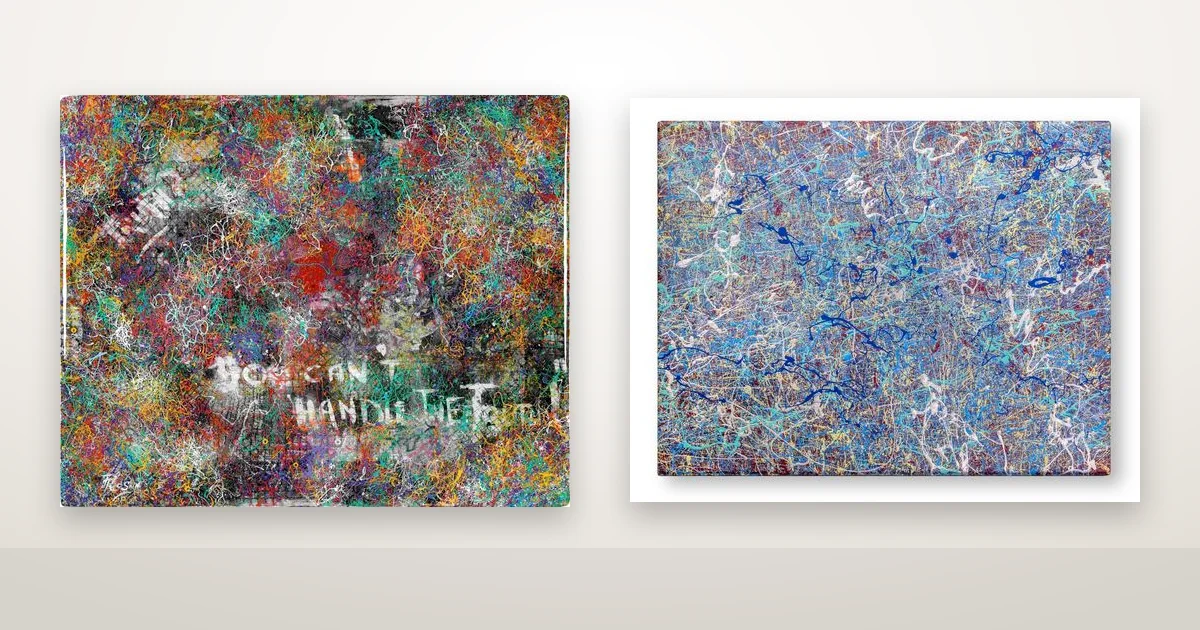
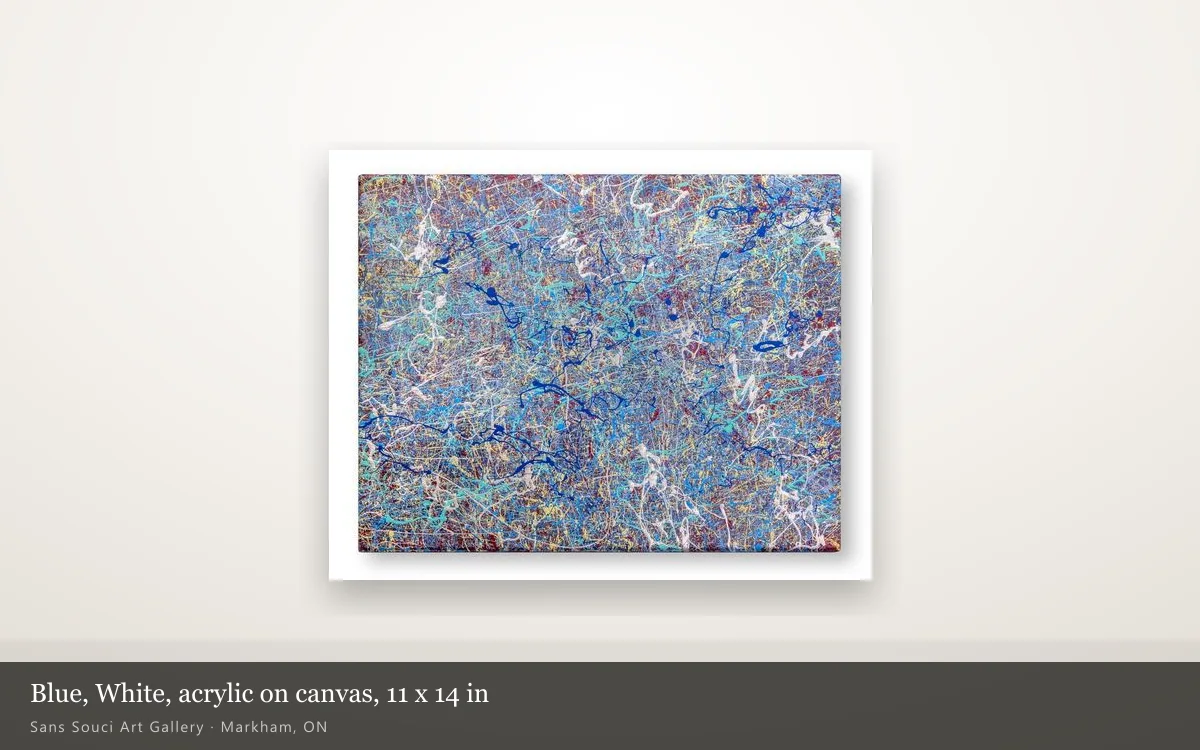
Blue, White is acrylic on canvas, 11 × 14 in, completed in 2019. Its whole surface is trailed line: dark blue, turquoise, white and pale yellow poured in threads over a dark red ground. Where the stream of dark blue paused, it landed as thick blots; the white runs in looser loops over the top. Every colour sits on one that had to be dry enough not to mix with it, and with acrylic that wait is short.
Truth uses the same method at a larger size: acrylic on hardboard, 24 × 20 in, completed in 2020, sealed with resin. Strands of red, orange, teal, violet and white cross a grey-and-black passage in which pale block lettering sits partly buried under the lines. The lettering is legible in places and overrun in others, so it went down before much of the line work did. That is the kind of order you can read straight off a surface, as our note on reading a layered surface explains.

Our own artwork pages describe acrylic in one line: it “dries quickly and stays flexible”. Both halves are true at room temperature. The second half needs a qualification, and in Canada it is the one that matters most.
Why acrylic and cold do not mix
Acrylic paint stiffens sharply as it cools. The Canadian Conservation Institute puts the change at 5–10 °C (41–50 °F), and at those temperatures a painting is vulnerable to cracking. That is a mild autumn day, not deep winter, so the cold season here is longer than most people expect.
The figures are in the Institute’s Note 10/17, Know Your Paintings. Acrylic “increases dramatically in stiffness at temperatures of 5–10 °C”; oil paint does not reach the same change until between −5 and −10 °C. The Note concludes that the risk of cracking makes handling and transporting paintings hazardous in Canadian winter conditions. It names handling as well as transport, which covers the carry from the car to the front door.
Five degrees is an unheated garage in November, a car left in a parking lot for an afternoon, a porch where a courier leaves a box. In practice:
- Carry it in the heated cabin, never in the trunk, whenever it is below about 10 °C outside, and go straight home.
- Do not store it anywhere unheated over winter: a garage, a shed, a closed cottage.
- Handle it as little as possible while it is cold. Hang it once it is back at room temperature, not on the way in.
- For delivery in the cold months, ask for heated transport. Our note on shipping an original across Canada sets out what that means and what to ask a carrier.
Does the resin coat on Truth change any of this? Nothing we have states how a poured coat behaves at those temperatures, so we do not claim that it helps. Treat every acrylic work the same way in the cold, sealed or not. Hardboard is rigid and does not flex the way canvas does, which removes one source of strain, but the paint on it is the same paint.
What household air does to an open acrylic surface
An uncoated acrylic surface slowly takes in dirt. The Institute says acrylic paints “tend to attract and absorb dirt at ambient or high temperatures” and that their surfaces can be particularly difficult to clean. Where the paint is the outermost layer, keeping dirt off matters far more than any way of taking it off.
Blue, White has nothing over its paint. Every raised strand meets the room directly: dust, cooking air, fingers. On Truth the acrylic is under a poured resin coat, so the surface the room meets is resin, a hard glossy face that, as its own page says, “scratches like any gloss surface”.
| Blue, White | Truth | |
|---|---|---|
| Materials, as the page states them | Acrylic on canvas | Acrylic, hardboard, resin |
| Size and year | 11 × 14 in, 2019 | 24 × 20 in, 2020 |
| Method | Trailed acrylic line | Trailed acrylic line over lettering |
| What the room touches | The acrylic itself | The poured resin face |
| Main risk at home | Dirt settling into the paint | Scratches to the gloss face |
| In the cold | Acrylic stiffens at 5–10 °C | Same paint; no claim about the coat |
“Waterproof once it has dried” describes the paint film, not permission to wash it. The Institute’s note on cleaning precautions warns that water-based cleaning can draw components out of acrylic emulsion paint, and asks owners not to attempt cleaning at all; our note on what to do if a painting gets damaged covers that in detail. For an open acrylic canvas, the useful steps are the ones that keep dirt away: hang it away from the kitchen, the dining table and a working fireplace, do not touch the paint with bare hands, and keep it off the floor.
How to tell whether a painting here is sealed
Read the materials line under the title. On this site it names the paint and, where there is one, the coat: “sealed with resin”, “sealed with epoxy”, or simply “resin” in the list. If no coat is named, assume the paint is the surface.
We counted every page in the catalogue this week:
- 48 works go on a wall; 43 of them name acrylic.
- 35 of those 43 also name a resin or epoxy coat.
- 8 name no coat at all, and 7 of the 8 are on canvas, Blue, White among them.
- All 13 pieces of painted furniture and home accents name acrylic too; the three hand-painted wine glasses are sealed with varnish rather than resin.
If the materials line does not settle it, ask. We can tell you what is on the face of a particular work, how it was finished, and how it should travel in the month you want it delivered.
The resin face on Truth and the open strands on Blue, White are far easier to tell apart in person than in a photograph.Ask us about either painting or arrange a viewing in Markham, or look through the full catalogue with the materials line in mind.