Stand a foot away from one of these paintings and it briefly stops being a picture. You start seeing the order things happened in: which line went down first, which colour was covered and which was left showing, where the surface was sealed and then worked on again. Reading a layered surface is not a specialist skill. Most of it is knowing what to look at — and knowing which questions the painting can actually answer.
What does a layered painting actually mean?
It means one of two things, and they are built quite differently. In the first, the work is made in stages and each stage is sealed under a clear coat, so earlier marks stay visible through the material sitting above them. In the second, the paint itself is stacked, so later marks physically rest on the earlier ones. Depth you look into, or depth you look at.
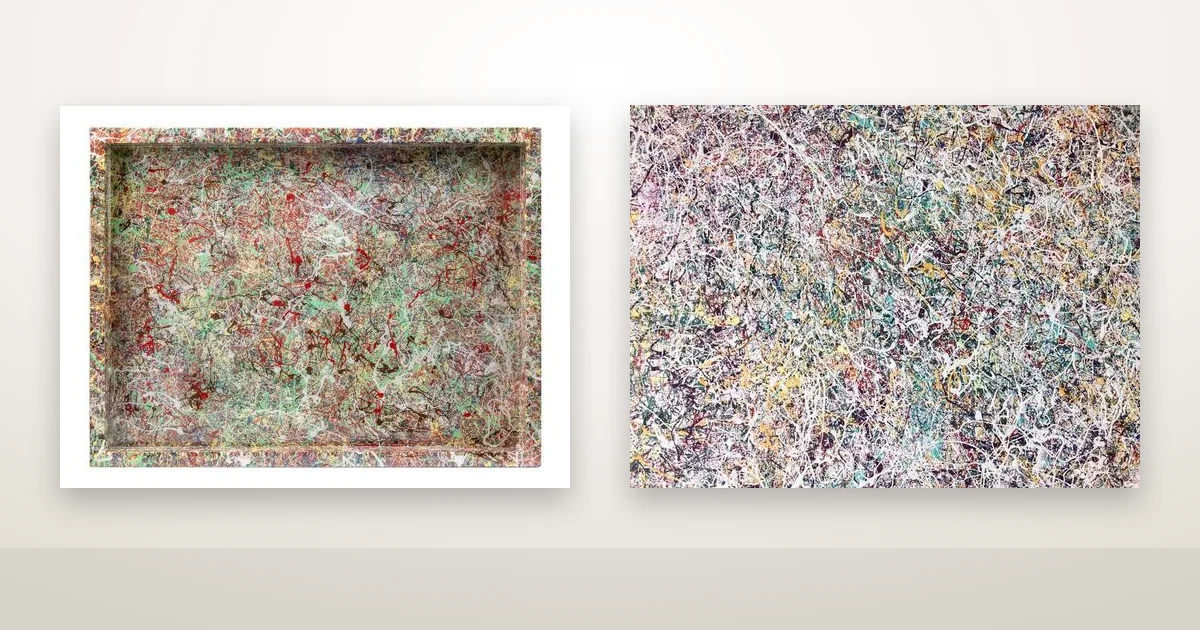
Of the 61 artworks on this site, 34 carry a description in the artist’s own words, and ten of those mention layers. They do not all mean the same thing by the word. The two paintings below were both finished in 2020, both are available, and at a glance they look related — dense webs of drizzled line. They are layered in opposite ways.
Depth you look into: Fair of Colours
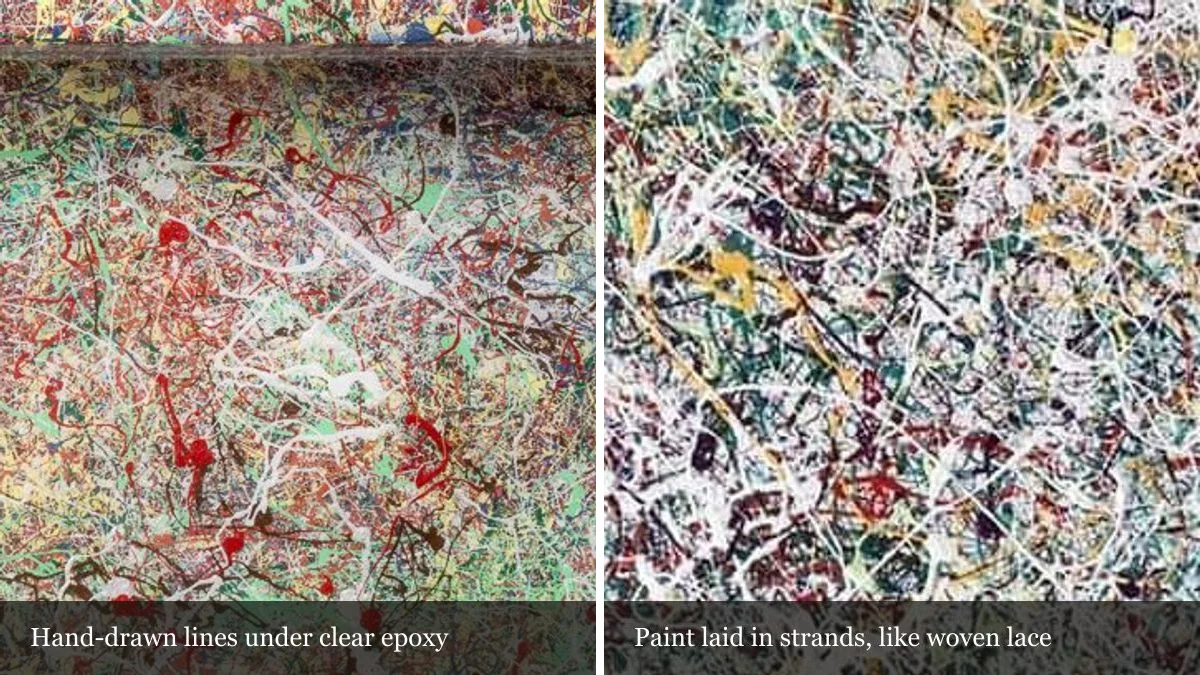
Fair of Colours (2020, 12 × 16 in, acrylic on wooden board sealed with resin) is layered in the first sense. Its page carries the artist’s own account of how it was made: “Every layer of my abstract lines is sealed with a coat of crystal clear epoxy. Sometimes they are up to ten floating layers there.”
That sentence describes a sequence rather than a finish. Lines are drawn; a clear coat is poured over them; more lines are drawn on the cured coat; and so on. A poured resin coat sets into a hard, glass-like film — Tate’s glossary entry on resin explains the material — and because it is clear, nothing that goes underneath it is lost. Every stage is still there. It is simply further from your eye than the stage above it.
The way to see that is to move, not to stare. Step slightly to the left, then slightly to the right. Marks sitting at different depths shift against one another as you go, the way lettering on a thick glass door shifts against whatever is behind it. Nothing in the image changes; your position does. This is the part a photograph cannot carry, for the same reason it cannot carry what a raised surface does to light: a photograph has already chosen one viewpoint for you.
Five works in the catalogue carry that same ten-layers sentence. Three are available and two are sold; the sold ones stay on the site as part of the artist’s archive. Fair of Colours itself sits in the “Abstract Variations” collection.
Depth you look at: Summer Languor
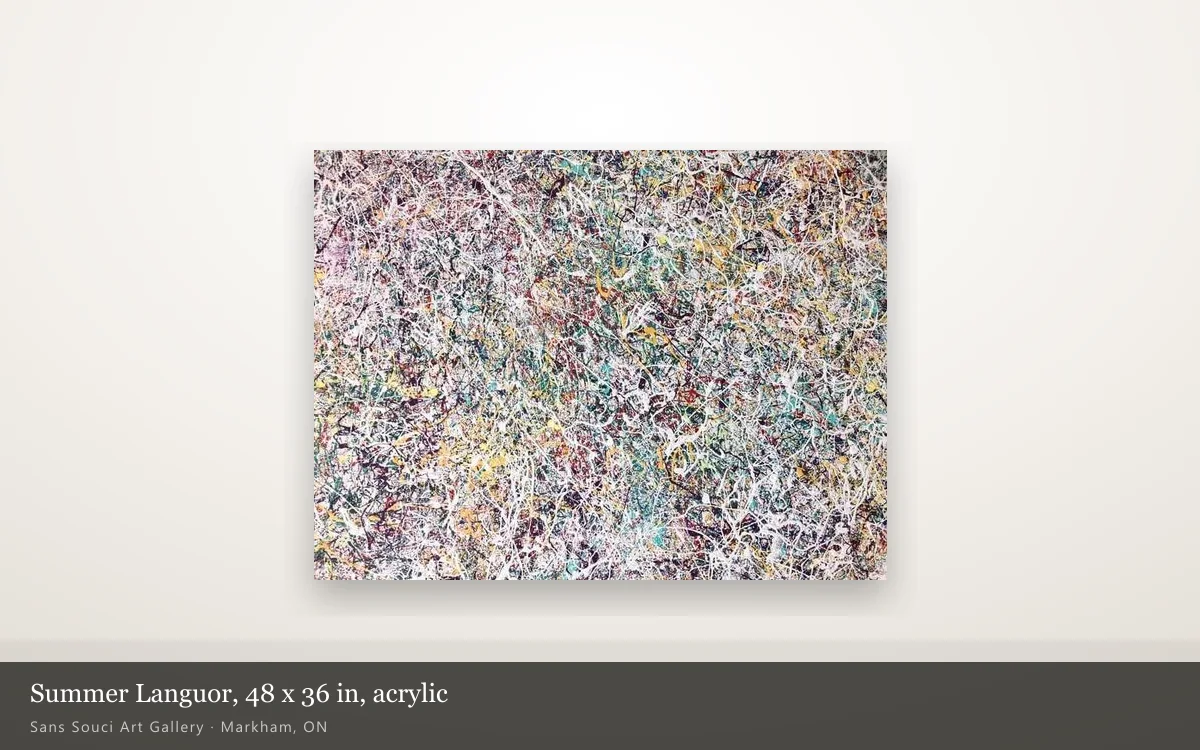
Summer Languor (2020, 48 × 36 in, acrylic on canvas) is layered the other way, and the artist does not describe painting it at all: “I didn’t paint it: I was making a piece of paint lace, spinning it, weaving it.”
Take that literally and it tells you what to look for. Lace is made by laying one strand across another, so at every crossing one strand is on top and one is underneath, and the whole fabric stands off the ground it sits on. Raised paint of this kind is called impasto — Tate’s glossary entry on impasto defines the term — and it behaves like very shallow relief: lit from one side, each strand catches light along one edge and drops a shadow on the other.
Its page names no poured coat, so that relief is open to the room rather than sealed under a hard film. That has a practical consequence when you hang it. A light raking across the surface from the side separates the strands; a light aimed straight at it from the front flattens them, and a good deal of the work goes quiet. At 48 inches across it also wants roughly its own width of clear wall on either side.
| Reading the two surfaces | Fair of Colours | Summer Languor |
|---|---|---|
| Year | 2020 | 2020 |
| Materials | Acrylic on wooden board, sealed with resin | Acrylic on canvas |
| Size | 12 × 16 in | 48 × 36 in |
| Where the depth sits | Under the surface — stages separated by clear coats | On the surface — strands stacked on strands |
| The face of the work | Smooth and hard; the relief is sealed in | Open relief, nothing poured over it |
| What a photograph loses | The shift between layers as you move | The shadow each strand casts |
| Status | Available | Available |
How to read the order of events
Look for crossings and interruptions. Wherever two marks meet, one of them is on top, and that single fact tells you which one came later. Do it a dozen times across a surface and the sequence assembles itself without any specialist knowledge. Five checks, easiest first:
- Crossings. Follow one line until it meets another. Whichever line stays unbroken is on top, and therefore later.
- Interruptions. A colour that stops and picks up again on the far side of something is running underneath it.
- Relief you can see but not feel. If a mark looks raised while the surface above it reads as smooth and unbroken, it is sitting under a clear coat. That one test separates the two kinds of layering in a few seconds. Look rather than touch — an open surface holds fingerprints.
- An earlier layer emerging through a later one. Sometimes this is the whole subject. The description of Treasure Behind the Wall II opens: “Beneath the multiple layers of wallpaper, the intricate, abstract pattern of the wall emerges.” What you are meant to notice there is not the top layer but what survives it.
- A surface broken on purpose. Exactly one work in the catalogue records this. On Morgenwald in Meißen the artist writes: “If we look closely, we will notice a slight crackle on the surface. This was necessary for binding my idea to the theme of antique porcelain.” The crackle is deliberate, so there is nothing there to repair.
And what about scraping?
A busy abstract surface invites the assumption that something has been scraped or sanded back to let a lower layer show. It is a real technique and a fair guess. Here it is simply not recorded: across all 61 artwork pages, not one description in the artist’s own words mentions scraping, sanding or cutting into a layer. Everything he describes doing is additive — drawing, weaving, pouring, sealing.
One source of confusion is our own doing, so it is worth naming. Every artwork page carries a short materials note written by the gallery, and the note on acrylic says the paint “lets layers be laid over one another in a single session and scraped back while still workable”. That is a statement about what the material allows, not about the painting on that page. Where the site does not record how a piece was made, we would rather leave the gap visible than fill it.
All of this is quicker to settle in person than to read about. If one of these pieces interests you, ask us about it — viewings are by appointment at the gallery in Markham. Two minutes in front of the work will tell you more about how it is built than any photograph can.