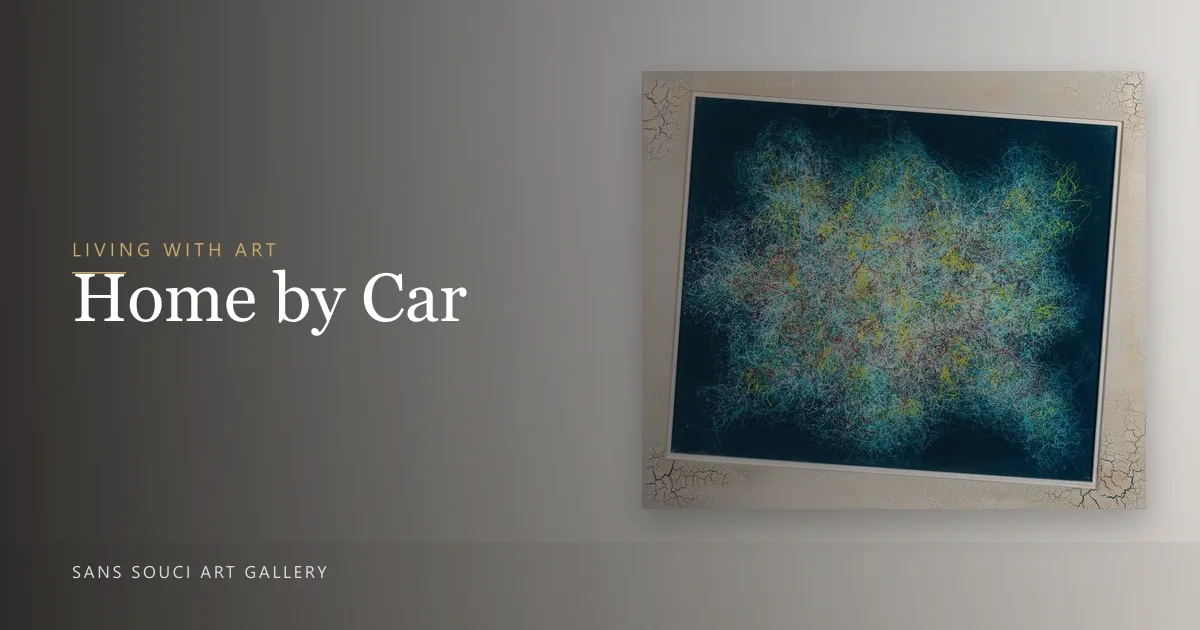
Sooner or later you will need to store a painting at home. A move, a repaint, a new radiator, a wall that turns out to take four hours of afternoon sun. Where the work goes next is usually decided in a hurry: behind the sofa, up into the attic, down to the basement. Two of those three are named in Canadian conservation guidance as places to avoid, and the reasons are worth knowing before you carry anything anywhere.
Where should a painting wait?
In a room you actually live in. The Institute's guidance on storing and displaying paintings names the two spaces most homes offer for the job and tells you to avoid both: "attics can experience extremes of heat and dryness, while basements can be damp and vulnerable to flooding (from ground water leaks and overhead pipes)." An ordinary interior room, kept at the conditions you keep it at anyway, is better than a space cleared specially for the purpose.
The same note adds two things that are easy to miss in a house. Outside walls are not neutral: "a building's perimeter walls can often experience fluctuations in temperature and relative humidity," and they can carry moisture if the insulation or vapour barrier is poor. And storage should not sit anywhere subject to vibration — which in a home usually means not against the wall a laundry machine is bolted near.
These are the same conditions that decide where a piece hangs in the first place — stable temperature, stable humidity, no direct sun — so a work in storage is being asked for nothing new. We have written about the seasonal half of it in winter air and the wall you chose.

Two constructions, two different problems
What a work is built on changes what storage has to protect it from. Of the 48 wall pieces in this catalogue, 32 are on a rigid support and 11 are on canvas, and the two behave nothing alike once they are off the wall.
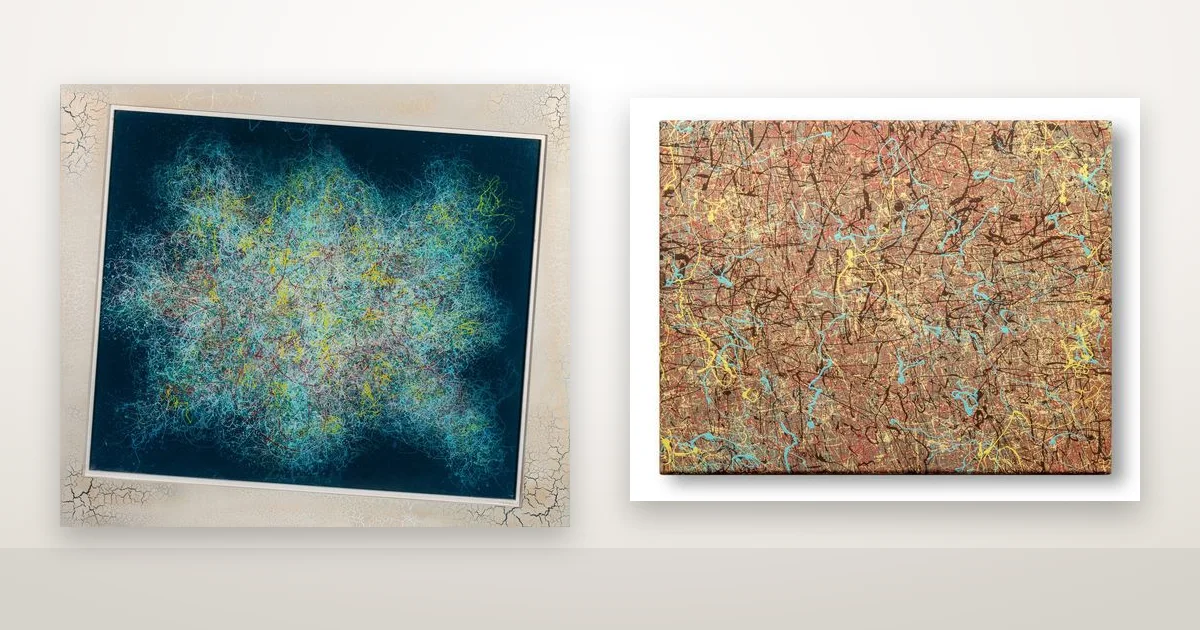
Dream Ocean is acrylic on fibreboard sealed with resin, 32 × 34 in. Rigid, and finished with a poured coat that cures to a hard, glass-like film. It will not flex and it will not puncture. What it will do is scratch: its own page says the resin face "scratches like any gloss surface," and in a stack the thing most likely to scratch it is the corner of whatever is leaning on it.
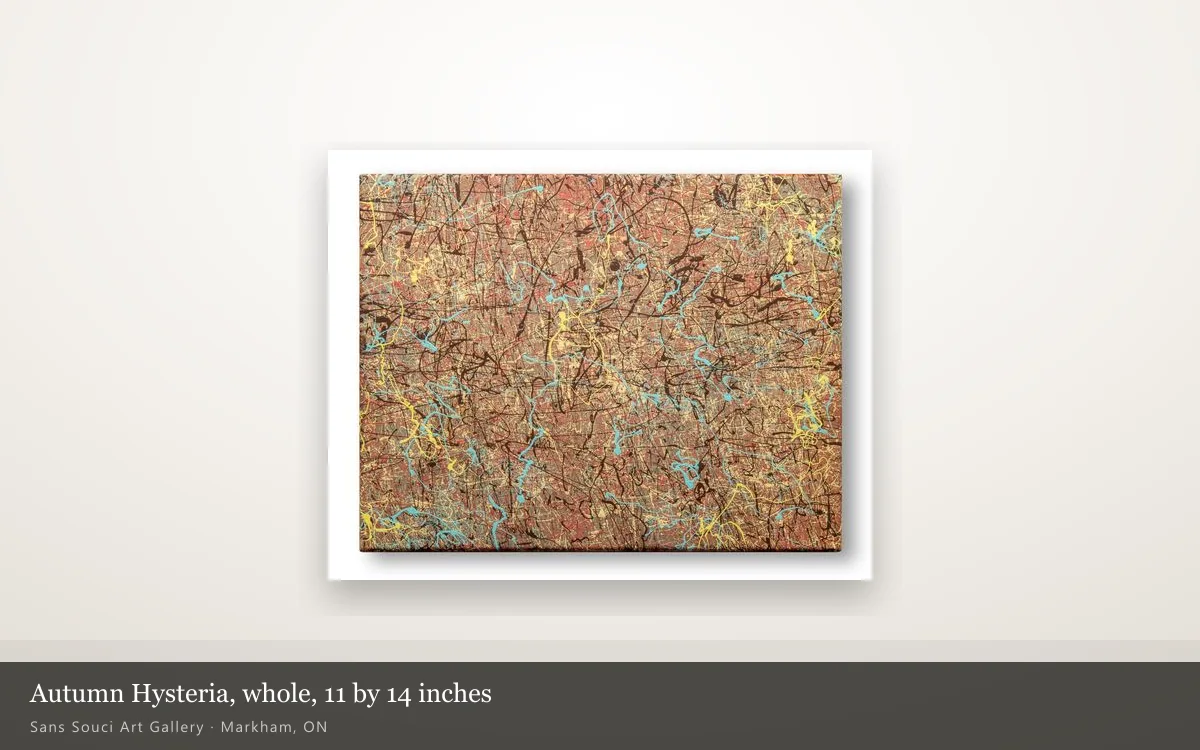
Autumn Hysteria is acrylic on canvas, 11 × 14 in, and carries no resin at all — dense trailed lines of dark brown, sky blue and yellow sitting open on a rust-coloured ground. A canvas has give. Pressure on the front dents it, and a knock from behind goes through it in a way that no board does. It is also light enough to carry in one hand, so it tends to end up on top of a pile rather than at the front of one.
| Dream Ocean | Autumn Hysteria | |
|---|---|---|
| Stated materials | Acrylic on fibreboard, sealed with resin | Acrylic on canvas |
| Stated size | 32 × 34 in (81.3 × 86.4 cm) | 11 × 14 in (27.9 × 35.6 cm) |
| Support | Rigid board | Flexible cloth |
| Face | Hard, reflective, poured | Open, matte, nothing over the paint |
| What storage must prevent | Scratching and pressure marks on the gloss | Denting from the front, puncture from the back |
| Realistic handling | Upright, two people — no weight is published | One hand, but never stacked under anything |
If you are going to lean them, lean them properly
The honest answer first: don't, if you can avoid it. The Institute is direct about this — "leaning paintings against a wall, especially as this often turns into a stack of paintings, is not recommended as a storage strategy," because stacked works are exposed both to contact damage from each other and to collision damage from people walking past.
When it has to happen anyway, the same note sets out how to make it survivable, and every number here is theirs:
- Lift them off the floor. Paintings "must be supported at least 7–10 cm (3–4 in.) above the floor" so that dirt, dust and any water on the floor cannot reach them.
- Stack no more than four to five works together.
- Put a rigid separator between every pair — cardboard or stiffer board, cut slightly larger than the works it sits between, so no edge lands on a painted face.
- Order them by size: largest against the wall, then the next, down to the smallest at the front.
- Turn the outermost work inward, facing a separator, so the exposed side of the stack is a back and not a picture.
- Set the lean angle so nothing can slip, and rope the area off if people will be walking past.
- If there are pipes overhead, cover the stack with polyethylene sheeting.
Applied to the two pieces above, the order follows from those rules. Dream Ocean goes against the wall, being the larger and the rigid one; Autumn Hysteria goes at the front and faces inward, because a canvas is the one thing in the stack that cannot take the load of the others.
Wrapping, and the measurement no page here publishes
Wrapping protects a work from dust, dirt and water, and the Institute's note on wrapping a painting is specific about the one thing that must not happen: the wrapping must never touch the paint. Cardboard laid over the front has to be rigid enough that it "will not sag and touch the surface of the painting," and where the frame or edge strips are too shallow to hold the materials clear, the work goes into a handling-travel-storage frame first.
That turns on depth — how far the paint sits below the outer edge of the piece. Nine of the 61 pages in this catalogue publish a depth. Neither Dream Ocean nor Autumn Hysteria is one of them, and no page here publishes a weight or names any hanging hardware. So if you own a piece from us and it is about to be wrapped, that is the measurement to ask for rather than estimate, and it is the same gap we ran into when writing about hanging a heavy painting.
The storage note flags raised paint separately. Where wrapping is ruled out by condition or by fragile impasto — paint standing proud of the surface — it says a smaller work may instead be kept in a rigid container. Several pieces in this catalogue carry trailed lines that stand off the surface, but whether any individual one is fragile enough to need that is a condition question, not something a photograph or a catalogue line can answer. Ask before wrapping, not after.
Before it goes away
Three things carry most of the weight here, and none of them costs anything: get the work off the floor, put a rigid board between it and whatever it touches, and choose a lived-in room over an attic or a basement. Beyond that, a piece in storage wants the same conditions it wanted on the wall, which we set out in how to look after an original.
If a piece of ours is going into storage, or coming out of it after a while, tell us which one and what it will be sitting in. We will answer with what we know about that particular work — its construction, its depth if we can measure it, and whether we would wrap it at all. You can see the current catalogue in the artworks listing, and reach us through the contact page or on +1 (416) 919-8331.