Every artwork page on this site is laid out the same way: the photograph, the artist, the materials, the size, then availability. On 34 of the 61 pages there is one more block, labelled Description, and it is written by Sergei Troshin about that single work. On the other 27 pages that block is simply absent. A note is not a specification, and a page without one is not a lesser work.
What the artist note actually is
It is testimony. One passage, almost always in the first person, about what the artist was remembering, reading or attempting while he made that one object. It is not written by us, it is not a catalogue record, and it is not the place where the object is specified. That work is done by the lines above it and by the generated block below it, which reads the same way on all 61 pages.
The notes vary more than anything else on the site. The shortest is three words long. The longest runs to 408 words, on Morgenwald in Meißen: the artist's own retelling of how porcelain came to be made in Saxony, written as a scene with dialogue and signed off at the end with his initial and surname. The middle of the range is 57 words. Thirty of the 34 are first person, and six contain a direct question. One is not prose at all — the note on The Power of the Abstract is sixteen lines of verse in four stanzas, and the page prints it with its line breaks intact.
Three things a note can tell you that nothing else on the page can
A note earns its place when it carries information the rest of the page cannot: a material the specification line leaves out, the artist's own measure of how long the work took, or the place the image came from. Those three things account for most of what is useful in the 34.
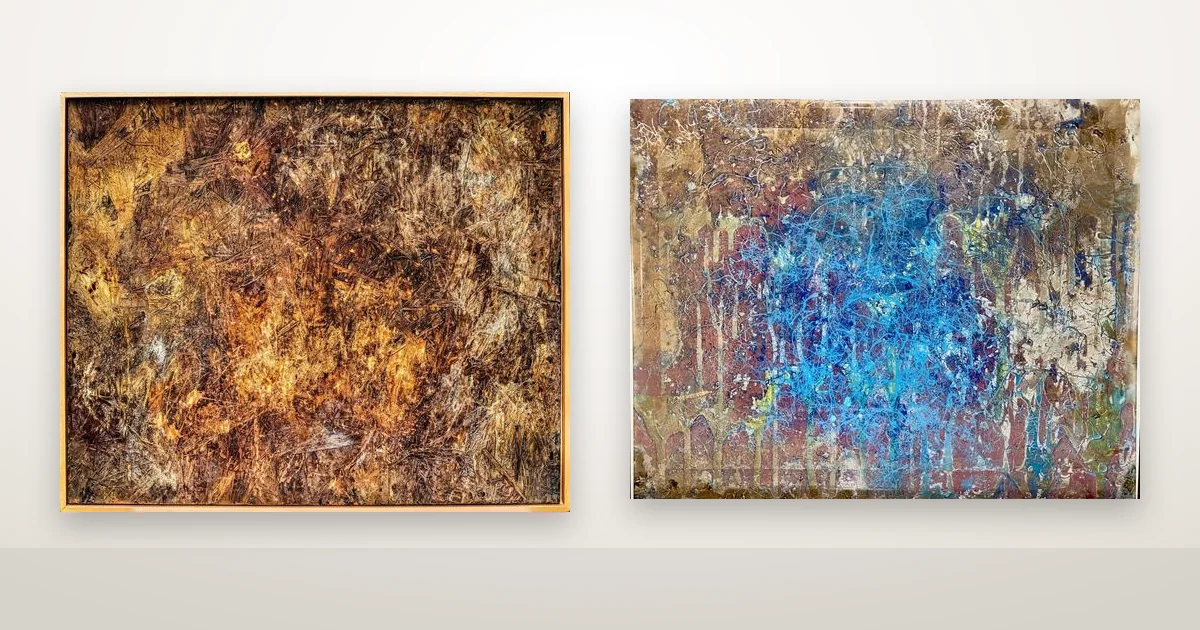
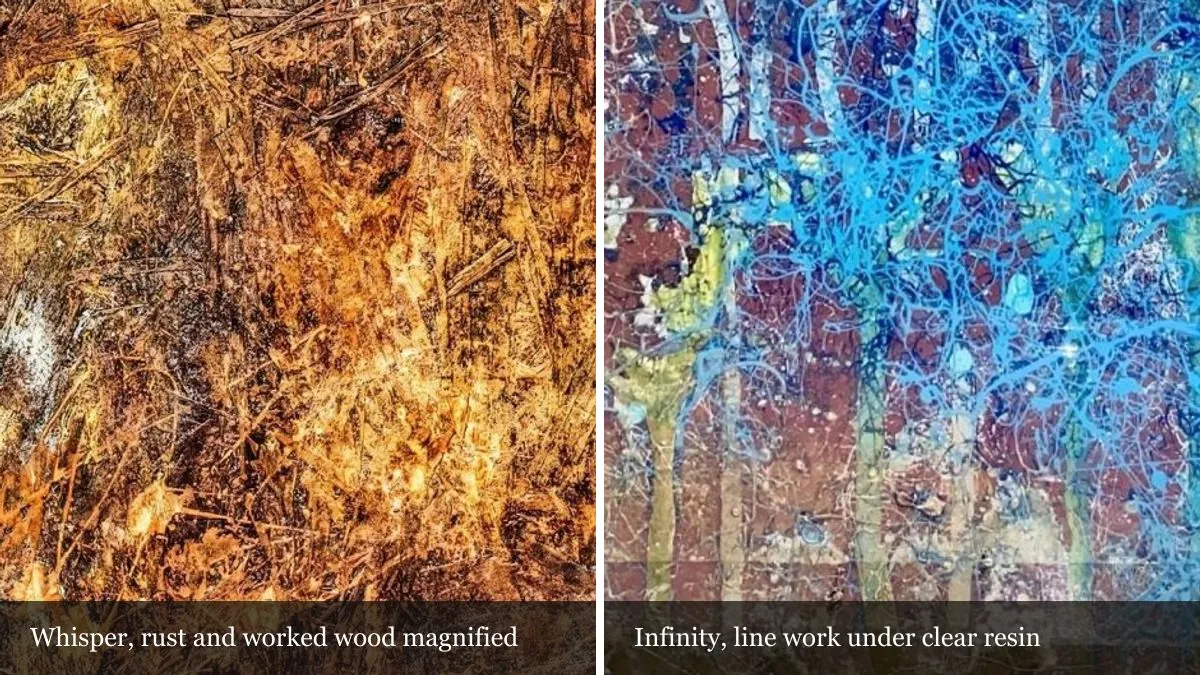
Materials the line does not name. On ten of the 34 pages the note names a material that appears nowhere else on the page. The clearest case is Whisper. Its materials line reads, in full, "Mixed media on panel" — a term that is accurate and tells you almost nothing, as Tate's glossary entry on mixed media makes plain. The note is where the materials are actually named: "I chose difficult materials: Wood, which remembers, and rust, which testifies to time." Magnified, the surface bears that out — splinters and fibres lie in the surface, and the rust-brown passages sit under a scratched, worked skin. If you had read only the specification line you would not have known there was wood in it. We wrote about what that phrase covers in mixed media, explained without the jargon.
Time, counted in lines. The artist measures the work in days: "As many lines, that many days of work". It is the artist telling you which part of the work he considers the expensive part. On a surface built from drawn line, that tells you where to look first.
Where the image came from. Eight notes name a real place — the Dead Sea, Masada, Saxon Switzerland, Meissen, Sinai. On those pages the note is the only thing that connects an abstract surface to a location, and it changes what you are looking at. Two of them are the reason we could write Meissen blue, Saxon forests, and where a palette comes from at all.
What a note is never
A note is not a record of the object. Across all 34 of them, not one states a condition, a depth, how the work hangs, whether it is still available, or whether it is signed on the face. We checked every note for those words: the count is zero. Those facts live elsewhere — some on the page, some only with us.
It is worth being precise about the difference, because one of these is a real document with a definition. A condition report, in the Canadian Conservation Institute's words, is "a written and/or electronically filed record that details the condition of a painting and its frame based on a close examination of these objects" — and kept systematically, such reports document any changes over time. An artist's note is the opposite kind of thing: it is about intention, not condition, and it is written once and never updated. If you want a condition record before you buy, ask us for one. It is a separate piece of paper and nobody should mind you asking.
There is a second limit that matters just as much. A note is written as an impression, so a material word inside one is not automatically an inventory. When a note speaks of rust, gold or calligraphy, that may mean the actual substance is in the surface, or it may be describing what the colour and marks look like. On Whisper the artist names his materials outright, so there is no ambiguity. Elsewhere there can be. Treat the word as a question to ask rather than an answer, and we will tell you which it is.
Why the same note appears on five pages
There are 34 notes on the site but only 27 different texts. Five works carry one 57-word paragraph word for word — Fair of Colours, Floating Feelings, Snowstorm, Transience and Zwei Goldfische, all five of them in the Abstract Variations collection and all 12 × 16 in. Four more share an identical 27-word paragraph, and a fifth repeats it with a single word altered.
This is not carelessness, and it is useful once you know it. A repeated note is a description of a method, not of a single painting: the same process, the same sealing in layers, applied to works that differ in colour and nothing else. When you notice a note you have read before, read it as a process description and then go and look at the two surfaces, because that is where the difference actually is.
And when there is no note at all
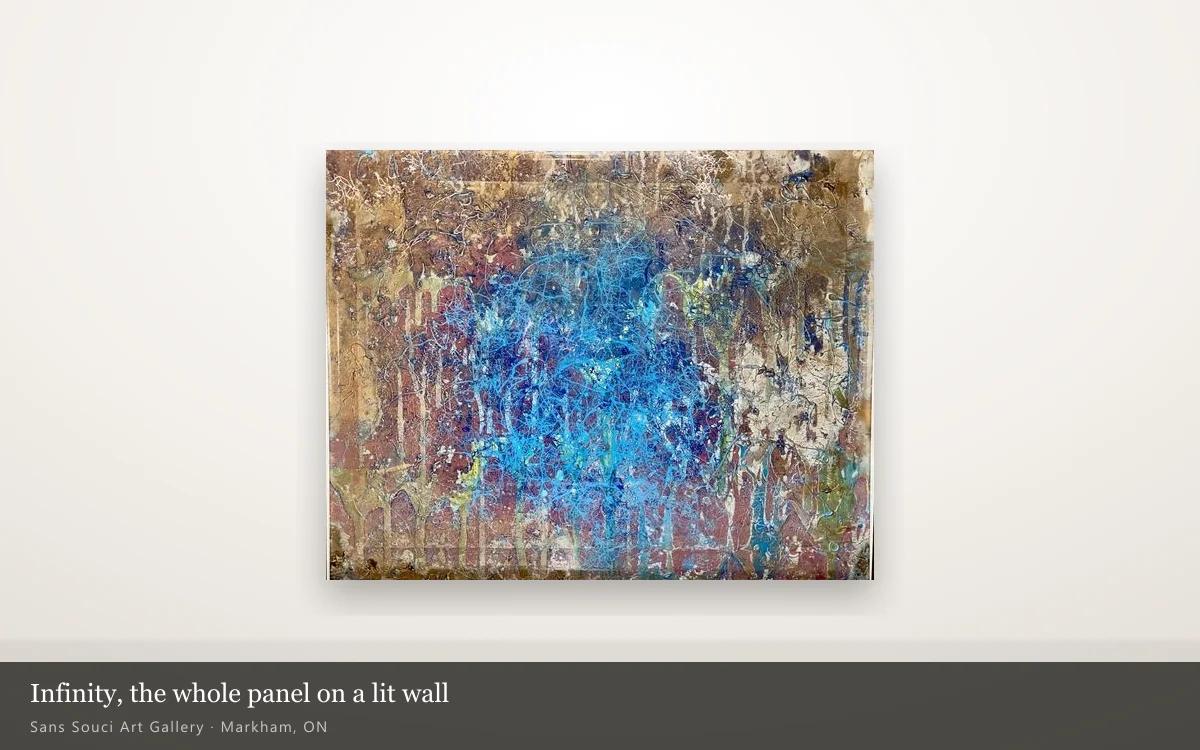
The 27 pages without a note lose the artist's account of the work and nothing else. Infinity is a good example. There is no Description block on it. The page still tells you it is acrylic on board sealed with resin, that it measures 16 × 20 in, that it was completed in 2024, why a rigid board is used under a heavy surface, how to dust a resin face and what not to clean it with, and which other works were finished the same year.
What the page does not tell you is anything about the blue. Magnify the panel and you find a dense network of drawn line, the same kind of surface that ten notes on this site describe as a day of work per line. Infinity's page does not say that, so neither will we. It is exactly the sort of thing to ask about, and the answer takes one message.
| Whisper (2025) | Infinity (2024) | |
|---|---|---|
| Artist note on the page | 111 words, first person, quotes scripture | none |
| Materials line | Mixed media on panel | Acrylic on board, sealed with resin |
| Size as printed | 83 × 109 cm | 16 × 20 in (40.6 × 50.8 cm) |
| Named only in the note | wood and rust, as chosen materials | nothing — there is no note |
| Stated identically on both | support and why it is used · the care routine for the finish · that it is one of a kind, not a print · the other works from the same year | |
| Not stated on either | condition · depth · hanging hardware · whether it is signed on the face | |
How we would read one before buying
- Read the note last. Materials, size and support first, so that the note adds to a picture instead of forming it.
- Check whether the note names a material the line does not. On ten pages here it does, and that is the most practical thing a note ever does.
- Treat a material word inside a note as a question. Rust, gold and calligraphy can be substances or descriptions. Ask which.
- If you have read the note before, you are reading a method. Compare the two surfaces instead of the two texts.
- Do not read anything into silence. Twenty-seven pages carry no note, and it says nothing about how much work went into the object.
- Ask for what no note contains. Condition, depth, how it hangs, whether it is signed on the face. None of that is in any of the 34.
A title tells you less than people expect, and we said so in what a title is and is not evidence of. A description tells you more, but a different kind of thing: it is the artist speaking, once, about one object, and it was never meant to do the work of a record. Read both, then look at the surface, and ask us the rest. You can see the whole catalogue in the artworks listing, bring a list of questions from what to ask a gallery before you buy, and write to us or call — we would rather answer the question than have you guess from a paragraph.