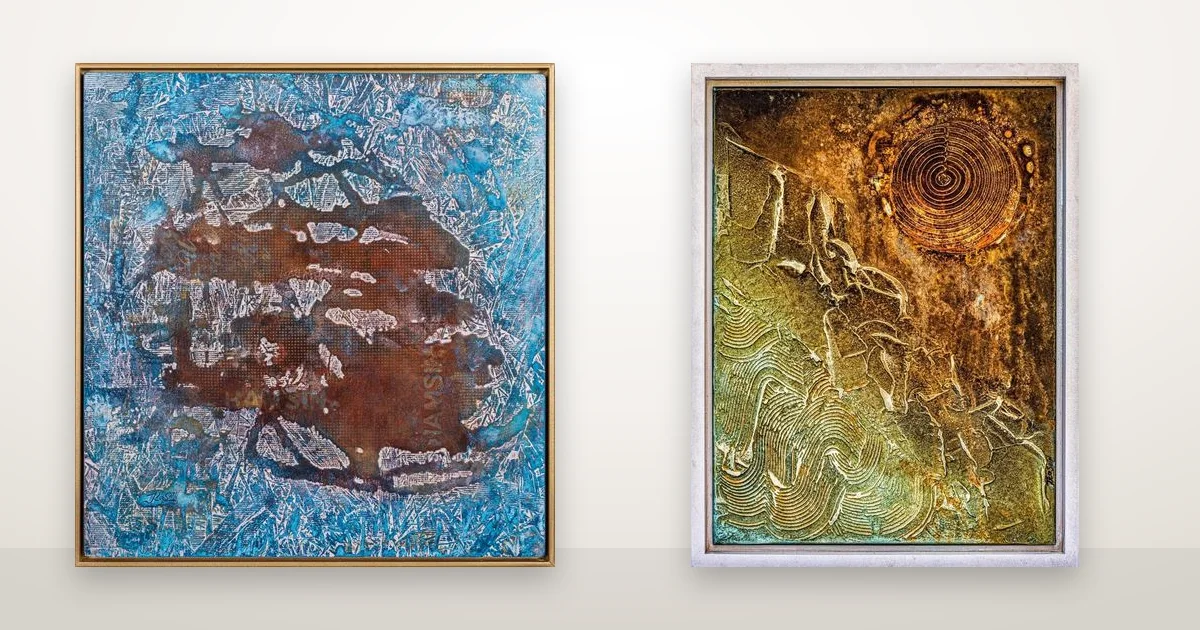
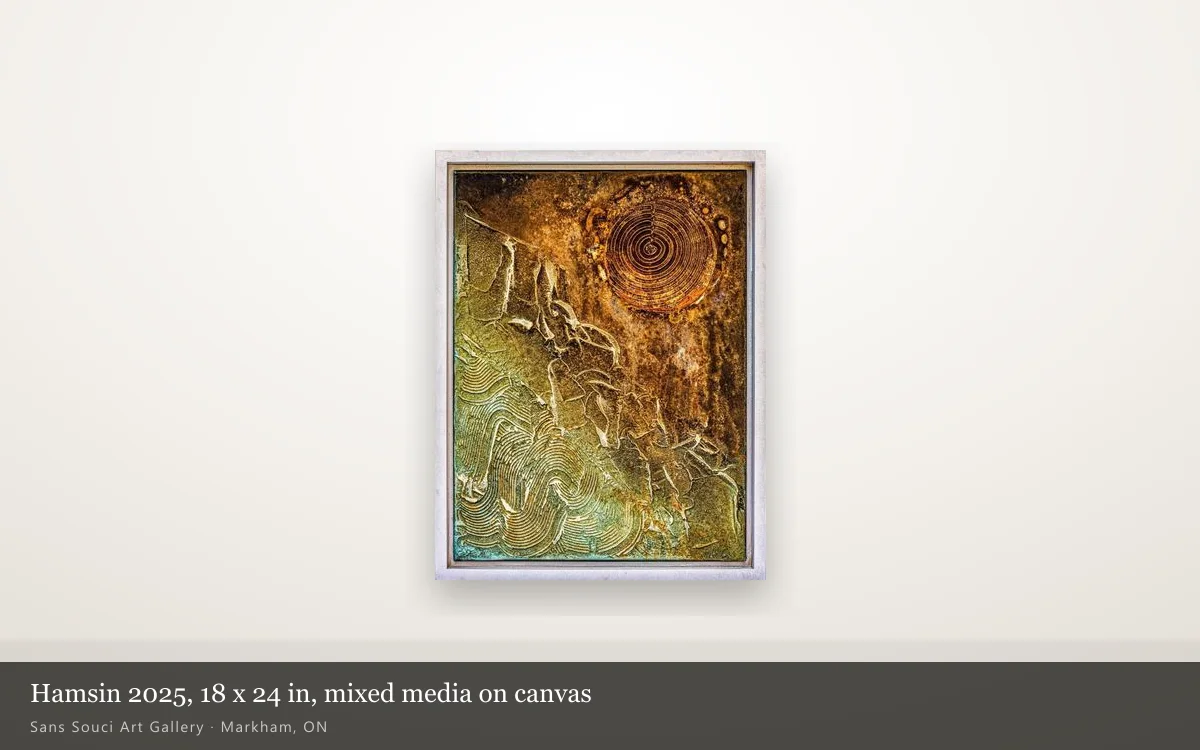
Two paintings in this catalogue carry the same title. Hamsin (2022) is blue natural dye, acrylic and resin on a wooden board, 24 × 24 in. Hamsin (2025) is mixed media on canvas, 18 × 24 in, with no clear coat named on its page at all. Same name, same remembered sandstorm at the Dead Sea, three years apart, and almost nothing about the two objects is alike.
That pair is the shortest argument we know for collecting one artist over years rather than buying one painting once. A single work tells you what an artist did on one occasion. Two works from different years tell you what changed, and that is a different kind of thing to own.
What does collecting one artist over years actually mean?
It means buying more than one work by the same painter at different points in their practice, so the group shows movement rather than a moment. In a small studio catalogue like this one it is unusually easy to do, because every page states the year the work was finished and every work stays online after it sells.
There is no membership and nothing to commit to. The years are published, so you can read the catalogue in date order this afternoon and decide later whether the change interests you.
The catalogue is dated, so the change is checkable
All 61 works publish a completion year in the description on their own page, and the years run from 2019 to 2026. We counted them this week rather than working from memory. Where a title also carries a year in brackets, the year in the description is the one counted here.
| Year finished | Works | Naming resin or epoxy | No longer available |
|---|---|---|---|
| 2019 | 9 | 5 | 2 |
| 2020 | 37 | 21 | 13 |
| 2021 | 2 | 2 | 0 |
| 2022 | 5 | 5 | 0 |
| 2023 | 1 | 1 | 0 |
| 2024 | 3 | 1 | 1 |
| 2025 | 3 | 0 | 0 |
| 2026 | 1 | 1 | 0 |
Two things in that table deserve a collector’s attention. The catalogue is heavily weighted to 2019 and 2020 — 46 of the 61 works — and the poured coat that runs through those years thins out afterwards: resin or epoxy is named on 26 of those 46 pages, and on 2 of the 7 works finished from 2024 onwards. All three works finished in 2025 name no clear coat at all. Read the third column downwards and you are watching a working method change.
The same subject, three years apart
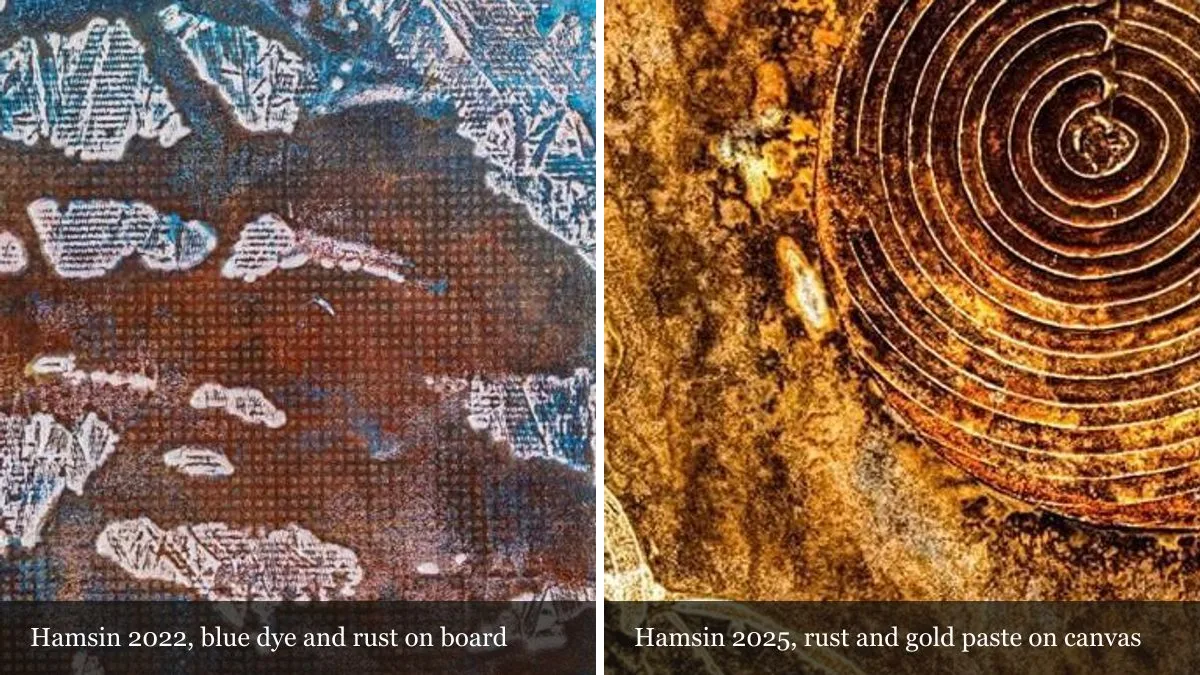
The two Hamsins are the clearest case in the catalogue, because the subject is held constant and everything else moves. Both pages carry the artist’s own writing about the same event: a sandstorm at the Dead Sea that turned the air, in his words on the 2022 page, “a dirty burgundy color”.
The 2022 painting is a blue field with a rust-coloured mass through the middle of it. It is built on a rigid wooden board with blue natural dye, which sinks into the wood rather than sitting on top of it, and its materials line names resin — the poured coat every resin page here describes as curing to a hard, glass-like, reflective film. The 2025 painting turns the same memory rust and gold, with a green-blue trace left only along the bottom edge. Its page describes “rich textures, golden pastes, and the evocative hues of rust”, a sky and a sun made invisible by the wind, and a concentric spiral, which sits near the top of the canvas. It is on canvas, which has give, and nothing is poured over the top.
| Hamsin (2022) | Hamsin (2025) | |
|---|---|---|
| Materials line | Blue natural dye, acrylic, resin on wooden board | Mixed media on canvas |
| Support | Rigid board | Canvas |
| Clear coat | Poured resin | None named |
| Size | 24 × 24 in | 18 × 24 in |
| What the artist writes about | The sea returning after the storm | Rust, gold paste, sky and sun gone |
| Face of the work | Hard, glass-like, reflective | Open, textured, no coat named |
| Status | Available | Available |
Hung on one wall those two would not read as a matched pair, and a buyer expecting a set would be disappointed. What they show instead is one subject approached twice, with three years of changed method in between: the same storm, once behind glass-hard resin on a rigid board, once left open on cloth. If you want the mechanics of why a sealed face and an open one behave so differently in a room, we set that out in why the same painting looks different at 9am and 6pm.
It is not the only return. Morning Forest in Meißen (2023) ends its description by saying it is another version of Morgenwald in Meißen (2022). Same porcelain blue, same Saxon forest, one year later, this time 52 in across and framed.
What to compare when you look at two years
Dates on their own tell you little. Four fields do most of the work: three of them appear on every artwork page, the fourth on 34 of the 61. All four are stated rather than interpreted, which is what makes them worth comparing.
- The support. Rigid board or canvas. It decides what kind of surface can be built on it and how the work behaves on a wall — we covered that in what the support changes.
- The clear coat. Resin, epoxy, varnish or nothing. Named on most work up to 2023 here, absent from all three 2025 pieces.
- The size. Both Hamsins and both Meißen works change scale between versions, and scale changes what a piece asks of a room.
- The artist’s own description. 34 of the 61 pages carry one; 27 carry none. Where it exists it is the only record of what the work was reaching for.
One field is easy to read past: the artist’s name. 58 of the 61 works are by Sergei Troshin and 3 are by Evgenia Troshin, born 1961, also based in Canada. Every page states which. If you are following one artist, check that line rather than assuming it.
The early work is the part that runs out
Sixteen works are marked Sold or Private Collection, and fifteen of those sixteen were finished in 2019 or 2020. The single exception is Wheel of Fortune, finished in 2024. Each piece is one of a kind, so anything already gone from the resin years is gone permanently. It stays on the site anyway: as the artist’s page puts it, sold work remains online as part of the archive of how the work has developed, which is exactly what makes a year-by-year reading possible at all. The badges are explained in what Sold, Private Collection and Available mean.
If the early line-labyrinth work on sealed board is the part of this practice you want, the pool only shrinks, while the recent mixed-media work is entirely available. That is what a catalogue of unique objects does over eight years, and it is a fact rather than a reason to hurry.
What to keep on file once you own two
A group needs slightly more record-keeping than a single piece, and almost none of it is difficult. Keep the Certificate of Authenticity for every work together in one place — what a certificate does and does not say covers what it records. Then add a photograph and a few honest sentences about the condition of each work on the day it arrives.
That second habit is standard practice, not our invention. The Canadian Conservation Institute describes a condition report as a record that, kept systematically, documents any changes over time, and notes that a report made before acquisition tells a buyer whether they can give the work the care it needs. For a private collection, a dated phone photograph and three sentences per piece will do.
The other thing that arrives with a second and a third work is the question of what is not on the wall. Leaning them in a corner is the usual answer and it is the wrong one: the CCI states that leaning paintings against a wall is not recommended as a storage strategy, because stacks rub against each other and get walked into. If you must stack temporarily, it advises no more than four to five together, raised 7–10 cm off the floor, with rigid board separators between them. Our short, honest care list covers the rest of the day-to-day.
What the catalogue does not record
Being useful here means naming the gaps as well. These pages give you materials, size, year, status and, on 34 of them, the artist’s own words. They do not give an exhibition history for any individual work, they do not say where a sold piece went, and they carry no valuation. None of that is withheld; it simply was never written down page by page, and we would rather say so than let a dated catalogue imply more than it holds.
So if you are following the work across years, ask us. We can tell you what came before or after a piece you are looking at, whether a subject has been returned to, and what is on the easel now. Read the years side by side in the artworks catalogue, or write to us and we will put the two Hamsins in front of you in the same light — which is the only way the difference between them is properly visible.