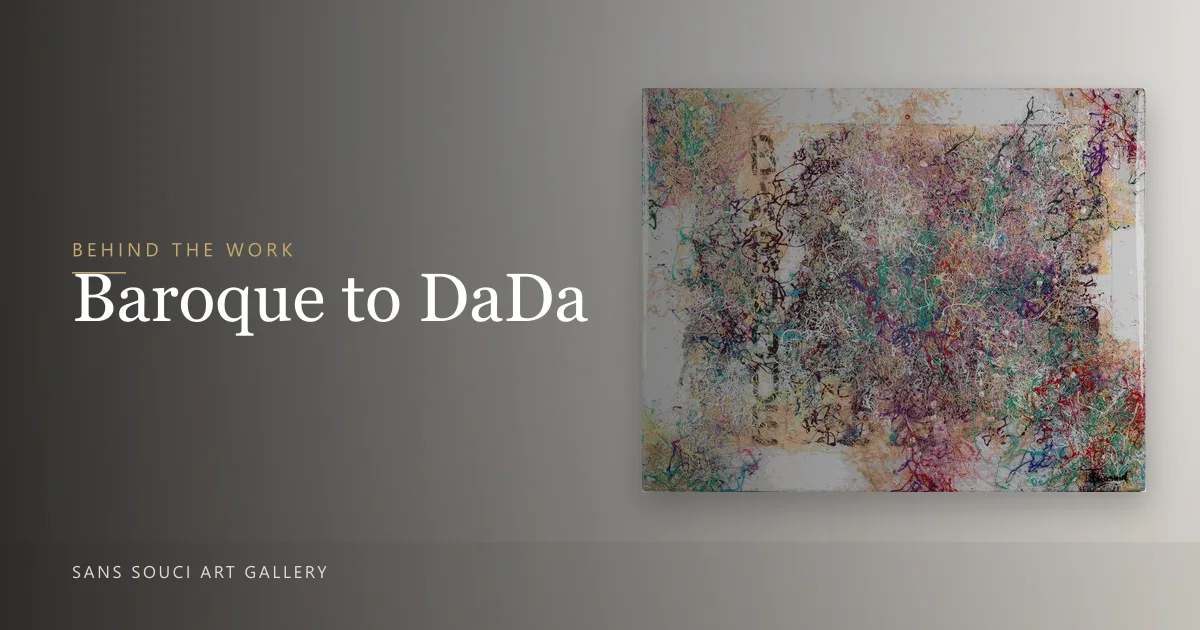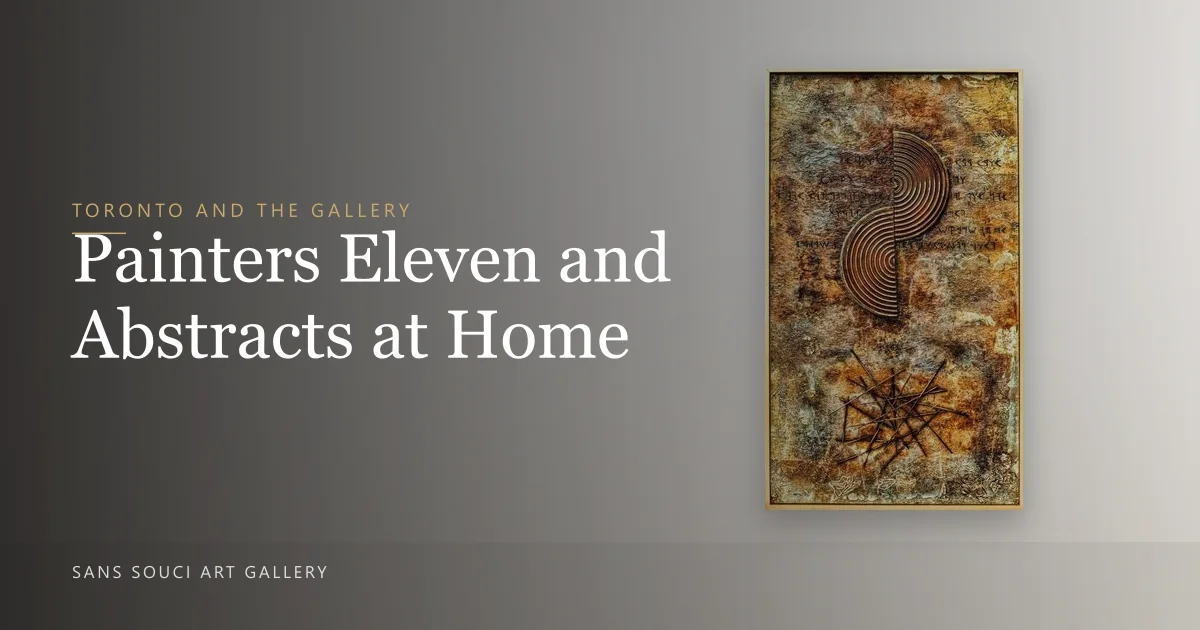
Every artwork page on this site ends its materials line with a support: canvas, wooden board, hardboard, fibreboard, plywood, paper or panel. Most people read straight past it to look at the picture. It is the line that decides how the work hangs on your wall, how it copes with a heated Canadian winter, and what kind of surface could be built on it in the first place.
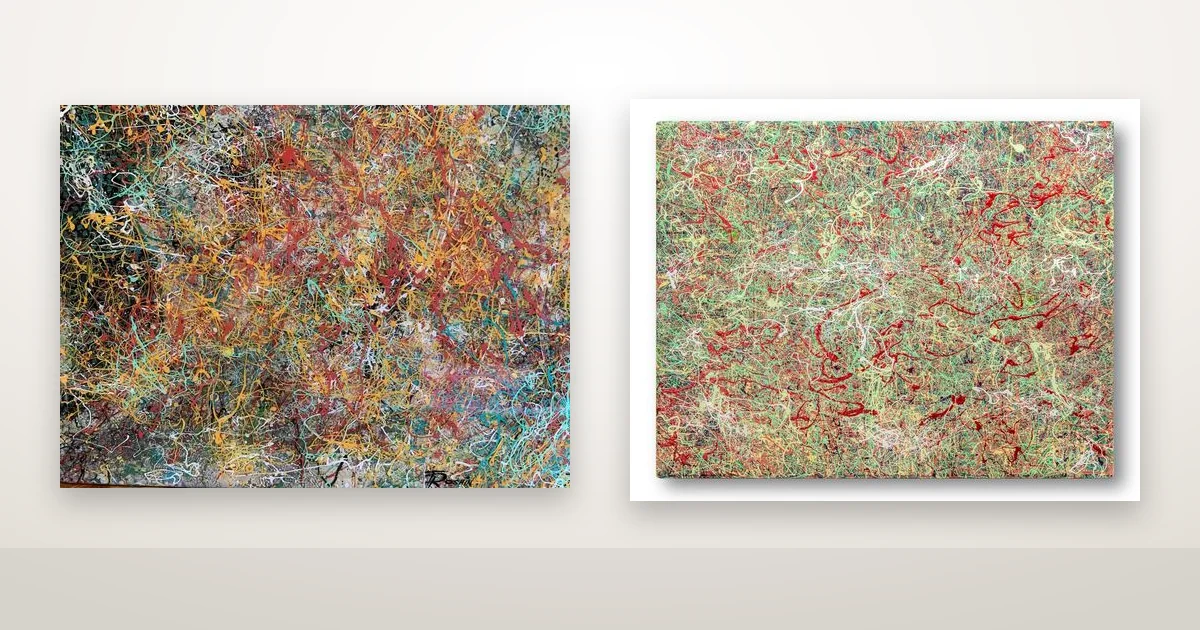
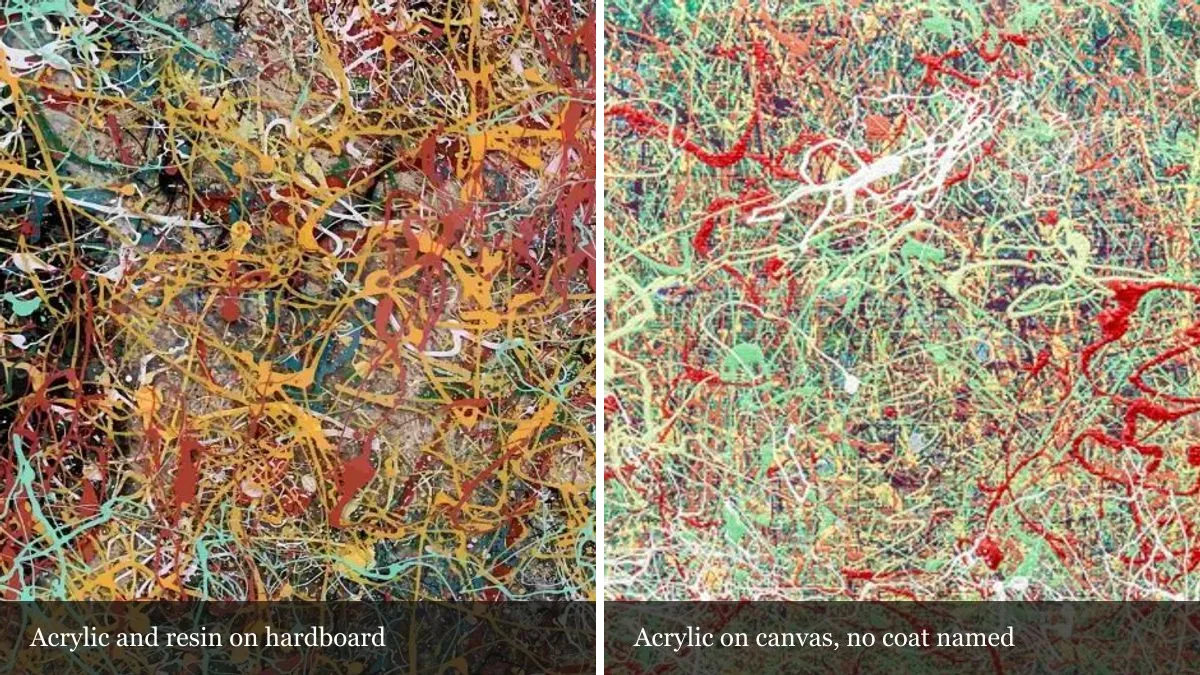
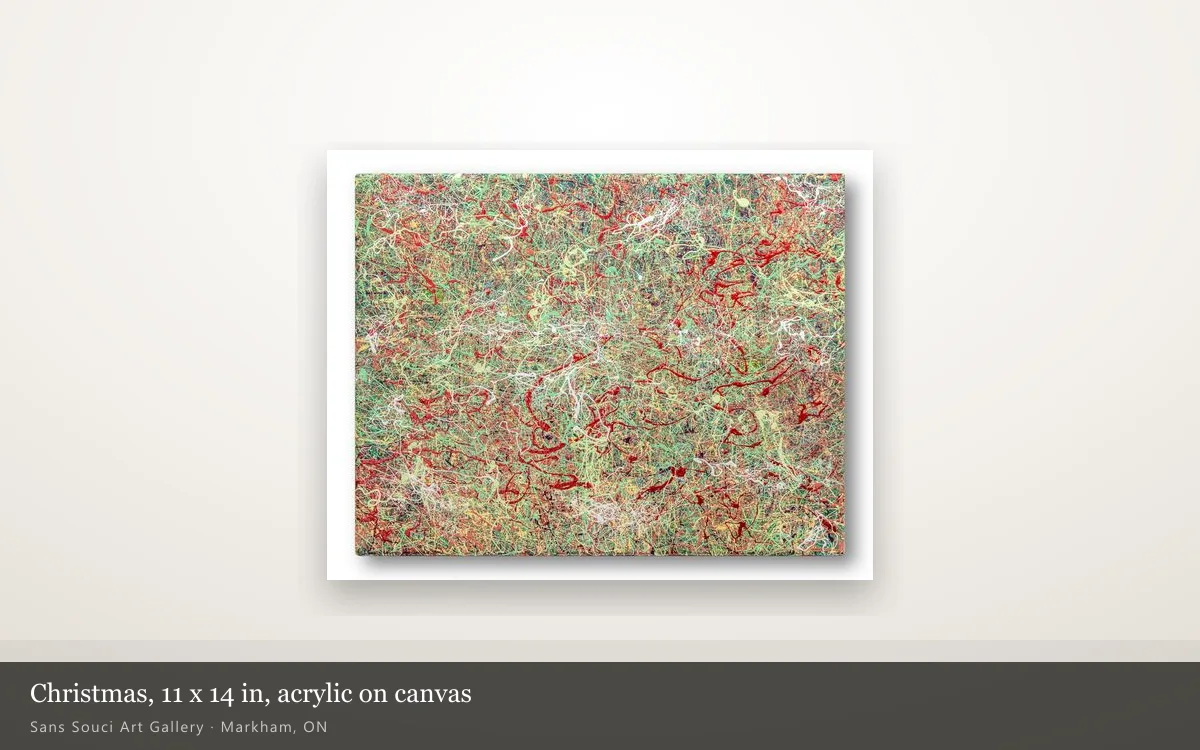
Two available originals make the difference easy to see. Christmas, acrylic on canvas, is 11 × 14 in with no clear coat named. Decorative Composition 1 is acrylic and resin on hardboard, 20 × 16 in, and its page gives a depth as well: 0.3 in for the whole object, front to back.
What does “support” mean on an artwork page?
The support is the surface the paint sits on, underneath every other material named. Tate’s glossary defines canvas as a woven cloth “traditionally used by artists as a support (surface on which to paint)”. On our pages the support is usually the last item in the materials line. Everything named before it is paint, texture or finish.
Supports here fall into two families. Flexible ones — canvas and paper — are cloth or sheet, and they can move. Rigid ones — wooden board, hardboard, fibreboard, plywood, panel — are solid and they do not. Several practical differences follow from which family a work belongs to, and those are the ones below.
What a canvas support changes
Canvas is woven cloth, so it has a little give and it is light for its size. The Canadian Conservation Institute places acrylic paintings on canvas in the low-sensitivity column of its table on humidity fluctuation, alongside the note “many paintings since 1960”. What canvas does not do easily is hold a thick poured coat flat.
Christmas is that plain case: acrylic, canvas, 11 × 14 in, nothing poured over the top. In a normal heated room it asks very little of you. The same CCI table carries a detail worth knowing in a Canadian January: “fluctuation to lower RH is much higher risk to paintings than fluctuation to higher RH”. A dry month with the heating running is harder on a painting than a humid one. The genuine danger for cloth sits at the other end — above 90% relative humidity, restrained woven textiles shrink — and that describes a basement, an unheated cottage or a bathroom wall, not a living room.
There is one thing our own pages do not tell you about any canvas here. Across all 61 catalogue pages the words stretcher, stretched, linen, cotton and primed appear zero times. The materials line says “canvas” and stops. So we cannot tell you from the page whether a particular canvas arrives on bars or as a mounted sheet — ask us and we will look at the piece itself. Only one canvas in the whole catalogue states a depth: Summer Languor, at 48 × 36 × 1.5 in.
What a board support changes
A rigid board holds a poured resin coat level while it cures, takes heavy texture without flexing, can be very thin front to back, and has two usable faces. It weighs more than stretched cloth of the same size, which matters for the fixing once a piece gets large, and its edge is a cut edge rather than a fold of fabric.
Decorative Composition 1 shows the first of those. Acrylic, resin and hardboard, with the page recording the whole object at 0.3 in thick. Our note on that page is that hardboard is dense and rigid, a stable base for heavy layers and a poured finish. Compare the depths the catalogue does publish: 0.3 in for this hardboard piece, 1.5 in for the canvas Summer Languor, and 1.9 in for Fall Waltz, which is fibreboard mounted on a stained and glazed wood panel. A thin board hangs almost flat against the plaster; a deep piece stands off it.
The second is easier to find in the catalogue than to describe. Exactly three works name “Two sides painted” in their materials line — White, Golden Night and Zwei Goldfische — and all three are 12 × 16 in wooden board. Two of them have sold; Zwei Goldfische is still available. A board has a front and a back that are both paintable. A canvas on a stretcher has one face, with a frame of bars behind it.
| Christmas | Decorative Composition 1 | |
|---|---|---|
| Support | Canvas — woven cloth | Hardboard — dense rigid sheet |
| Materials line | Acrylic on canvas | Acrylic, resin, hardboard |
| Size | 11 × 14 in | 20 W × 16 H × 0.3 D in |
| Clear coat | None named | Resin |
| Depth published | Not stated | 0.3 in |
| Face | Acrylic, no coat named | Poured resin, reflective |
| Status | Available | Available |
How the catalogue actually splits
Of the 61 works in the catalogue, 48 go on a wall; the other 13 are painted furniture and hand-painted objects. Of those 48, thirty-two name a rigid support, eleven name canvas, one is on paper and four name no support at all. We counted this week off the materials lines themselves, not from memory.
| Support named | Wall works | Of those, naming resin or epoxy |
|---|---|---|
| Rigid (wood, hardboard, fibreboard, plywood, panel) | 32 | 30 |
| Canvas | 11 | 3 |
| Paper | 1 | 1 |
| No support named on the page | 4 | 1 |
The finish follows the support closely, for a mechanical reason: a poured coat needs a level, non-flexing base to cure flat. The exceptions are real and worth knowing before you assume the rule. Improvisation is a canvas sealed with resin. Treasure Behind the Wall II is on wood with no poured coat named at all. What the catalogue records is the outcome; it does not record why any single piece was built the way it was, and we are not going to guess on the artist’s behalf.
Should the support decide which work you buy?
For most rooms, no — choose the work you want to look at. The support decides five practical things after that, and each has a plain answer:
- The fixing. A rigid board of a given size weighs more than stretched cloth of the same size, so a large board asks more of the wall and the hook than a large canvas does. See hanging art in a rental for the fixings that need no big anchor.
- Humidity. Canvas and board respond to moisture differently. What matters more than either is the wall you pick: avoid the damp one, and avoid the big swings.
- Travel. Everything here is packed individually and shipping is quoted per piece, so the support shows up in how a work is boxed and in that quote.
- Cleaning. A poured resin face is hard and scratches like any gloss surface; an uncoated acrylic face is softer and wants a gentler touch. Neither wants solvents. That is covered in how to look after an original.
- The edges. A board can be finished, or painted, on its sides and its back. A canvas edge is a fold, and whether it is painted round the side is a question to ask about the individual piece.
What our pages do not record
Four things, and each is simply missing from our own record. No page in the catalogue states a weight — the words lb and kg appear zero times across all 61. Only nine of the 61 publish a depth. Only one work, Fall Waltz, records what it is mounted on. And no page names hanging hardware.
So the useful questions to send us about a specific piece are short: what does it weigh, how thick is it, is the canvas on bars, and what is already fitted to the back for hanging. We measure the actual object and answer; nothing about that is difficult, it simply is not on the page yet.
Both works in this note are available, and both can be seen in person in Markham by appointment. If you are weighing a canvas against a board for a particular wall, tell us which wall and we will tell you what each one would need. The rest of the catalogue, supports and all, is in the Artworks collection.