
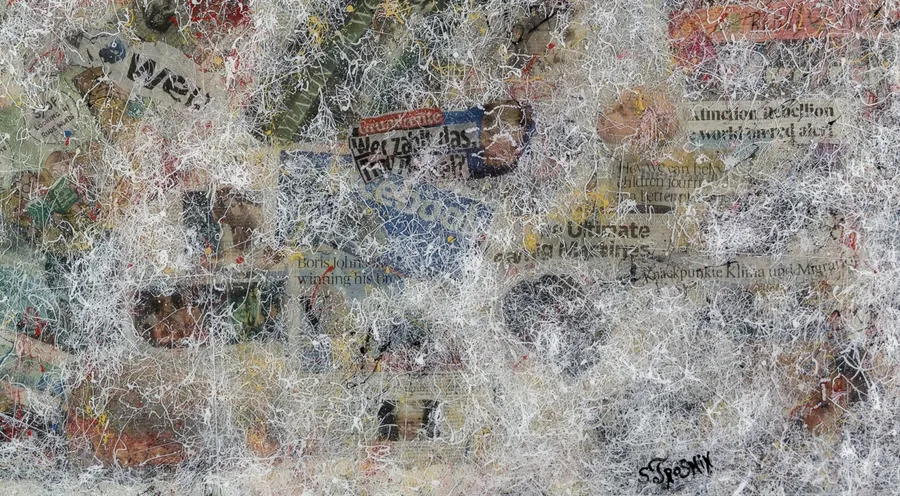
Large original paintings for an office, lobby or boardroom
The gallery in Markham holds eight originals by Sergei Troshin that are big enough to carry a commercial wall on their own, from 36 inches square up to the 80 inch piece above.
This page sets them out at true scale, then covers what an office does to a painting: the distance people stand at, the ceiling lights, the air and the door it has to get through.
Call +1 (416) 919-8331How big are these paintings next to a person?
Each rectangle below is drawn to the same scale as the figure, who is 175 cm tall. Every work is hung the way a gallery hangs them, with its centre 57 inches off the floor. On a wall, 48 inches is roughly the width of an office desk; 80 inches is taller than a door.
Swipe the drawing sideways to see all seven.
- 1Under Media Cobweb, 201960 × 80 in, mixed media and resin
- 2Morning Forest in Meißen, 202352 × 28 in, framed board
- 3Summer Languor, 202048 × 36 in, acrylic on canvas
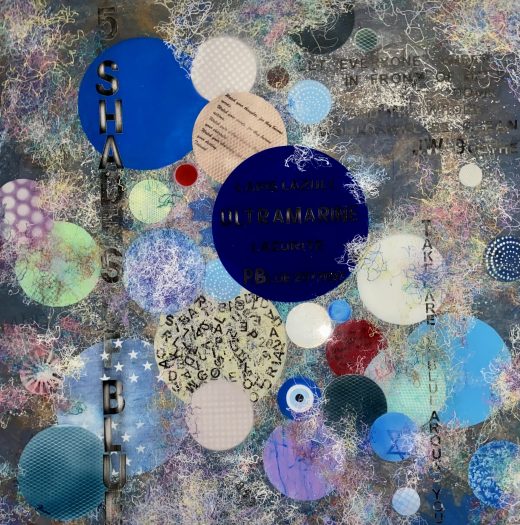
- 45 Shades of Blue, 20224 × 4 ft, collage on plywood, resin
- 5Traces of the Forgotten, 202530 × 48 in, mixed media, upright
- 6Whisper, 202532.7 × 42.9 in, mixed media on panel
- 7Fall Waltz, 201936 × 36 in, resin on fiberboard
Dream Ocean (2022, 32 by 34 inches) is the eighth and sits just under this group. All of them were listed as available when this page was written. The catalogue changes, so ask about a piece by name before you put it into a proposal. The whole list is on the artworks page.
What size suits a lobby, a boardroom or a corridor?
Size it from how far away people will be when they look, not from the width of the wall. The bar is the distance from the wall in metres.
Corridor, under 1.5 m
People pass at arm's length and never stop. One big piece is only ever seen at an angle here. Two or three works of 24 to 36 inches spaced along the wall get looked at; a single 48 inch piece gets walked past.
Boardroom, 3 to 4 m
People sit and look at the same wall for an hour. Between 30 and 48 inches holds attention without taking over the room. Whisper or Fall Waltz are this size. If the wall is behind the screen for video calls, keep the piece off to one side of the camera.
Reception, 6 to 8 m
The first look happens from across the room while walking in. Under 40 inches on the long side, a painting reads as a framed notice. Above about 48 inches it becomes what the room is arranged around. Pieces 1 to 4 in the line-up are for this wall. Our note on choosing the scale for a wall shows how to test a size with paper first.
Which of them will reflect the ceiling lights?
Offices are lit from above with rows of even downlights, and a lobby often faces a glass wall. A poured resin coat cures into a hard, glossy film that deepens the colour under it and also catches whatever is opposite. Matte surfaces do not. That one fact can decide which piece goes on which wall.
Under resin: glossy
Hang these where the reflection they pick up is a plain wall, not a window or a row of lights. One aimed light from the side brings the depth up.
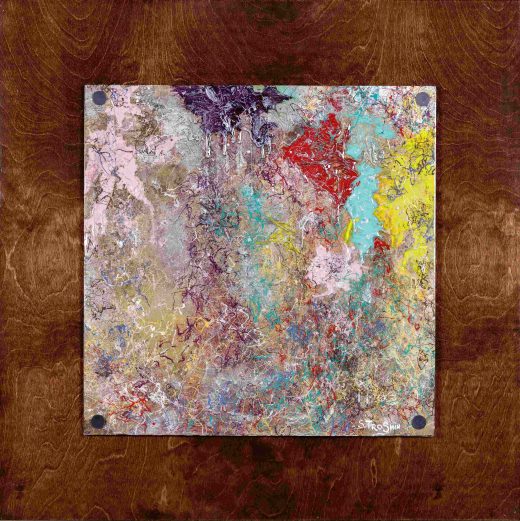
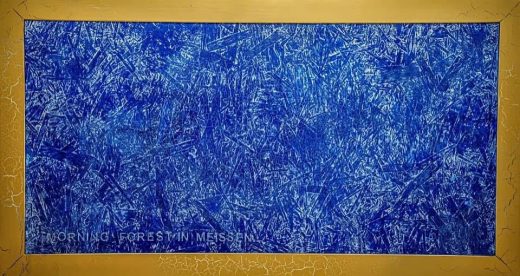
No resin listed: matte
The catalogue lists no resin coat on these three, so they suit the wall facing the glass or the brightest part of the room.
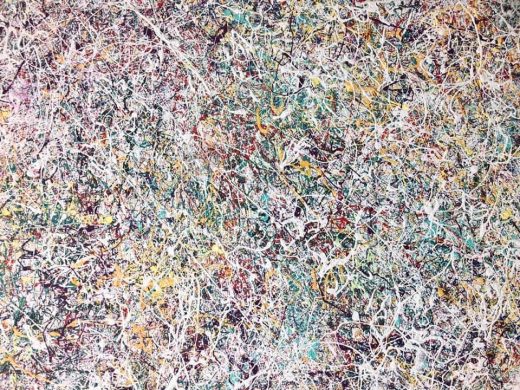
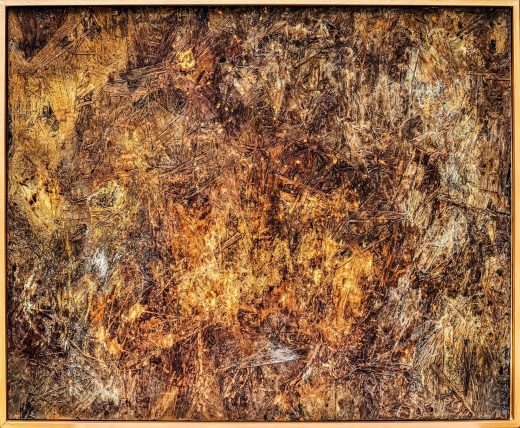
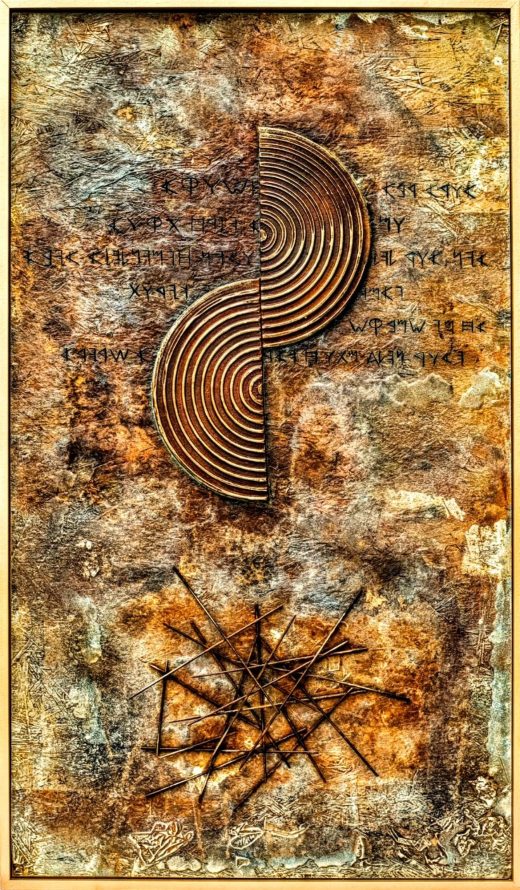
The colour of the lamps matters too: rust and gold read warm under one light and grey under another. A resin finish in a room and the same painting in different light go into both.
What should facilities check before a large painting arrives?
Most damage to art in offices happens at delivery or because of where it was hung, and all of it is decided before the piece leaves the gallery. Send this list to whoever runs the building.
Clear wall height
Measure from the ceiling grid down to the top of whatever sits below: a credenza, a bench, the wall base. That is the space the piece and its margins have to fit.
The way in
Measure the doors, the corridor turns and the lift car, and check the diagonal of each, not only the width. An 80 inch work needs openings a smaller building may not have.
What the wall is made of
A panel under poured resin is far heavier than a canvas of the same size. Plain drywall and one hook will not hold it. It wants two fixings into studs, blocking or concrete, so it hangs level and stays level. Read how to hang a heavy painting.
Vents
Not directly over or beside a supply vent. A wall that gets a blast of dry heated air every winter morning is worked much harder than the rest of the room.
Sun
Watch where the sun falls through a south or west glass wall over a full day. Light damage adds up, it does not reset overnight.
Cleaning
Tell the cleaning contractor in writing that the painting is not to be sprayed or wiped. Glass cleaner on a glossy resin face is exactly what a helpful cleaner will try.
Acrylic on canvas has low sensitivity to humidity in the Canadian Conservation Institute's table on incorrect relative humidity, and office air runs to a schedule, so a building is usually a calmer home than a house. In winter, a piece carried in from a cold vehicle should warm up still wrapped, so moisture forms on the wrapping and not on the paint. More in winter air and the wall.
How do you get a painting approved when the site shows no prices?
- Artist
- Sergei Troshin
- Year
- 2020
- Medium
- Acrylic on canvas
- Size
- 48 × 36 in (121.9 × 91.4 cm)
- Status
- Available, price on request
- Papers
- Certificate of Authenticity signed by the artist
Ask for the price of the piece you have in mind, by name. Every work here is one of a kind, so there is no list price; you get the figure for that painting. There is no online checkout either. Each piece starts with a call or a message.
For a purchase request, ask for the particulars in writing. You get what a finance or facilities process usually wants, laid out like the card on the left: title, year, medium, exact size and status. Each work leaves with a Certificate of Authenticity signed by the artist. That is also the document an insurer or valuer will ask for later. What a certificate of authenticity says explains it.
If the painting is going onto an asset register or an insurance schedule, add it when you buy it. Insuring an original you own covers how originals are described for that.
What if nothing in the gallery fits the wall?

Some walls have a shape nothing finished matches: a long run over a reception counter, a narrow pier between two windows, a double-height atrium. Then a commission makes sense. Sergei Troshin accepts commissions for a set size and palette.
The layers of acrylic, resin and wax paste each have to cure hard before the next goes on and before the work can travel. That is why the time is agreed at the start of each commission and why the conversation should begin before the fit-out dates are fixed. The steps are on the commission a painting page.
One thing to settle early either way: whether the painting belongs to the company or to a person. It changes who insures it and whether it stays on the wall when the lease ends.
Questions offices ask
What size painting suits a reception or lobby wall?
Size it from viewing distance. Seen from six to eight metres, a painting under about 40 inches on its long side looks like a notice. Above about 48 inches it becomes the focus of the room. In this gallery that means Under Media Cobweb, Morning Forest in Meißen, Summer Languor or 5 Shades of Blue.
Will a resin-coated painting show glare under office lights?
It can. A poured resin coat is glossy and picks up a window or a row of downlights opposite it. Hang it where it reflects a plain wall, or choose a work with no resin listed, such as Summer Languor, Whisper or Traces of the Forgotten.
Is the air in an office building bad for an original painting?
Usually less than people think: acrylic on canvas has low sensitivity to humidity, and office heating runs to a schedule. The real risks are where it hangs: over a supply vent, in direct sun from a glass wall, or within reach of a cleaning crew nobody has told.
Can I see the large paintings before buying one for the office?
Yes. They hang at 473 Simonston Blvd, Markham, ON. Viewings are by appointment, daily 9:00 to 18:00, so call +1 (416) 919-8331 and someone will be there to let you in.
Can a painting be commissioned for a specific wall?
Yes, Sergei Troshin accepts commissions for a set size and palette. The time is agreed at the start, because each layer of acrylic, resin and wax paste must cure hard before the work can be handled.
Why are there no prices on the website?
Each work is one of a kind, so the price belongs to that painting. Prices are on request across the whole site and there is no online checkout. Name the piece and ask; asking commits you to nothing.
More about the artist is on the about page, and any question can be sent through the contact page.
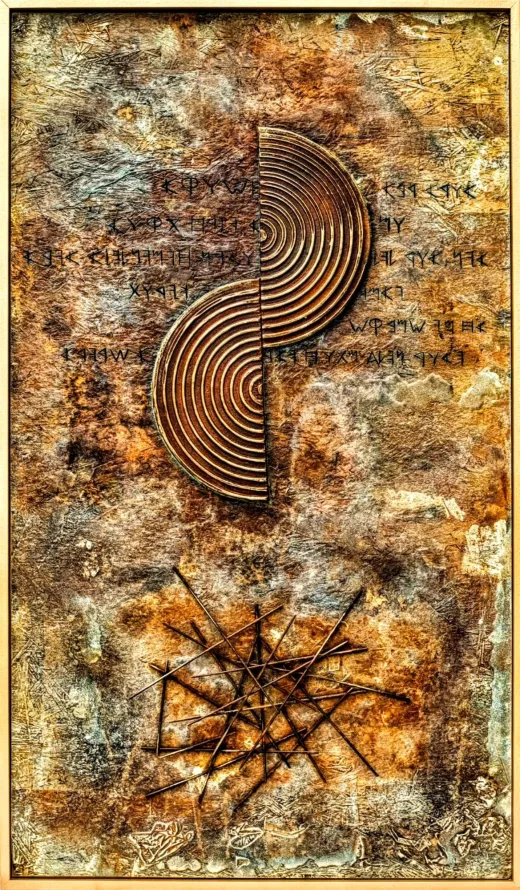
Six of the large works, with their catalogue pages



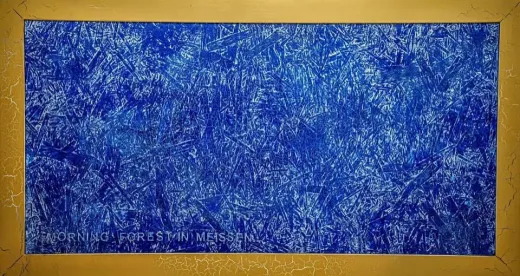

Bring the wall measurements and come and look
Tell us the size of the wall, how far away people will stand and what the lights do, and we will say which of these pieces would work there and which have already gone. Prices are on request for each work. Call +1 (416) 919-8331, send a question through the contact page, or book a time to stand in front of the large works in Markham.