
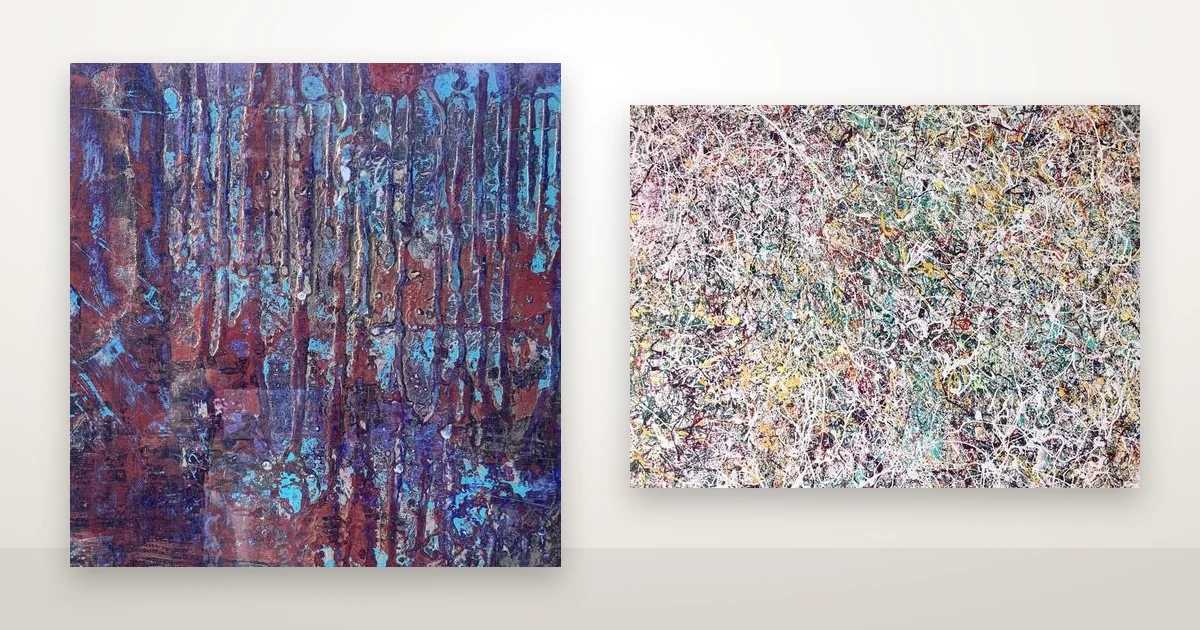
Some time in October the furnace comes on in most houses around us, and the air in every room quietly changes. Nothing on the wall looks any different that week. But dry winter air is one condition every original in this country lives through each year, and the wall you chose in July is the wall it will spend the winter on. Here is what actually changes, which pieces notice it, and which walls make it worse.
Does dry winter air actually harm a painting?
Not by itself, and not as fast as people fear. Cold outdoor air brought inside and heated ends up much drier than it was, which is why indoor humidity falls through a Canadian winter — the Canadian Conservation Institute describes exactly that mechanism, and notes that a swing towards drier air carries more risk for paintings than a swing towards damper air. What decides whether it matters to your piece is not the season. It is how the piece is built, and where it hangs.
The surprising part: the canvas is the easy case
Most people assume a stretched canvas is the fragile thing and a solid board is the safe one. The CCI table on incorrect relative humidity puts it close to the other way round. Sorting paintings by how they respond to humidity swinging up and down, it places acrylic paintings on canvas in the lowest-sensitivity column — the class it illustrates with "many paintings since 1960". Rigid oil paint on canvas sits a column further along. Paint on wide spans of wood and on other rigid supports sits further along still, and the table names one case in particular: heavy modern paintings on the smooth face of fibre-board, where the paint layer can lift if adhesion was weak to begin with.
That reads directly onto this catalogue. We measured all 61 pages again this week:
- 48 works go on a wall — the other 13 are painted furniture and objects.
- 11 name canvas, and 10 of those 11 name acrylic: the low-sensitivity row.
- 32 name a rigid support — 14 of them fibreboard or hardboard, 18 wood, plywood, board or panel.
- 30 of those 32 rigid works name a resin or epoxy coat, against 3 of the 11 canvases. Rigid and sealed go together here.
- One is on paper, and four name no support at all.
That is close to three rigid pieces for every canvas — and the rigid ones are the ones whose surroundings are worth thinking about. Two works in the gallery make the contrast concrete.
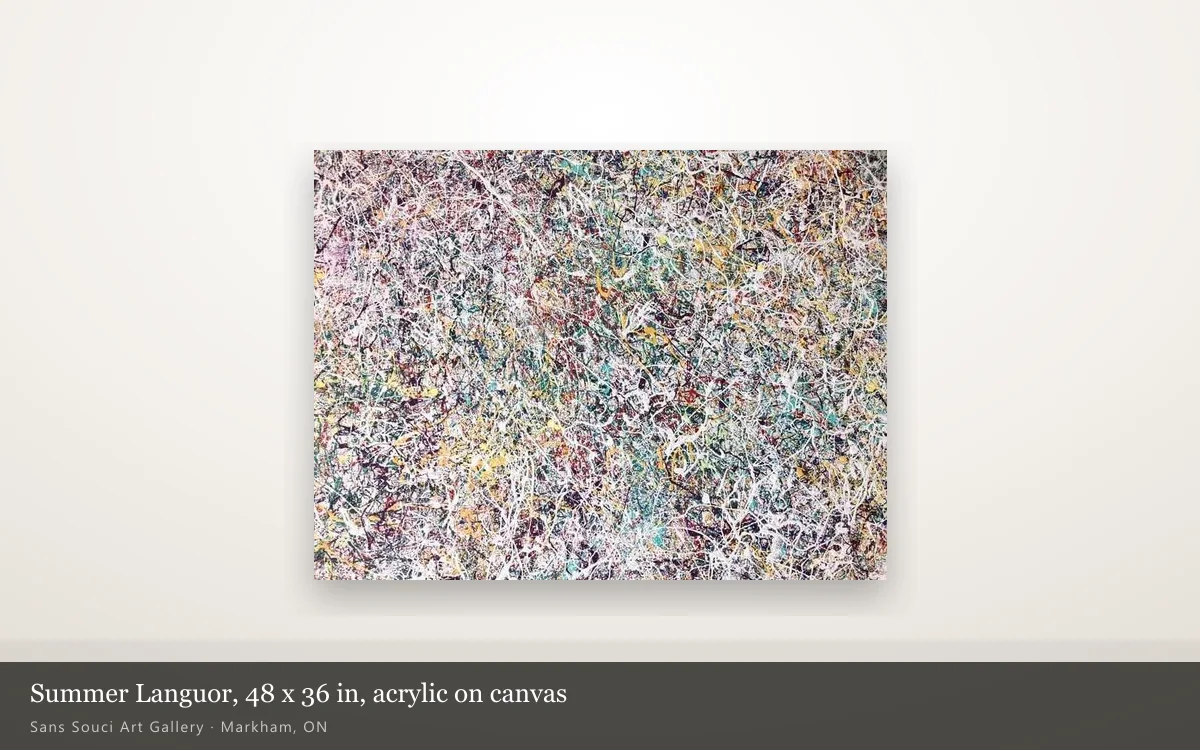
| Summer Languor | Over The Horizon | |
|---|---|---|
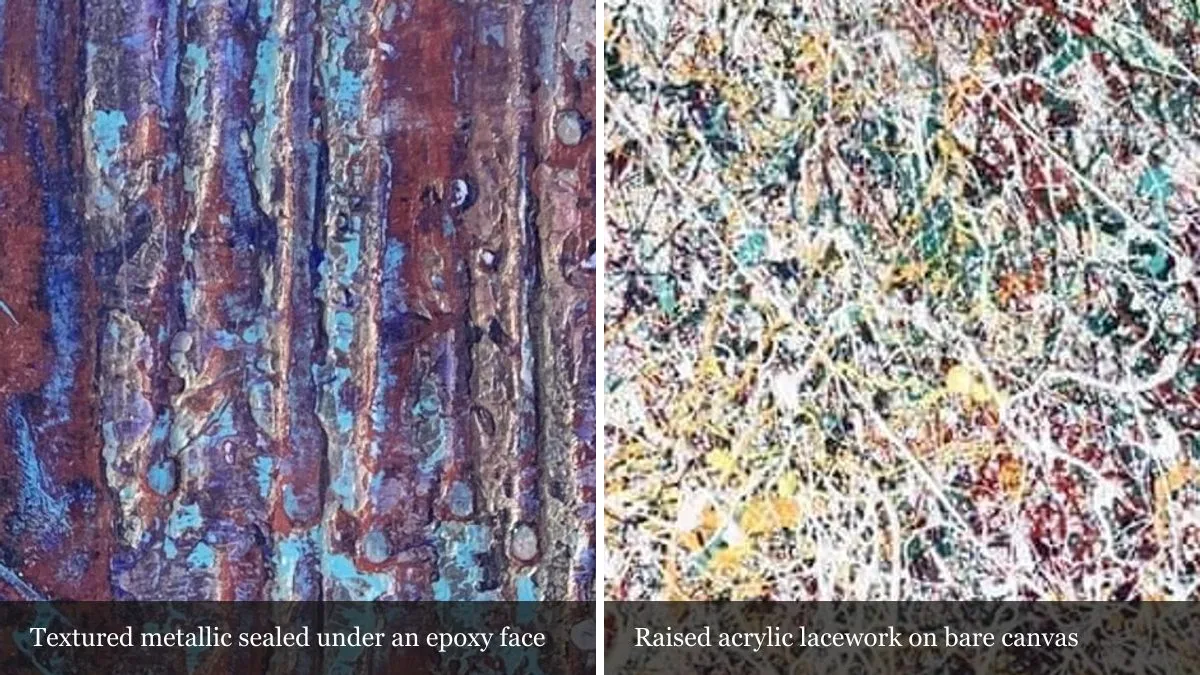
| Materials, as the page states them | Acrylic on canvas | Fibreboard, acrylic, texture, metallic, sealed with epoxy |
| Size | 48 × 36 × 1.5 in | 24 × 24 in |
| Support | Fabric under tension | Rigid sheet |
| Face | Open, uncoated acrylic | Hard poured epoxy film |
| Where CCI's table puts this construction | Lowest sensitivity to humidity swings | Further along the same table — rigid supports |
| What its wall should not be | An uninsulated exterior wall with no air gap behind it | Anything that heats or cools it on a daily cycle |
Summer Languor is the piece whose method the artist describes himself: "I didn't paint it: I was making a piece of paint lace, spinning it, weaving it." Look at the right-hand detail above and that is literally what you see — trailed acrylic threads standing off the cloth, with nothing poured over them. It is also one of only nine works in the catalogue whose page publishes a depth at all — 1.5 inches — though the page does not say what the canvas is mounted on, and we would rather you asked than assumed.
Which spots in a house are actually hard on a painting
Short answer: anywhere the piece is heated, cooled, blown on or touched. The CCI's storage and display guidance for paintings is unusually blunt about location, and every item on its list is a wall someone in a Canadian home is tempted by:
- Above a radiator, a heat vent or a fireplace. The note advises against drafty spots and against walls beside radiators, heat vents or fireplaces. The space above a fireplace is the wall most people picture first, and it is also the one that gets warmed every evening from November to March.
- The inside face of an exterior wall. That surface runs colder than the room in winter, and a cold surface is where moisture collects. If it is the only wall you have, the fix is a backing board and spacers so air can move behind the piece rather than sitting against it.
- Kitchens, and any room cooking fumes reach. The same note rules those out. A greasy film is not dust, and it does not come off with a soft brush.
- Anywhere the work can be touched by something else. Curtains, a door swing, the back of a chair, a blind cord. A raised surface like the one on the left above is exactly the kind that catches.
- Bathrooms, and unheated garages or cottages. A bathroom is damp on a schedule — and damp, in conservation terms, starts at 75% relative humidity. An unheated space simply follows the outdoor temperature all winter.
The rest of the wall question — height, light angle, how far from a window — we wrote about separately in where to hang a textured piece, and the support side of it in canvas, wood or board.
One daily swing is worse than a whole dry season
Damage from humidity is a fatigue process: it accumulates by cycle, not by how far the number drifts once. The CCI illustrates it with a century-old painting in Ottawa that went through roughly 30,000 daily cycles and about 100 seasonal ones, and shows heavy cracking everywhere except the bands sitting over the stretcher bars — the wood there buffered the daily swing for about thirty hours, enough to flatten out the day but not the year.
For a home that means the slow drift from a humid August to a dry February is the smaller problem. The bigger one is a spot that swings every single day: the wall a heat vent blows across each morning, the alcove beside a fireplace lit each evening, the hallway by a door that opens onto winter. If you have a humidifier, running it steadily is better than running it hard when you remember. The museum target is around 50% relative humidity at somewhere between 15 and 25 °C, and a home that stays reasonably near that, without lurching, is doing the work.
What the page cannot tell you, and what to ask us
Three honest limits. First, the conservation table sorts classes of construction; it is not a condition report on any individual work, and nobody should read "lowest sensitivity" as "indestructible" or a rigid support as "at risk". Second, the fibre-board case it names depends on weak adhesion and on the smooth face of the board — no page in this catalogue states which face of a board was worked on, and most of these works carry a poured resin coat that the table's example does not assume. That is a question to put to us about a specific piece, not something to infer. Third, as we have said before, no page here publishes a weight or names hanging hardware, and both matter once you know which wall you want.
So ask. If you tell us the room — which wall, what is under it, whether a vent or a radiator is anywhere near, whether it is an outside wall — we can tell you whether the piece you are looking at is a comfortable fit for it, and whether it wants spacers behind it. That is a five-minute answer before you buy, rather than a painting moved twice after. You can write to us with a photograph of the wall, or come and see the work in Markham first; more of the catalogue is in the artworks listing, and the general care routine is in how to look after an original.