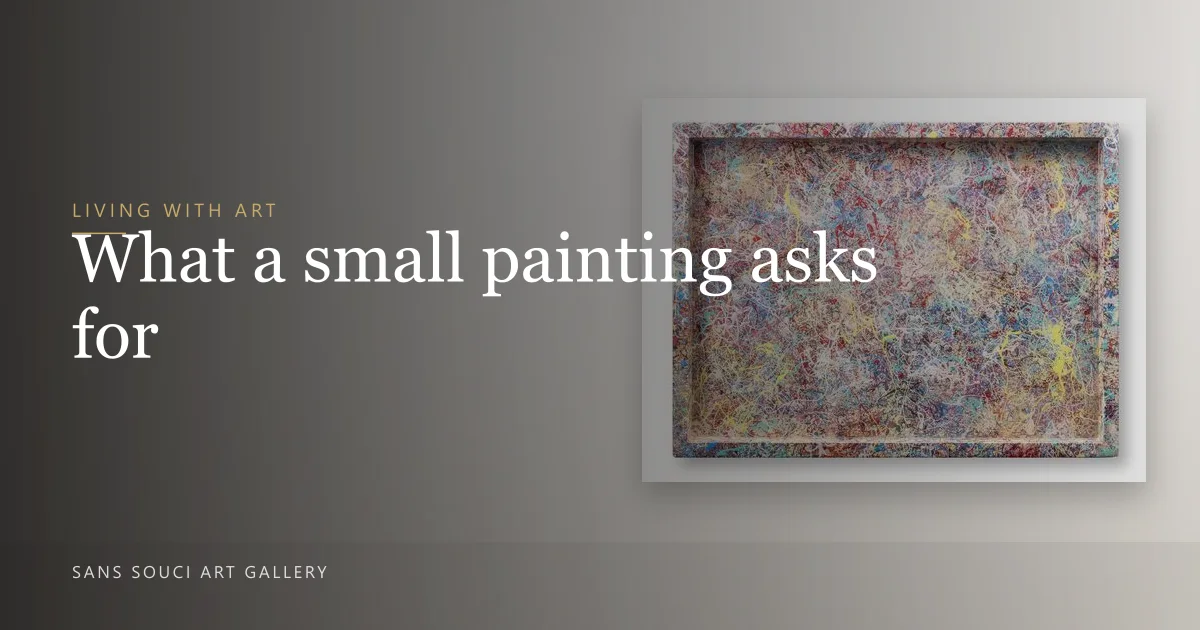
Most people who fall for a painting do it somewhere other than the wall it will eventually hang on — a gallery, a photograph, a friend’s living room. The piece that looked exactly right in that space can look wrong within a week of getting it home, and it is almost always the same reason: the wall was remembered, not measured. Choosing the right scale for a wall is the one decision a photograph cannot make for you, because nothing in most photos tells you how big anything actually is.
A phone photo of a painting rarely has a reference object in the frame — no door frame, no chair, no hand — so two works of very different size can occupy the same rectangle on a screen and look identical. The gallery room itself distorts the comparison too: a piece hung among several others, or in a room with high ceilings, reads smaller than the same piece would on a single wall at home. None of this is a trick; it is simply how the eye judges size relative to whatever else is nearby, and it is exactly why a number in inches is worth more than a glance.
How much wall does a piece actually need?
A painting needs roughly its own width of clear space on either side to read as a piece rather than clutter, plus a wall whose exact width and height you have measured with a tape — not recalled from a visit weeks ago. Furniture underneath should be at least as wide as the piece, ideally wider.
The trouble is that “large” and “medium” mean different things to different people, and a piece that reads as generously sized on a gallery wall next to five other paintings can look small alone above a sofa at home, or the reverse. That is why every artwork page on this site lists exact measurements in inches and centimetres rather than a size category — a number is the only description that travels reliably from the gallery to your own room. It also means two very different questions get the same answer when someone asks “is it big?” — big compared to what was hanging there before, or big compared to the wall itself. The tape measure answers only the second question, and that is the one that actually matters once the piece is up.

Two real pieces, two different footprints
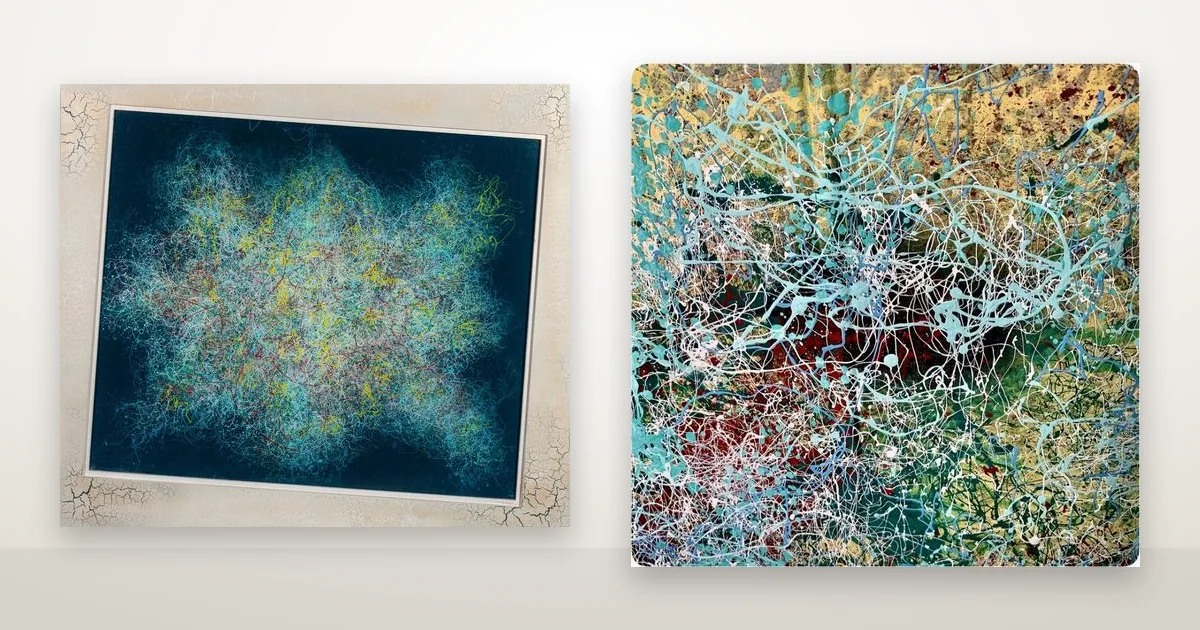
The Power of the Abstract (2022) and Dream Ocean (2022) were painted the same year, in the same resin-sealed acrylic, and they behave completely differently on a wall because of one number: size.
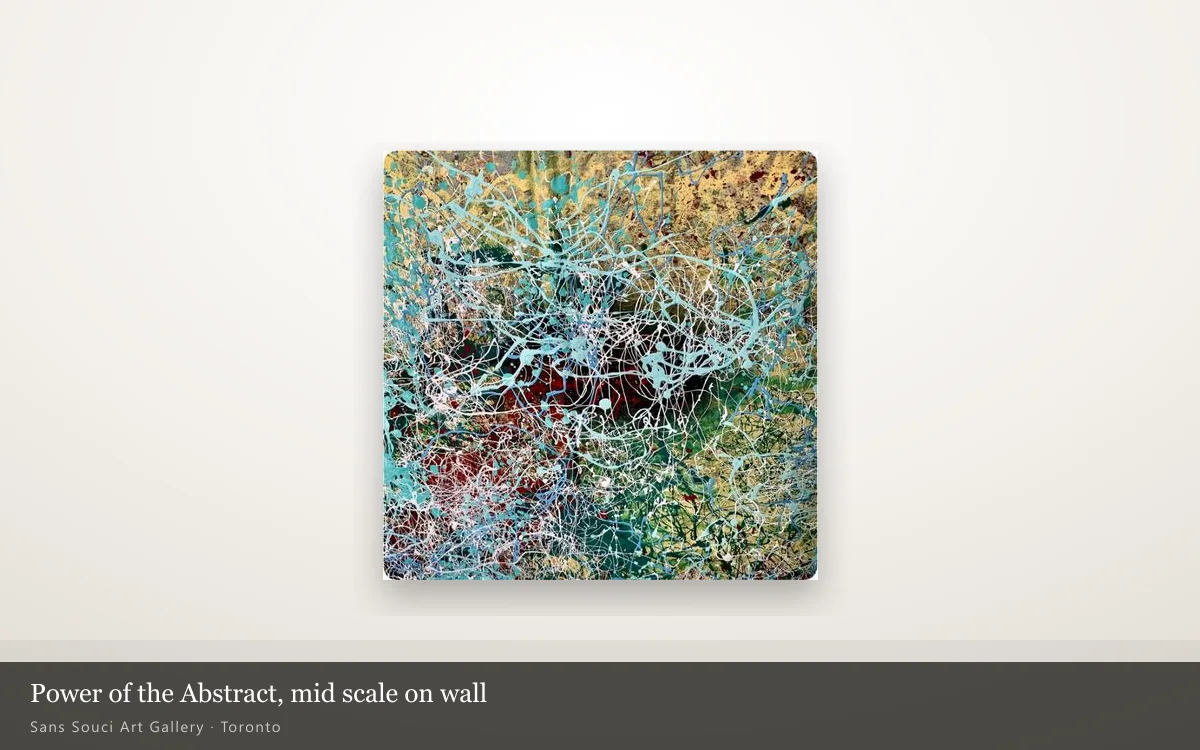
The Power of the Abstract is built on paper and measures 15.7 × 23.6 in (40 × 60 cm). It reads as an upright, mid-scale piece — enough presence to hold a section of wall on its own above a console, a desk or a bedside, without needing much clearance around it. Paper is the lightest of the supports used in this collection, and part of why a piece this size stays proportionate in a smaller room is that it asks for a modest footprint while still giving back a fairly concentrated field of colour.
Dream Ocean is built on hardboard and measures 32 × 34 in (81.3 × 86.4 cm), close to square. This is a large piece by the gallery’s own standard: it can carry a sofa wall or a dining wall by itself, and it wants roughly its own width of clear space on each side so it does not crowd whatever else is nearby. Put the two side by side and the difference is not subtle — Dream Ocean covers roughly four times the area of The Power of the Abstract, on the same kind of wall, in the same finish. Nothing in a photograph of either piece communicates that ratio; only the two numbers do.
| The Power of the Abstract (2022) | Dream Ocean (2022) | |
|---|---|---|
| Size | 15.7 × 23.6 in (40 × 60 cm) | 32 × 34 in (81.3 × 86.4 cm) |
| Support | Paper, sealed with resin | Hardboard, sealed with resin |
| Best wall | Above a console, desk or bedside | A sofa wall or dining wall, on its own |
| Clearance needed | A modest section of wall | Roughly its own width clear on each side |
What actually goes wrong when you skip the tape measure
The common mistakes are rarely about taste — they are about numbers nobody checked: a wall remembered as bigger than it is, furniture narrower than the piece meant to hang above it, or a delivery path too tight for what was ordered. Every one of these is avoidable with five minutes and a tape measure before you commit to a piece.
- Measure the wall itself — width, height, and anything already on it, like switch plates, vents or a thermostat
- Measure the furniture underneath it — a piece wider than the console or sofa below it looks stranded
- Check the delivery path, not just the final wall — doorways, stairwells and elevators for anything near three feet across
- Ask for the exact size in inches, not a description like small, medium or large
- Note the room’s light before you decide where it goes — direct sun changes the right spot for a resin-finished piece regardless of its size, as we cover in Where to Hang a Textured Piece
A tape measure and a roll of painter’s tape solve most of this before a piece ever leaves the gallery. Taping the outline of the frame directly onto the wall, at the exact dimensions on the artwork page, is a five-minute check that catches a mismatch no photo ever will — you can stand back, live with it for a day, and see whether the space genuinely reads the way you pictured it.
Living with the size you chose
Scale is also a maintenance decision, not only a visual one: a large, close-to-square piece like Dream Ocean gets handled less often once it is up, so hanging hardware and wall anchors matter more than they do for a piece you might reposition later. The American Institute for Conservation’s guidance on caring for art at home is worth reading before you hang anything you plan to keep for years, whatever its size.
A tape measure settles more of this than any photograph can. If you already have a wall in mind, bring its measurements to a viewing by appointment in Markham, and we can hold up real comparisons in person, including these two pieces, from the full Artworks collection if either is still available. For the broader question of what should decide a first purchase beyond size, see How to Choose Your First Artwork. To ask about a piece or arrange a viewing, get in touch.