The packing comes off, the work is leaning against the sofa, and the question turns practical: what holds it up. It is easy to go to the hardware store with the width and height in your head and come back with the wrong hook. To hang a heavy painting safely you need the one number a picture almost never comes with — what it weighs — and that is decided by how the piece is built, not by how big it looks. Here is how to read the construction off a work before you drill anything, and what to ask us first.
What actually decides the hardware
The load is set by the support, not by the picture on it. A stretched canvas is fabric and air over four bars: even a large one is light in the hand. A solid panel with a poured resin face is a solid object, and every square inch of it is mass. Two works the same size on the wall can be a different job entirely, and the materials line on each artwork page is where you find out which one you are dealing with.
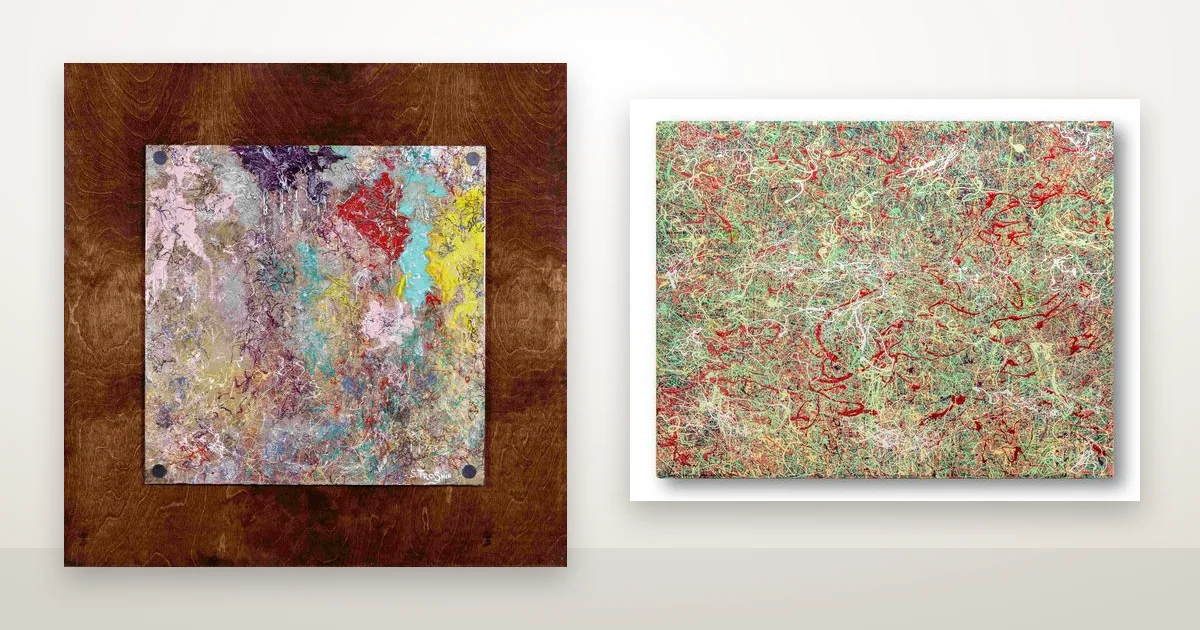
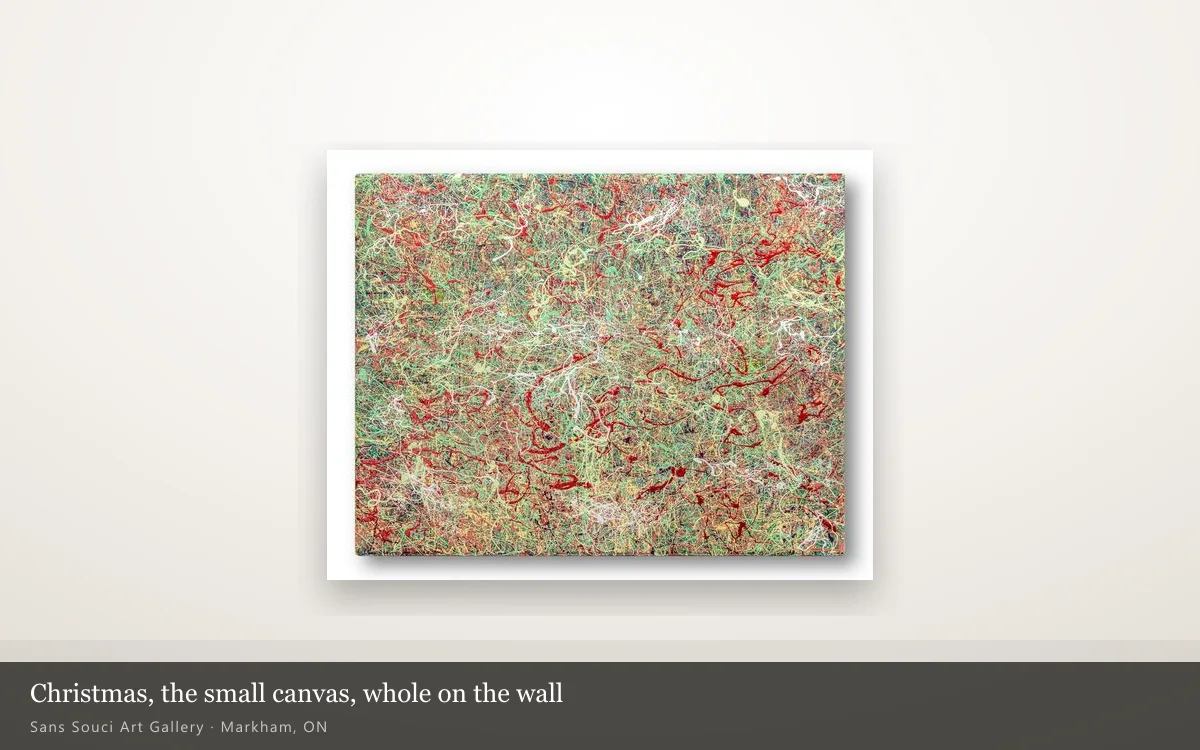
Take two pieces from this catalogue. Fall Waltz is listed as acrylic and resin on fibreboard, mounted on a stained and glazed wood panel, 36 W × 36 H × 1.9 D in — three feet square, two rigid layers, and a cured resin coat over the whole face. Christmas is acrylic on canvas at 11 × 14 in. Nobody needs advice for the second one. The first is the case worth planning — and its catalogue photograph shows why: the painted board sits on a larger stained panel, a dark stud at each of its four corners, so what goes on the wall is two rigid layers travelling together.

We counted the whole catalogue again this week. Of the 48 works that go on a wall — the other 13 are painted furniture and objects — 32 name a rigid support (18 wood, plywood, board or panel; 14 fibreboard or hardboard) and 11 name canvas. Twelve works have a side of 36 inches or more, and nine of those twelve are rigid. The median wall piece here is about 371 square inches, roughly 18 by 20. So the everyday case is modest, and the heavy case is specific and easy to identify: large, rigid, resin-faced.
What these pages tell you, and the three things they do not
Every artwork page states the materials and, for 47 of the 48 wall works, a size. That is enough to tell canvas from board. It is not enough to choose a fixing, and we would rather say so plainly than let anyone guess. Across all 61 pages: not one publishes a weight, not one names hanging hardware of any kind — no D-rings, no wire, no cleat, no "ready to hang" — and only nine publish a depth. Fall Waltz is one of the nine, which is why its 1.9 inches appears above and most works have no third number at all.
| Fall Waltz | Christmas | |
|---|---|---|
| Materials as listed | Acrylic, resin on fibreboard, mounted on a stained and glazed wood panel | Acrylic on canvas |
| Stated size | 36 W × 36 H × 1.9 D in | 11 × 14 in |
| What carries the load | Board plus a wood panel behind it, plus a cured resin coat | Fabric over stretcher bars |
| Face | Cured resin — hard, reflective, unforgiving of a knock | Open acrylic surface, no coating stated |
| Realistic fixing | Into studs, or a cleat spanning the width | One rated hook in a wall plug at this size |
| What to ask before you buy hardware | Weight, and what is fitted to the back | Weight, and whether anything is fitted at all |
Those last two rows are the honest gap. The page records what the work is made of; it does not record what is on the reverse. Ask us that about a specific piece — it takes one email, and it is the difference between buying one hook and buying a cleat. It belongs with the other questions in what to ask a gallery before you buy.
The wall decides more than the hook does
A fixing is only as good as what it is anchored into. The Canadian Conservation Institute's guidelines for storing and displaying paintings set out the wall types and what each one needs:
- Drywall or hollow block. Drill and insert wall plugs or expandable anchors. A nail driven into hollow drywall is holding nothing but paper and gypsum.
- Brick, plaster, stone or poured concrete. Also a drilled hole lined with a plug, into which a threaded hook is secured.
- A plywood wall. Hooks with nails or screw-threaded ends will hold without plugs, because the wall itself is solid all the way across.
- Anything heavy, on any wall. CCI is explicit: the hangers "should be fitted directly to hardware secured to studs in the wall". For very heavy work it recommends metal cleat hangers or a traditional French cleat, which supports the weight "across its whole width" rather than at two small points, with a spacer strip at the bottom edge so the piece sits parallel to the wall.
A cleat is also the kindest answer for a large rigid piece with a resin face, because it holds the work flat and takes the pull off any single screw. If you rent, the no-drill options and what they can and cannot carry are in hanging art in a rental.
Two points, not one — and be careful with wire
Use two fixing points wherever the piece is wide enough to allow it. CCI puts the reason simply: attaching at two points on the wall makes levelling easier and "will prevent the painting from falling if one of the hangers comes loose". Screw eyes, D-rings and wire are each rated for a maximum load, and exceeding that rating is how a ring bends open.
Two details from the same source are worth repeating because they are counter-intuitive. First, picture wire is not the best choice for a heavy work: it frays and rusts where it crosses the hanger, and it lets a picture drift off level. Fittings hooked directly onto hardware at two points on the wall remove that failure mode altogether. Second — do not double up wire to raise the limit. One strand invariably ends up stretched tighter than the other, carries the full load, and breaks — and then the next one does.
The five minutes around the lift
The wall is only half of the job. CCI's note on basic handling of paintings asks for a minimum of two people for anything easel-sized, one hand at a bottom corner and one towards the top on the side, and it is blunt about the rest: never carry a painting by its hanging wire, by the top edge, or by one side alone.
Two things apply particularly here. Clear the landing spot before you lift — a padded surface, nothing sharp on it, and no tape or wire lying where a corner will come down. And treat the edges as part of the work: CCI notes that painted edges in modern and contemporary work "are considered to be an integral part of the work" and should not be touched. That is literal in this catalogue. Exactly one of the 61 works is described as framed, so on everything else there is no frame between your hands and the work itself — and three pieces are painted on two sides, which makes the edges surface rather than a handle. Carry an unframed panel with the flat of your palms against its edges, as if it were freshly varnished on both faces.
Before you commit to the wall
One last thing that has nothing to do with hardware. An outside wall runs cold in a Canadian winter, and a work hung tight against one can meet condensation. Spacers that hold the piece a little off the wall let air move behind it. That, and the vents and radiators worth avoiding, are covered in winter air and the wall you chose; the light and height side of the same decision is in where to hang a textured piece.
If you are looking at a particular work, tell us which one and describe the wall — plaster or drywall, where the studs run, whether it is an outside wall — and we will answer with what we know about that piece before you spend anything at the hardware store. You are welcome to see the piece in Markham first; more of the catalogue is in the artworks listing.