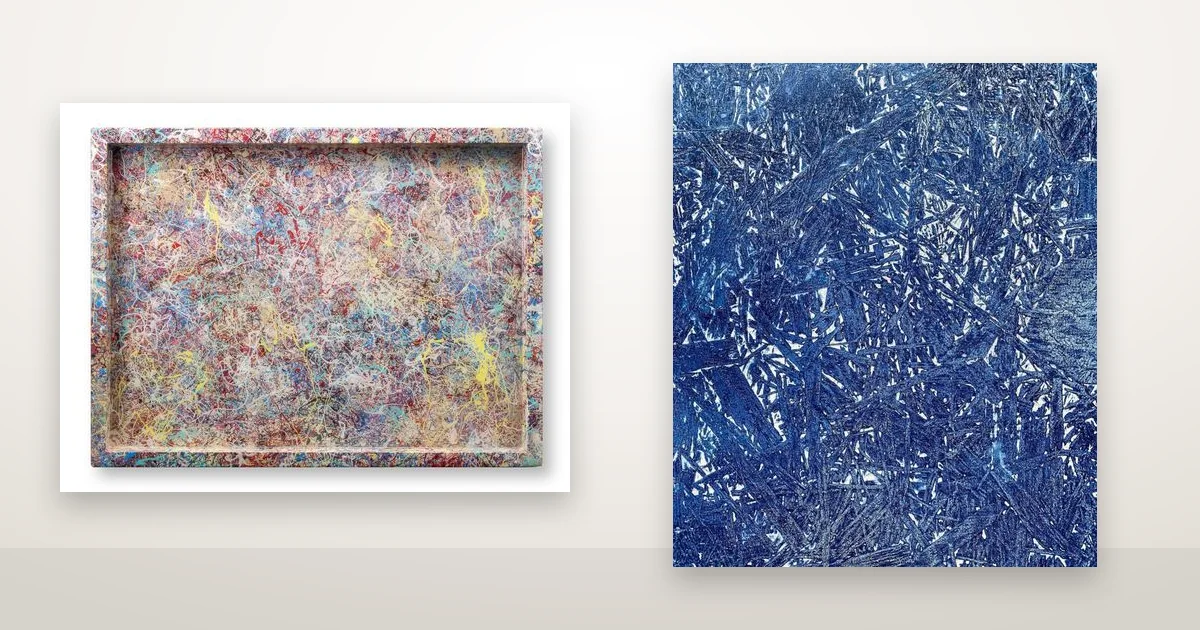
Two things get said in front of an abstract painting more than anything else: I do not know what I am looking at, and how long can that have taken? Both are fair questions. Both also rest on assumptions about abstract art that the work itself usually contradicts. So this is a note about what abstract is not, written against two originals in our catalogue — one built from thousands of hand-drawn lines, one built from a town in Saxony and the colour of its porcelain.
Is abstract art just random?
No. In an abstract work the order sits in the process rather than in a recognisable image, which is why it is invisible from across the room and obvious up close. Transience is 12 × 16 in of acrylic on a wooden board, and the artist measures it in days rather than hours: “As many lines, as many days of work.”
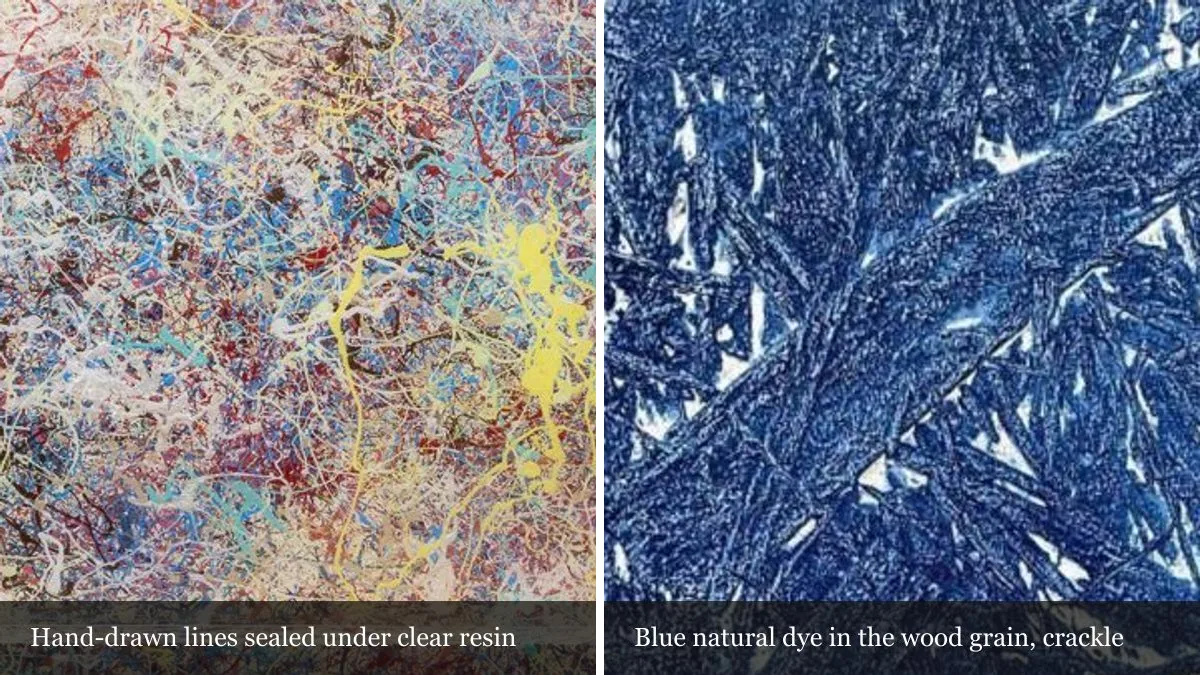
The mechanism behind that sentence explains the surface. Lines are drawn, sealed under a poured coat of clear epoxy, then drawn over again. In the artist’s own words on the piece: “Every layer of my abstract lines is sealed with a coat of crystal clear epoxy. Sometimes they are up to ten floating layers there.” The depth you see is literal depth. You are looking through cured resin at marks that were laid down days apart. Tate’s glossary entry on resin describes the material itself.
A random surface cannot be built that way. Every pass has to be decided while the one underneath it is locked under hard resin and can no longer be touched.
Does abstract mean there is no subject?
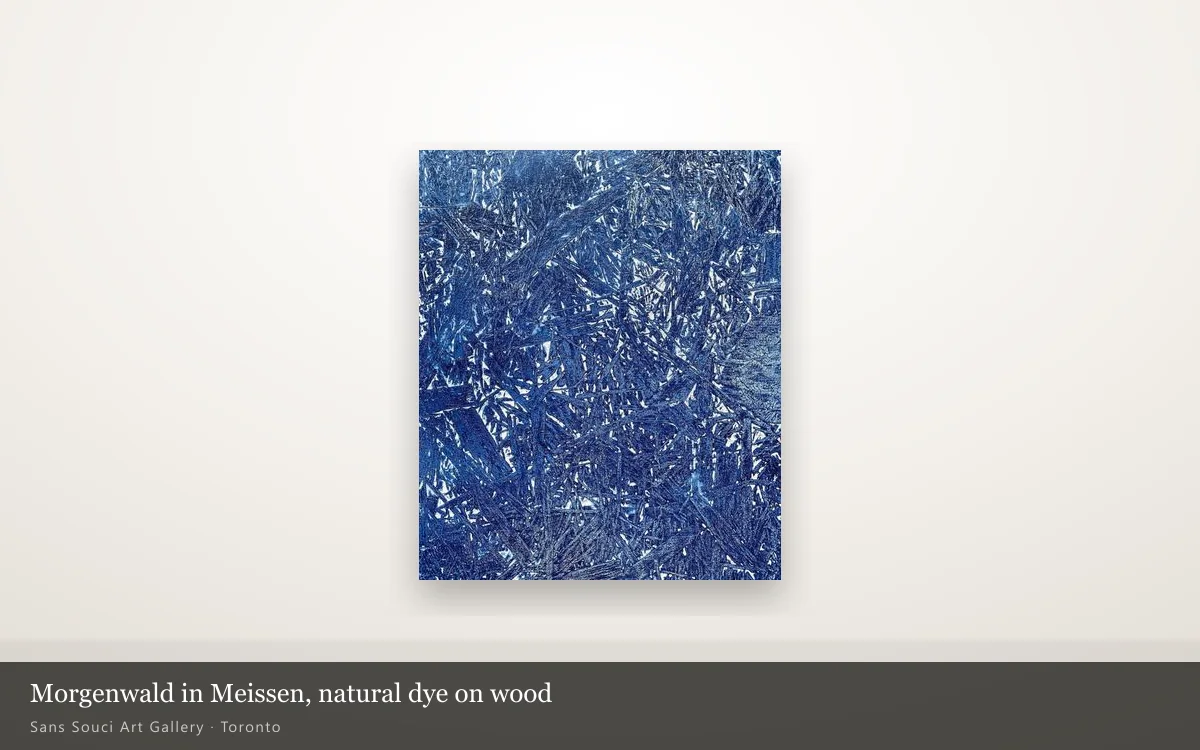
No. A great deal of abstract work starts from something entirely specific — a place, an object, a colour someone saw once. What is absent is the depiction, not the subject. Morgenwald in Meißen is a four-foot-square panel whose starting point is named on its own page: the blue of Meissen porcelain.
The artist’s note on that piece opens with a long retelling of how porcelain came to be made at Meissen — an alchemist shut in a laboratory to produce gold, who produced porcelain instead. That is his telling of it, and it sits on the artwork page in full. What matters in front of the painting is what he did with it: it is, he writes, “a tribute to the blue color of porcelain from this town, which fascinated me with the emerald forests of Saxon Switzerland.”
The blue is a natural wood dye pulled through the grain of the board, so the structure of the wood does much of the drawing. The faint crackle across the surface is deliberate — he calls it “necessary for binding my idea to the theme of antique porcelain”. And there is metal in it: “a touch of gold powder is visible here too, as a reminder of why it all started.” None of that is decodable from the picture alone, and it does not have to be. But “no subject” is simply untrue of this painting.
Six assumptions, and what is actually there
The recurring assumptions are that abstract work is random, subject-free, quick, meaningless, decorative rather than serious, and new. Each one can be checked against something concrete: the artwork page, the surface in front of you, or a museum glossary.
- Not random. Transience is ordered by sequence. Ten sealed layers cannot be reshuffled afterwards.
- Not subject-free. Morgenwald in Meißen begins from a named town, a named colour and a named forest.
- Not quick. Curing sets a floor on the calendar: a poured coat has to harden before the next pass of line work can go onto it.
- Not “whatever you want it to mean”. The artist’s own reading is published on each artwork page. Yours may differ — but there is a stated one, and you can read it before you decide.
- Not a print run. Every piece here is one of a kind and leaves with a Certificate of Authenticity signed by the artist. We set out the difference in original, print and reproduction.
- Not new. Deliberate abstract painting is more than a century old; Tate’s glossary entry on abstract art sets out the term and where it came from.
| Transience (2020) | Morgenwald in Meißen (2022) | |
|---|---|---|
| Starting point | Process: line, layer, seal, repeat | A place and a colour — Meissen porcelain blue |
| Materials | Acrylic on wooden board, sealed with resin | Natural dye, acrylic, resin, mixed medium on wood |
| Size | 12 × 16 in | 4 ft × 4 ft |
| What draws the image | Thousands of hand-drawn lines and dots | Dye carried through the wood grain, plus crackle and gold powder |
| Where the order lives | In the sequence of sealed layers | In the structure of the support |
| Status | Available | Available |
So what are you actually looking at?
You are looking at a surface built in a particular order out of particular materials, by someone who can say why each pass is there. You do not have to identify anything in it. In front of an abstract piece the useful questions are about proportion, surface and light, not about what it represents.
Three that work in a real room. Which colour holds the largest area, and which one only appears in flecks: the proportion decides how a piece sits in a room far more than the list of colours in it does. Whether the surface sits under a hard poured coat or stays open to the air, because that decides how much it shifts between morning light and lamplight. And what happens when you stand a foot away, which is the point at which a printed reproduction stops giving anything back and an original does not.
Both pieces are available and in the catalogue, Transience among the “Abstract Variations” works. Viewings are by appointment in Markham, in the Greater Toronto Area, and we are glad to talk through materials, scale or how a work will sit on the wall you already have — get in touch.