Every artwork page on this site ends its care note with the same three words: no direct sun. It appears on all sixty-one, which makes it the easiest line on the page to read as boilerplate. It is not boilerplate. Of the things that happen to a painting in an ordinary home, direct sunlight is the one whose effect accumulates and cannot be undone afterwards.
Why does every page here say no direct sun?
Because light damage accumulates and nothing reverses it. The Canadian Conservation Institute states it plainly: the effect of light on a painting is cumulative and irreversible. Damage is brightness multiplied by time, so the same harm arrives from a bright spot over a short while or a dim one over a long one.
The multiplication is the useful part: it gives you two dials, not one. CCI’s own example — 200 lux for 200 hours does the same damage as 100 lux for 400 hours, or 50 lux for 800. Halve the brightness and you halve the damage; halve the hours and you halve it just the same.
The other thing worth knowing is the scale. Lux measures how much light lands on a surface. Museums use 50 lux as the benchmark for light-sensitive work; an office runs at 300–500; average daylight is around 30,000. A wall that takes the afternoon sun is not slightly brighter than the one opposite it. It is a different order of magnitude.
What actually fades is the colour, not the paint
The speed of fading is set by the colourant — the pigment or dye that makes a colour — not by the binder that carries it. “Acrylic on canvas” names the binder. It tells you how the paint was laid down, and nothing about how lightfast any colour inside it is.
CCI sorts coloured materials into four bands: no sensitivity, low, medium and high. Most mineral pigments, and modern pigments made for exterior use, sit low. The high band is largely plant extracts — historic bright dyes and lake pigments, in yellows, oranges, greens, purples, many reds and blues. A vulnerable passage can be in any medium: CCI names watercolour and pastel as the famous cases, then says oil and acrylic are susceptible too.
Here is what the bands cost, in CCI’s terms. These times are to a first noticeable fade, not a ruined painting, and assume a display day of eight hours.
| Light level | What that is in practice | High-sensitivity colour | Medium-sensitivity colour |
|---|---|---|---|
| 50 lux | the museum benchmark for sensitive work | 1.5 to 20 years | 20 to 700 years |
| 500 lux | normal office lighting | a few months to two years | around two years |
| 30,000 lux | average daylight | a day to two weeks | two weeks to a year |
Figures are CCI’s, from its Environmental Guidelines for Paintings and its longer note on light, ultraviolet and infrared as agents of deterioration.
Two pieces here, two different questions
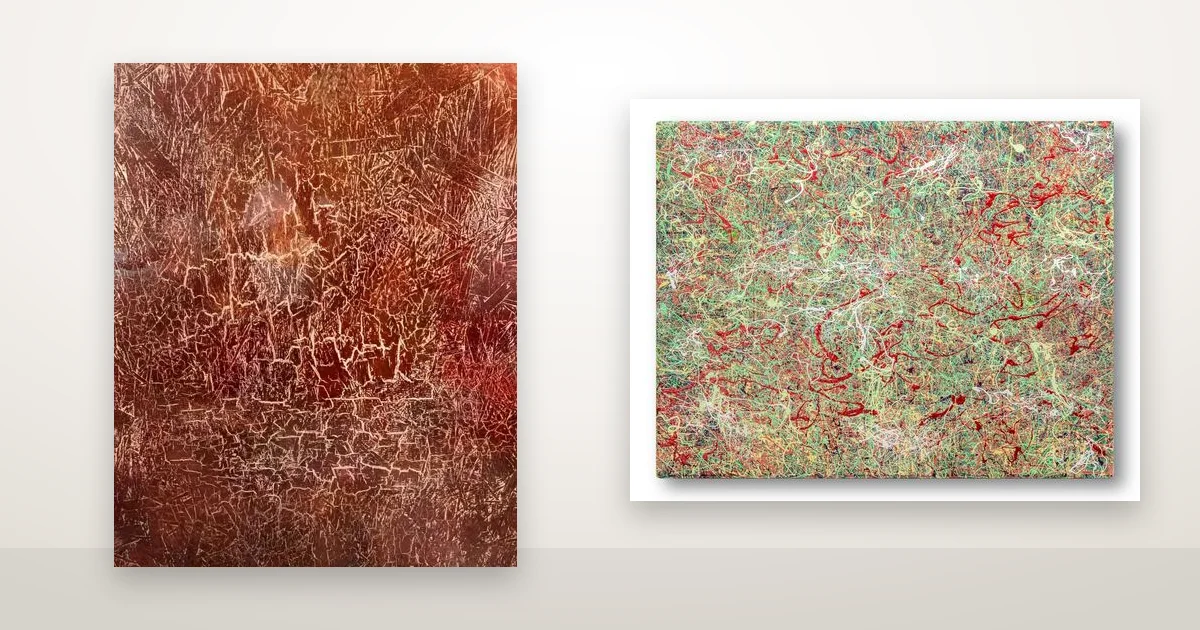
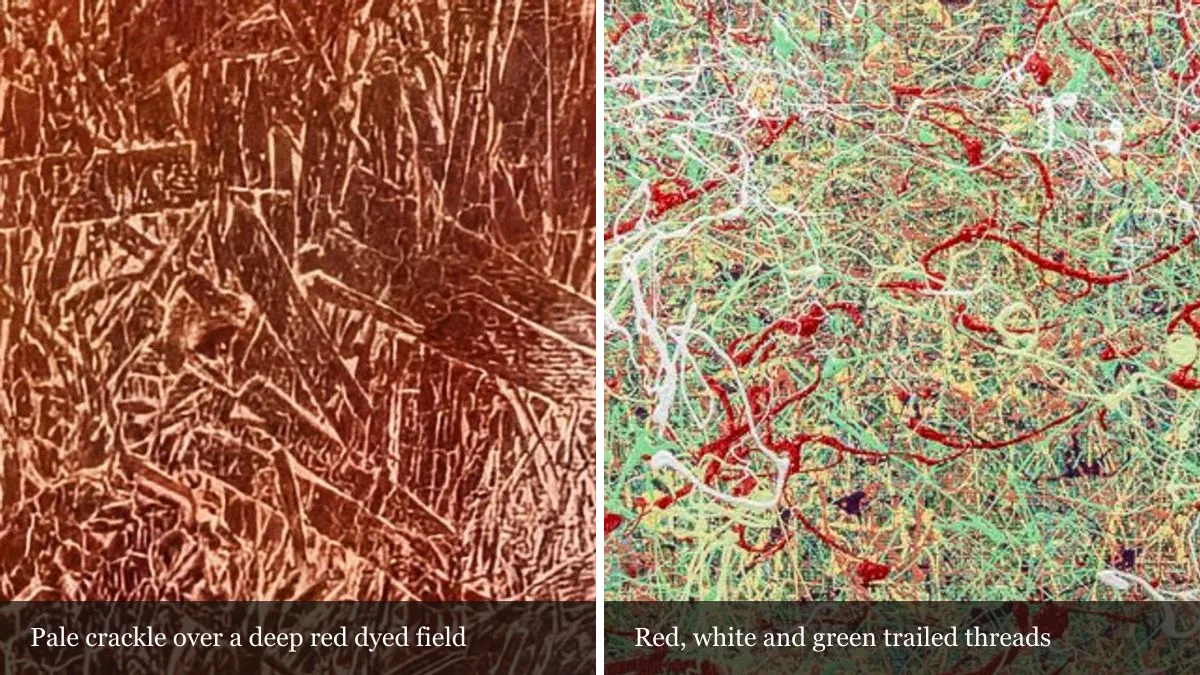
Sunset at the Dead Sea is four feet square — natural dye, acrylic and resin on wood — and its surface is a deep red field broken by pale branching crackle. Its page carries a sentence only three other pages here carry: dyed passages are light-sensitive in the way any dye is, and steady indirect light keeps them true far longer than a sunlit wall. Those four are this one, Hamsin (2022) and the two Meißen forest pieces — the only works whose materials line names a natural dye.
What no page tells you is which dye, and that matters, because CCI’s high-sensitivity band is mostly plant-derived colour. With the dye unrecorded, treat a dyed passage as the most light-sensitive part of the work and give it the dimmest wall available.
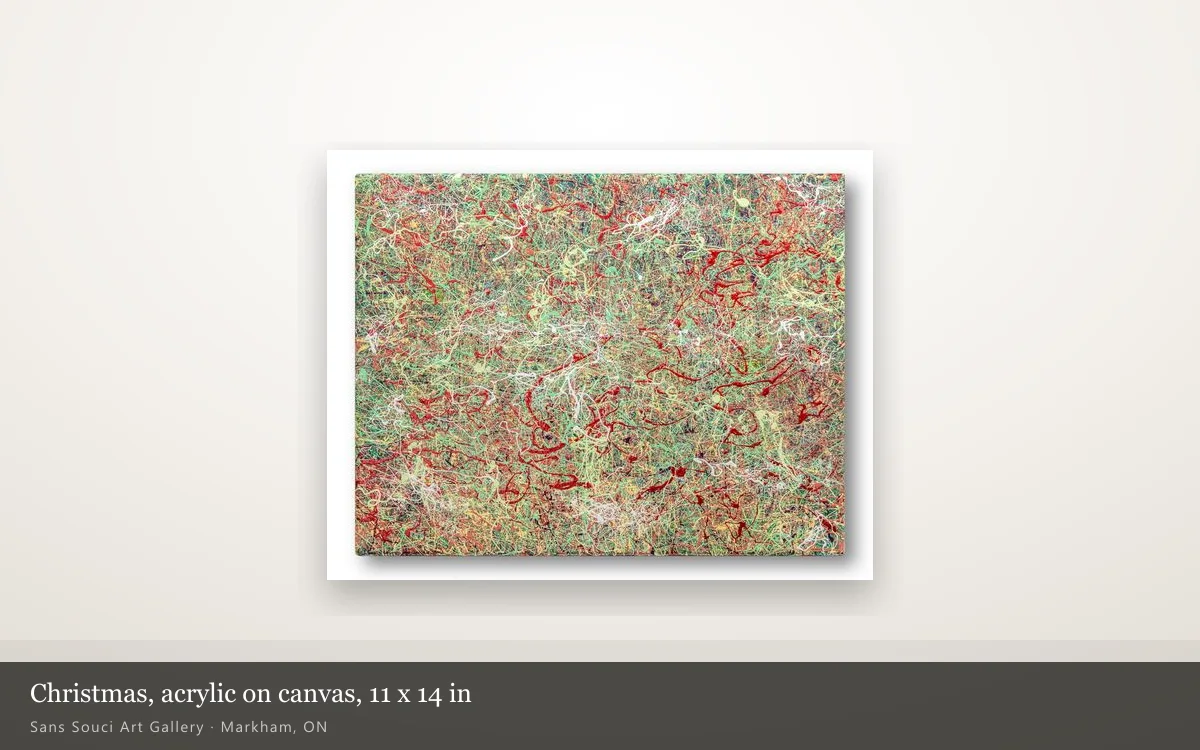
Christmas asks something different. It is 11 × 14 in, acrylic on canvas, no coat named, and its surface is dense trailed line — red, white and pale green threads over one another. Several distinct colourants sit side by side on one small surface, with no reason to share a single lightfastness. Where colours are adjacent, what changes first is the balance between one and its neighbour, not the whole surface at once.
| Sunset at the Dead Sea | Christmas | |
|---|---|---|
| Materials line | natural dye, acrylic, resin on wood | acrylic on canvas |
| Size | 4 ft × 4 ft | 11 × 14 in |
| Coat over the colour | poured resin | none named |
| Care line on its page | the dye sentence and the clear-coat one | the general one: out of direct sunlight |
The clear coat ages separately from the colour
Thirty-six of the sixty-one pages here name a poured resin or epoxy coat, and every one says the same thing: prolonged ultraviolet is what ages a clear coat. Twenty-one name a bare surface and say only to keep the work out of direct sunlight. The distinction matters: light and UV do different damage.
CCI is specific about the second kind. Ultraviolet promotes chalking in some paints and starts the yellowing, embrittlement and cracking of binders and varnishes. Its figures: medium-sensitivity paints can chalk and varnishes crack within three years of UV through unfiltered windows, and highly sensitive paints show UV damage after several months. On a sunlit wall, then, two things happen to a coated piece at once — the colour fades, and the film over it yellows and grows brittle.
Why UV glass is not the answer people expect
A UV filter helps with the coat and much less with the colour. For colours genuinely sensitive to visible light, CCI finds UV usually contributes less than half of the fading and often only a tenth. Museums, donors and framers have all assumed good UV filtering prevents fading; it does not. CCI’s conclusion is blunt — to reduce fading from display lighting there is one option, and it is to reduce exposure.
That is not an argument against UV filtering. It is an argument against buying it and then hanging the work in the sun. One more line from the same note, because these are the pieces people buy them for: picture lamps clamped to a frame are rarely successful. They light unevenly and can overheat the painting, which is how blisters and cracks start.
Choosing the wall in a room you actually live in
Nobody lives at 50 lux and we are not going to suggest you try. A home has two realistic levers: where the piece hangs, and how many hours of strong light reach it.
- Follow the sun patch, not the window. Note where light actually lands on the wall, three times in one day. It also moves through the year: the winter sun sits lower and reaches further into a room, so a wall that is safe in July may not be in January.
- Use whichever dial is easier. Halving the hours and halving the brightness do the same work. Closing a blind across the brightest part of the afternoon is a real reduction, not a gesture.
- Give the dyed and brightly coloured pieces the dimmest wall. If one work in the room has to take the light, make it the one whose colour you are least worried about.
- Do not solve glare by hanging it opposite the window. A resin face reflects whatever is in front of it, so the bright window arrives as reflection instead.
- Skip the frame-mounted picture lamp. Light the piece from a distance and at an angle, which is also what shows a raised surface properly.
- If a piece must live in a bright room, take it down for part of the year. Rotation is exposure control, and it works the same in a house as in a museum.
What the page cannot tell you, and what to ask us
CCI describes a small public gallery in Brampton working through exactly this, and reaches a conclusion we can act on: because many of the artists shown are local and alive, the gallery could ask them what is in the palette and obtain the sensitivities. Sergei Troshin works in Thornhill, and the paint on any piece in this catalogue is something he can describe.
So three questions are worth asking before you commit a wall: which passages are dye and which are acrylic, whether anything is coated over them, and which wall in your room we would avoid given what is in the paint. The answer keeps working long after the purchase, because it is also what tells you where the piece can hang in the next house. We wrote about how a surface shifts between morning and evening in the same painting, different light, and the wider routine in how to look after an original; every materials line is in the Artworks collection.
If you already own one of ours and are unsure which wall it belongs on, send a photograph of the room and say roughly when the sun comes in. Write to us and we will tell you what we would do — including that it is fine where it is, if that is the honest answer.