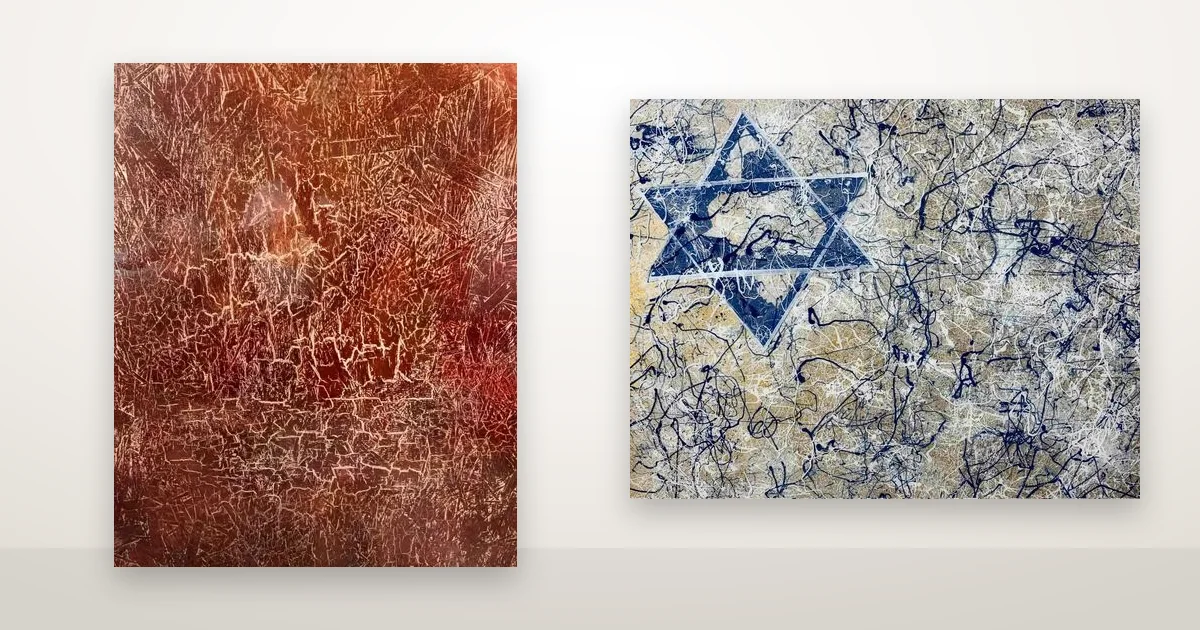
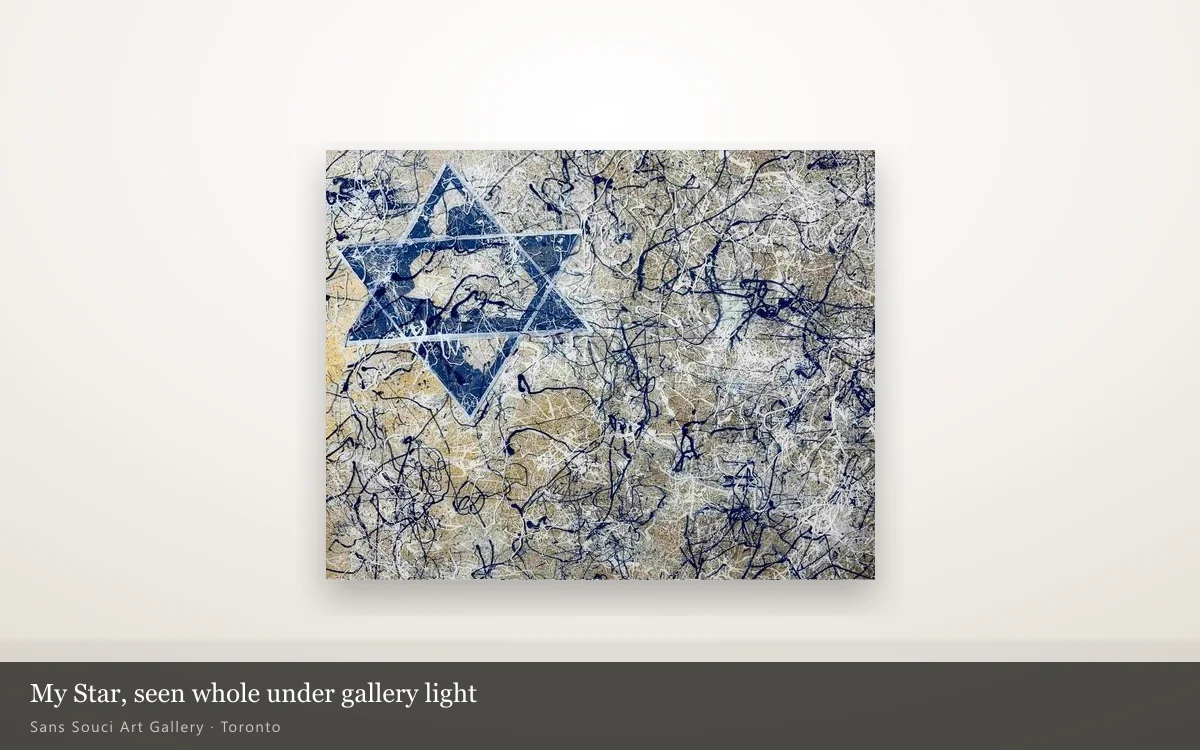
Stand close to Sunset at the Dead Sea and the crimson at its base does not look painted on — it looks like it grew out of the wood itself. A few feet away, My Star shows the opposite: crisp white lines sit cleanly on top of a dark ground, each one a distinct layer of paint you could, in theory, scrape back to bare board. Both are Sergei Troshin originals built on wood. The difference between them is not skill or subject. It is what happens when colour meets wood two different ways — natural dye against manufactured acrylic paint.
What actually changes when you use a natural dye instead of paint on wood?
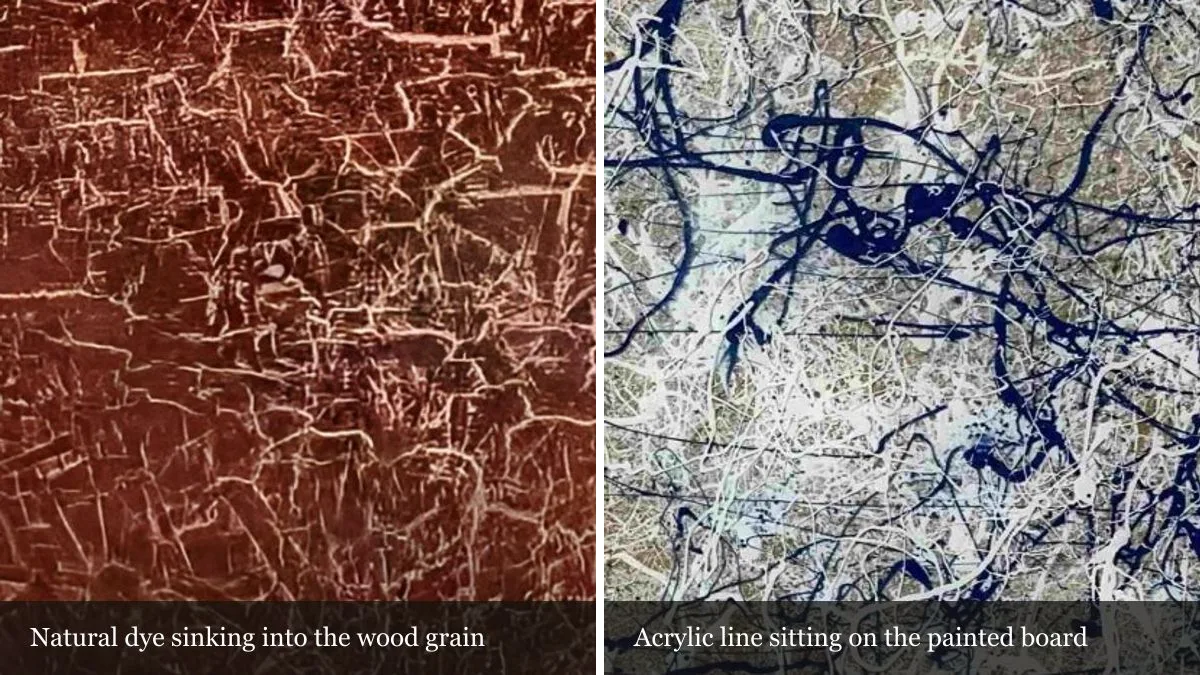
A natural dye soaks into the wood fibre itself, so the colour becomes part of the support rather than a layer sitting over it. Acrylic paint stays on the surface as a film — it bonds to the wood, but the pigment never penetrates the grain the way a dye does. The visual result: a dyed passage looks like coloured wood, and a painted one looks like paint on wood.
On Sunset at the Dead Sea, the wine-red passages at the base of the piece are built with natural dye before acrylic and resin go on top. Because the dye has already sunk into the board, the grain still reads through the colour in places — you can see the wood's own texture doing part of the work, the way a stain on furniture leaves the grain visible while paint would hide it. That is the mechanical reason a dyed piece and a painted piece on the same kind of board can look so different up close, even before either one is sealed.
Sunset at the Dead Sea vs My Star: two ways of working colour into wood
Sunset at the Dead Sea combines dye with acrylic and resin on a four-foot-square wooden board; My Star is acrylic alone, sealed with resin, on a much smaller board. Comparing them side by side is a fast way to see what each material is doing, because the finish — resin over the top — is identical on both.
| Sunset at the Dead Sea | My Star | |
|---|---|---|
| Materials | Natural dye, acrylic, resin on wood | Acrylic painting on wooden board, sealed with resin |
| Support | Wooden board, 4 × 4 ft | Wooden board, 12 × 16 in |
| How the colour sits | Dye sinks into the grain; acrylic and resin layer over it | Acrylic sits on the surface as a distinct painted layer |
| Availability | Available | Private Collection |
My Star is no longer available — it found its owner and now stays in the artist's archive as a record of the technique, not a piece you can buy. Sunset at the Dead Sea is available. Neither material is better on its own; they simply do different jobs. Acrylic gives Sergei Troshin exact, repeatable lines, the kind you see across My Star's surface. Tate’s glossary entry on acrylic paint explains why the medium behaves that way — it dries fast and stays workable long enough to build up layers in a single session. A dye cannot be controlled with the same precision, but it can do something acrylic cannot: become part of the wood rather than sit on it.
Which one is right for a piece on your wall?
Neither is more "authentic" than the other — both are original, hand-built surfaces. The honest way to choose is by what you want the wood to do:
- Want the board's own grain visible through the colour? Look for pieces described as natural dye on wood, like Sunset at the Dead Sea.
- Want a flat, consistent colour regardless of what the board looks like underneath? Acrylic alone, the way My Star is built, gives you that.
- Both can be finished the same way. A poured resin coat over either one gives the same hard, glass-like face — we cover what that coat does in What a Resin Finish Really Does.
- Dyed colour is more light-sensitive over the years than acrylic sealed under resin. Either way, keep a piece out of long direct sun — the American Institute for Conservation publishes plain-language guidance on caring for artwork at home.
The only way to really see the difference is up close, in person, where the light can catch the wood grain through a dyed passage the way a photograph never quite manages. If Sunset at the Dead Sea or a similar dyed piece sounds right for your space, or you would like to see more wood-based originals from the Artworks collection, get in touch and we will set up a time to view them in Toronto.