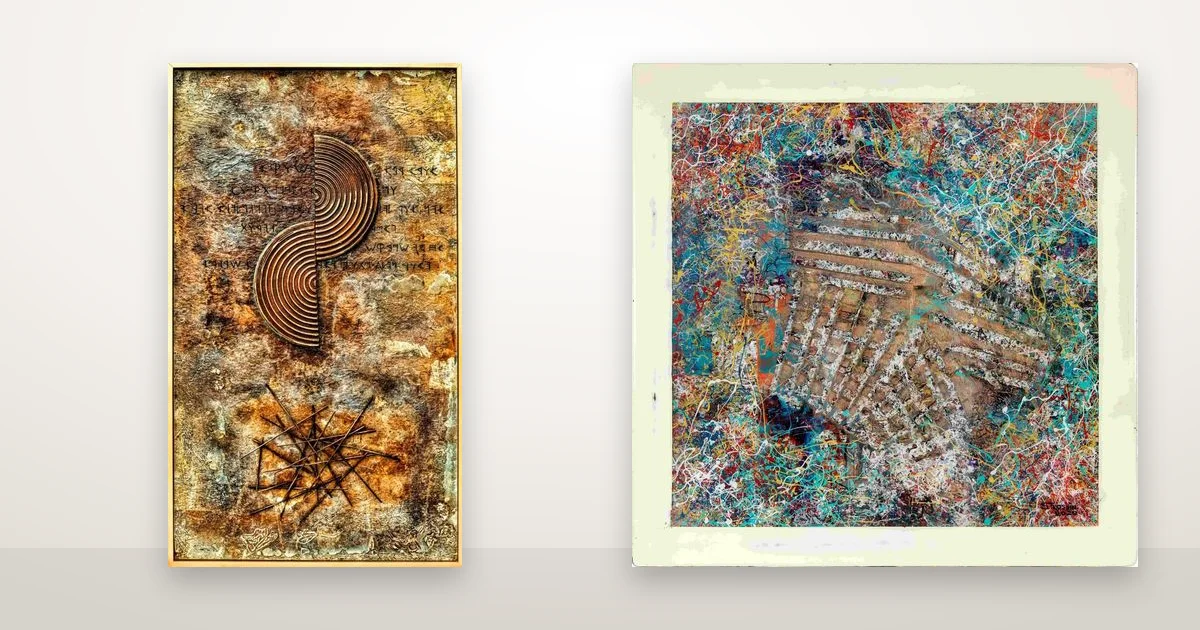
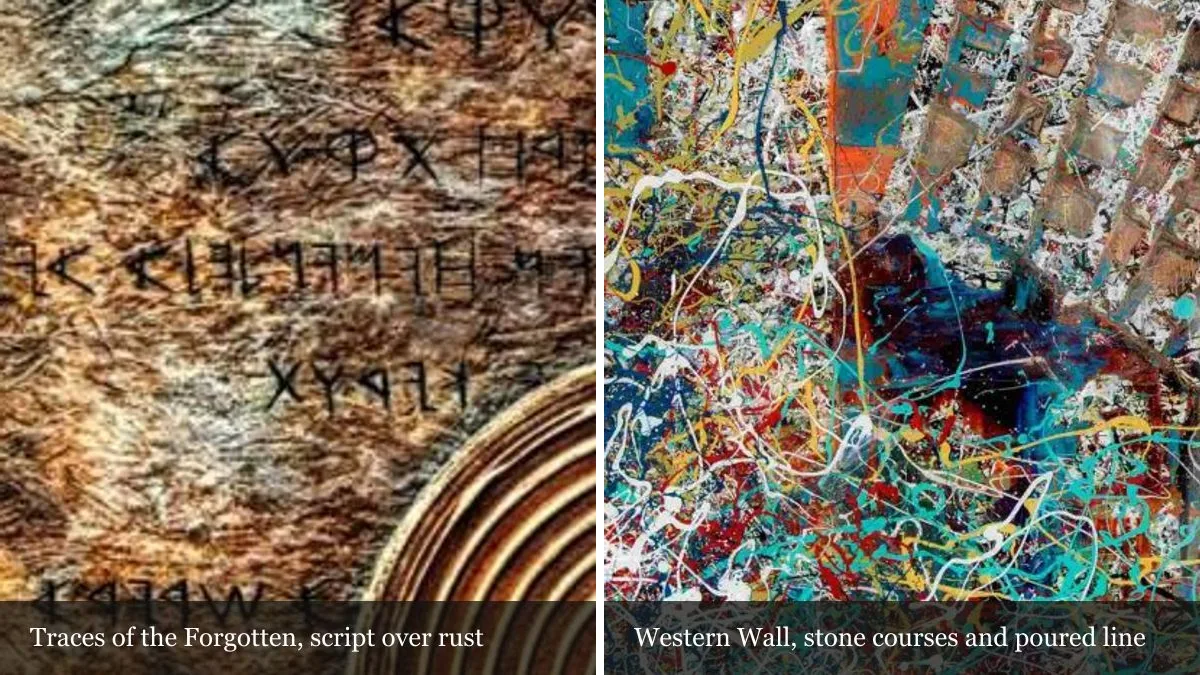
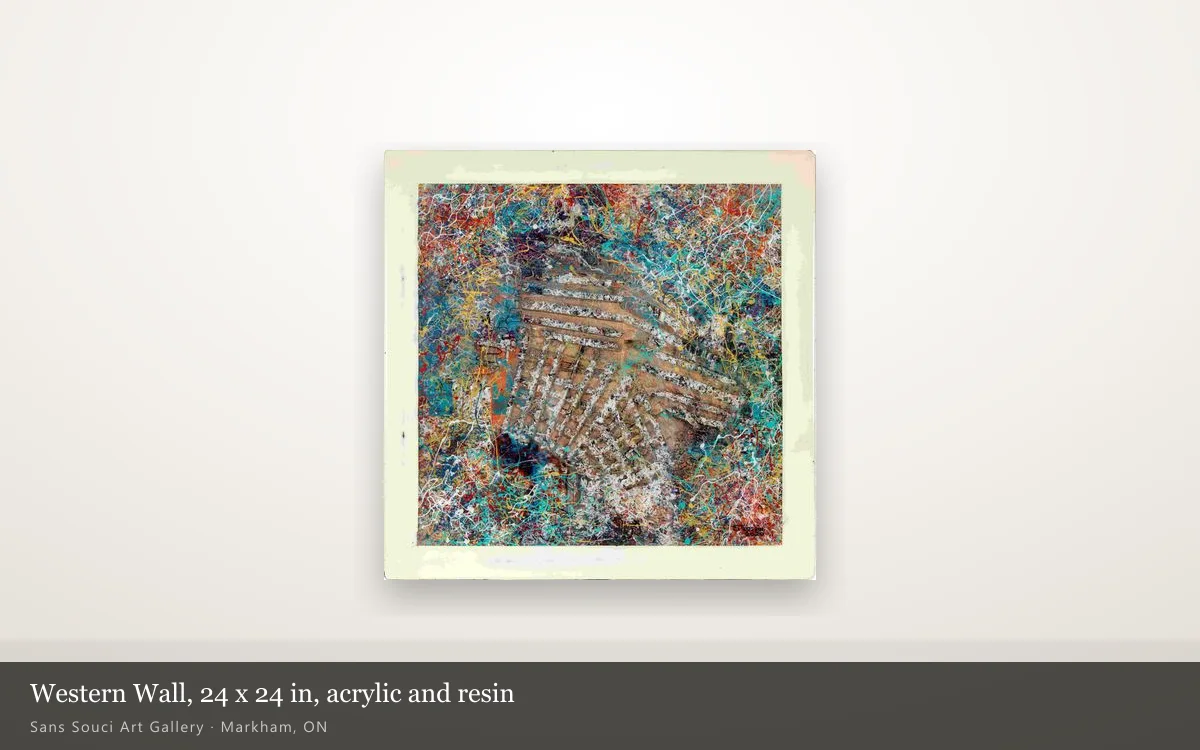
The description on Western Wall begins like a diary entry: “I am painting The Wailing Wall and touching its stones that are a witness of the ages.” It is an abstract painting, and the stones really are in it — courses of pale blocks stacked across the middle of the panel — but they surface out of a tangle of poured line, and from the doorway you can miss them entirely. That is worth knowing before you decide an abstract painting has nothing to say to you. In both of the works below, the thing the artist names in writing is physically there on the surface — you just have to be told where to look.
Can an abstract painting be about something specific?
Yes, and in this catalogue it often says so in writing. Abstraction describes how a work is made, not whether it has a subject. Tate’s definition of abstract art covers work that does not attempt an accurate depiction of visual reality, and adds that the same term applies to art based on an object, figure or landscape whose forms have been simplified.
So the question is not whether an abstract work has a subject. It is where the subject was written down. We counted this morning across all 61 originals on the site: 34 carry a description written by the artist and 27 carry none. Of those 34, eight name a real place, seven name a historical person or period, three name rust as a material, and two name a script or a symbol worked into the surface. So roughly half the catalogue tells you what a work is about, and half of it says nothing at all — which is not a riddle, only a note that was never written.
Western Wall: a memory kept as duration
Western Wall is acrylic and resin on fiberboard, 24 × 24 in, and it is available. Its note barely describes what the painting looks like. Instead it gives a rate of exchange: “As many lines, that many days of work it took. As many colours, that many emotions.” By that measure a denser surface means more days, and the line count is the record of the time spent.
When you stand in front of a painting built this way, the thing to count is layers of line crossing each other, not shapes. The stone courses in the middle of Western Wall are the only part that looks like the thing it is named after; everything around them is the record of the days.
Traces of the Forgotten: a memory kept in the material
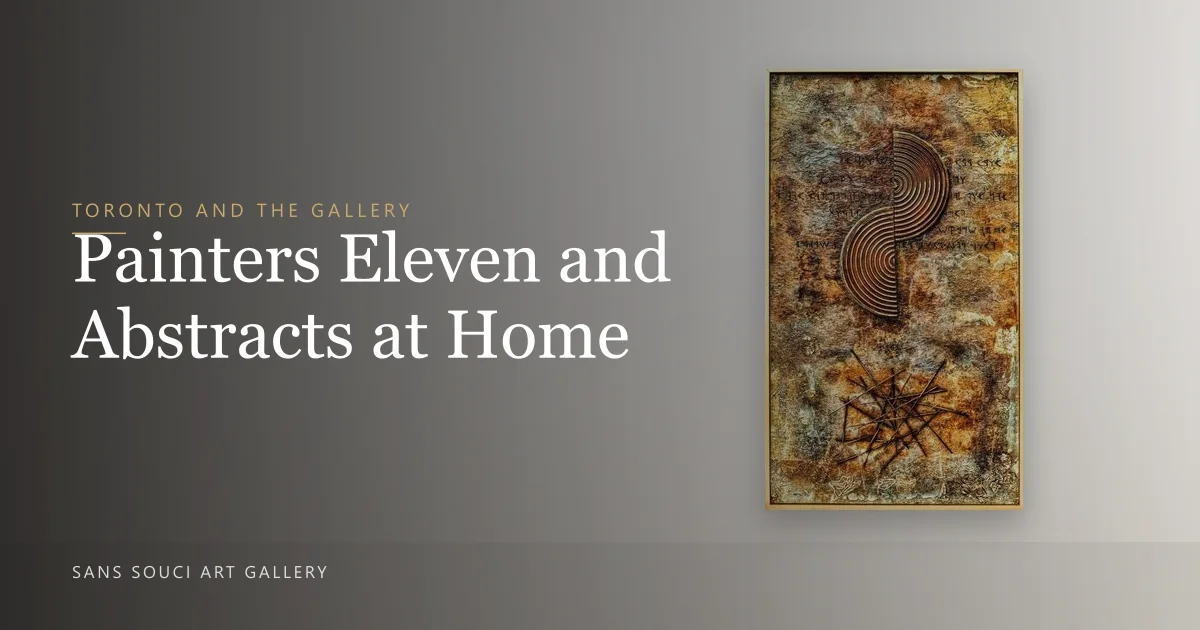
Traces of the Forgotten (mixed media, 30 × 48 in, available) puts the subject into the surface instead. Its note names four things, and all four are visible in the photograph: a fractured circle, whose concentric rings are split and offset; rusted textures across the whole ground; scattered metallic remnants, sitting low in the panel as a spray of dark rods; and “ancient calligraphy” that “faintly whispers of wisdom hidden beneath the layers of time”, running in rows of letter-like marks.
What the page does not tell you is which of those are materials and which are painted to look like materials. The materials line reads “Mixed media” and stops. It does not say what the metal is, or whether the rust is real oxide or a rust-coloured paste, and no page here names the script or its language. We are not going to guess at any of that in writing — mixed media is a description of method, not an inventory. It is a fair question to put to us before you buy, and for this piece the answer comes from the artist rather than from the label.
Where the memory is actually kept
In four places — or, for 27 of the 61 works, nowhere at all — and they do not carry equal weight. A title points; a written note explains; a symbol worked into the surface is checkable with your own eyes; a material commits the artist to something physical. Knowing which one you are looking at tells you how much you actually know.
| What carries it | Where you see it | How much it settles |
|---|---|---|
| The title alone | Titles that name something real: Hamsin, Morgenwald in Meißen, Western Wall | Names the subject and nothing else. It does not tell you what in the picture belongs to it. |
| A note by the artist | 34 of the 61 works on this site | The strongest evidence there is: his own account, in his words, on the page. |
| A symbol in the surface | Wheel of Fortune — the page states that חַי, “Life”, stands at the centre of the spinning wheel (this one is sold) | Specific and verifiable. You can find it in the painting and see what it is doing there. |
| The material | Rust is named in three descriptions: Traces of the Forgotten, Whisper and Hamsin (2025) | A commitment, not a mood. Whisper’s note calls it out: “Wood, which remembers, and rust, which testifies to time.” |
| Nothing at all | 27 of the 61 works | No claim was made. Look, decide for yourself, or ask us — do not read a story into the silence. |
What rust asks of the wall you hang it on
If a work contains real metal, damp is a practical problem rather than an aesthetic one. Two materials lines in this catalogue state metal plainly — Over The Horizon lists “metallic” and The Choice lists “metal elements” — and the Canadian Conservation Institute is blunt about what that means: in general, for metals the lower the relative humidity the better, and above 75% RH all corrosion speeds up a great deal.
In a home that translates into three places to avoid for anything with metal or a rusted surface in it: a bathroom, an unheated garage or porch, and an exterior basement wall. None of that is specific to these paintings and none of it says a particular work will change — it is the same rule that applies to any object with metal in it. Our short guide on looking after an original covers the rest.
When there is no note at all
Twenty-seven of the 61 works here carry no description at all, and two of the notes that do exist show why that need not be a gap. Summer Languor’s note is about method only: the artist writes that he did not paint it so much as make a piece of paint lace, spinning it and weaving it. Fluently Python opens with “What is this about? It’s about nothing!” and then talks about layers and languages.
Both of those are answers, not evasions. A painting is allowed to be about its own making. The mistake is to assume every abstract surface is a code with a solution — we wrote about that assumption in what abstract art is not. In this catalogue the pieces that are reaching for something outside themselves tend to say so on their own page.
What to do with this in front of an actual painting
Read the title, then the note, then the materials line, in that order, and notice which of the three is doing the work. Then look for the one thing the note names — the stone courses, the split circle, the word at the centre of the wheel — and let the rest of the surface be what it is. If the note is silent, the painting is not withholding anything; there is simply nothing written down.
Both works in this note are available and can be seen by appointment at the gallery in Markham. If you want to know what the metal in Traces of the Forgotten actually is, or how long Western Wall took, ask us and we will put the question to the artist; his own account of how the work is made is on the about page.