You can hang a painting above a fireplace when two things check out: the wall there stays close to room temperature while the fire is on, and the surface of the work is one that tolerates a little warmth and can be kept clean. Neither is true of every fireplace or every painting. This note explains what a fire adds to the wall above it, how to test your own wall with a thermometer in one evening, and how two works in our catalogue would answer the question differently.
What a working fire adds to the wall above it
The Canadian Conservation Institute (CCI) is direct about this spot. Its guidelines for displaying paintings say that areas near radiators, air vents or fireplaces are not recommended, in the same paragraph that rules out kitchens. Three separate things are behind that advice.
Heat
Warm air rises from the opening and the wall itself warms up. How much depends on the fireplace, so it has to be measured. The temperatures that matter for a painting are in the table further down.
Humidity that rises and falls
Air warmed by a fire is drier while the fire burns and returns to the room's level when it goes out. CCI's note on how paintings deteriorate lists working fireplaces, radiators and heating ducts among the places where these swings happen, and says swings of more than 10% relative humidity can stress paint layers until they crack. It writes that about oil paintings. Acrylic on canvas sits in the institute's low-sensitivity group for humidity, which is one reason the answer differs by material.
Particles
Anything that burns in the room, including candles on the shelf, puts fine particles into the air, and rising warm air carries them up the wall. CCI's note on pollutants says oily particles settling on a surface can start or speed up deterioration. On a painting they also simply darken it.
Test your own wall in one evening
No article can tell you how warm your wall gets, because fireplaces differ too much. A basic digital thermometer can. Do this before the painting goes up, on a normal evening of use.
- Tape the thermometer, or its probe, to the wall where the bottom edge of the painting would sit. That is the part closest to the heat.
- Note the reading with the fire off, and the reading from a thermometer elsewhere in the room.
- Run the fireplace the way you really use it, for as long as you usually do.
- Read the wall thermometer every half hour and write down the highest number.
- Put your hand flat on the wall above the test spot as well. A wall that feels clearly warm to the hand is already telling you something.
- Look at the wall and ceiling above the opening in daylight. A grey shadow there means particles are reaching the wall.
Then compare your highest reading with the figures CCI publishes in its note on incorrect temperature.
| Wall reading | What CCI says happens | What it means for a painting |
|---|---|---|
| Within a degree or two of the room | Nothing listed | Heat is not the problem on this wall. Check for particles and you are done. |
| Above 30 °C | Mixtures based on waxy components deform, separate or bloom. Some common white glues soften and lose strength. | Not a wall for a work that contains wax, or for collage held by glue, until you know more about its materials. |
| Above 45 °C | Waxes soften or melt. CCI gives 47 to 65 °C for paraffin wax and 60 °C for beeswax. | No painting should hang here. |
| Above 60 °C | Many common plastics distort quickly and for good. | The wall is unsafe for far more than art. |
CCI's figures describe materials in general, and a reading between room temperature and 30 °C is a grey zone that the table does not settle. In that zone the surface of the particular work decides.

Two works that answer differently
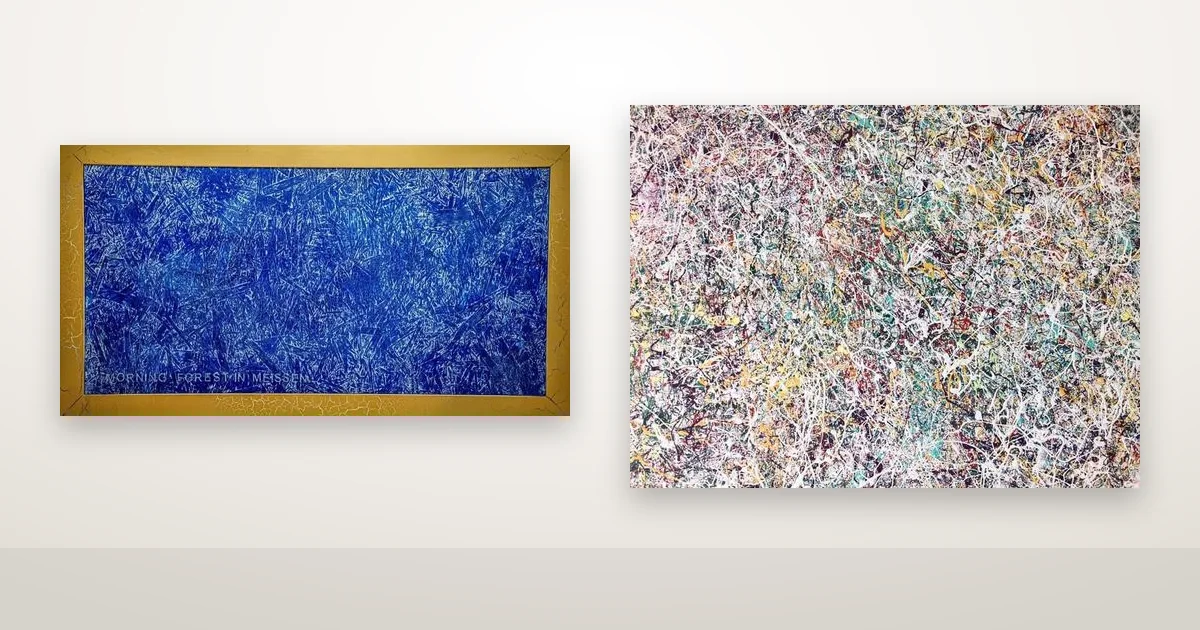
Both of these are large enough to be the kind of painting people picture above a mantel. They are built from different materials, and the fireplace question lands on a different point for each.
Morning Forest in Meißen: the one work with wax in it
Morning Forest in Meißen measures 52 by 28 inches. Its materials line reads: acrylic, natural dyes, resin, wax paste and diamond dust on wooden board, framed. We checked all 61 works in the catalogue, and it is the only one whose materials line names wax.
That makes heat the first question for this piece. CCI's 30 °C line for waxy mixtures is the cautious figure to hold this work to. If it is the one you want above a fireplace, ask us which wax is in the paste and where it sits in the layers before you decide, and bring your thermometer reading. It is also a large framed board, so the fixing matters as much as the heat; our note on how to hang a heavy painting covers that part.
Summer Languor: an open acrylic surface
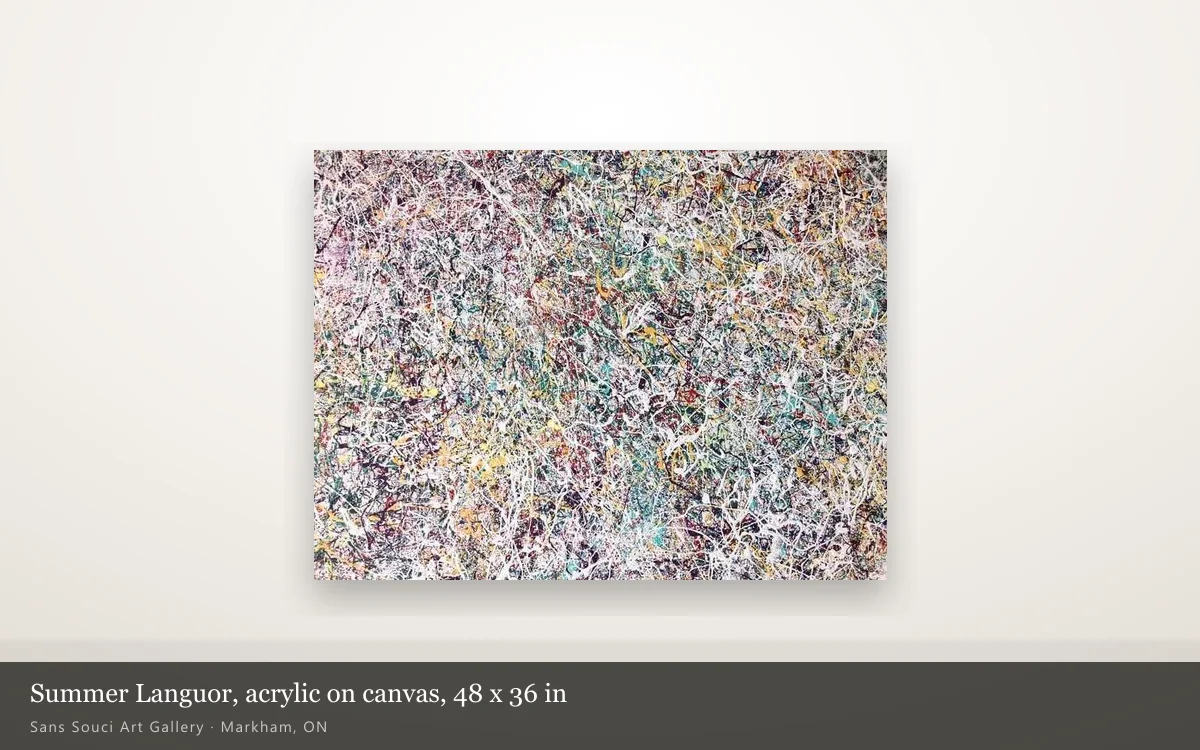
Summer Languor is acrylic on canvas, 48 by 36 inches. The artist describes how it was made:
"I didn't paint it: I was making a piece of paint lace, spinning it, weaving it."
A lace of raised paint lines has thousands of small edges and hollows where dust can settle. The same CCI note on how paintings deteriorate says acrylic paint attracts and absorbs dirt at room temperature and more so when warm, and that such surfaces are hard to clean. So for this work the particles matter more than the temperature. Above a sealed fireplace on a wall that stays at room temperature it would be at home. Above an open wood fire that leaves a grey shadow on the ceiling, it would slowly collect the same grey in a surface that is hard to clean. We explained why in what acrylic paint is and how it behaves.
Three things to find out about the fireplace
We sell paintings, not fireplaces, so these are questions for whoever installed or services yours. The answers change what your thermometer test is likely to show.
- Is the flame open to the room or behind sealed glass? An open flame can send smoke and particles into the room. A unit behind sealed glass keeps the flame out of the room air, but it still gives off heat.
- Where does the heat leave the unit? Some push warm air out of the front, some out of a grille at the top, directly under where a painting would hang. Find the outlet and test above it.
- How often is it lit? A fire on a few evenings a year and a fire that runs every day from October to April are different walls, even in the same house. Test for the way you actually use it.
When the wall beside it is the better place
If your reading comes back warm, or the ceiling shows a shadow, the painting does not have to leave the room. A side wall a few steps from the fireplace sees the same firelight in the evening without the rising air. It is often a better wall for a textured surface as well, because light from a fire or a lamp reaches it from the side. Dry winter air affects every wall in a heated house, and we covered that in winter air and the wall.
If you are choosing a work for a room with a fireplace, tell us what kind it is and what your thermometer showed, and ask which of the works in the catalogue suit that wall. Send us a note or call, and come and see them in Markham by appointment.