
Most people who ask us about hanging are not asking about the painting. They are asking about the wall — about a deposit, an inspection at the end of the lease, and a landlord who was vague about it on the phone. Hanging art in a rental is a practical problem with a practical answer, and the answer starts with the piece rather than with the wall.
Does hanging a picture count as damage?
In Ontario the governing sentence is short. Section 34 of the Residential Tenancies Act, 2006 says a tenant “is responsible for the repair of undue damage to the rental unit or residential complex caused by the wilful or negligent conduct of the tenant”. It says nothing about picture hooks. Two small holes, filled and sanded before you hand back the keys, are not what that section is aimed at.
Your own lease can be stricter than the Act, and a condo board can add rules of its own, so read it before you drill. If it is unclear, ask in writing and keep the reply — an email you can find in a year is worth more than a friendly yes on the phone. We sell paintings and we are not a law office: where real money is at stake, take advice from someone who gives it.
The piece decides the fixing, not the wall
What a wall is asked to do depends almost entirely on what goes on it. A small canvas is fabric and a thin skin of paint, and it hangs from one small hook. A four-foot panel of plywood carrying collage and a poured resin coat across its whole face is a solid sheet of material, and it wants a fixing that reaches something structural. Same drywall, two different jobs.
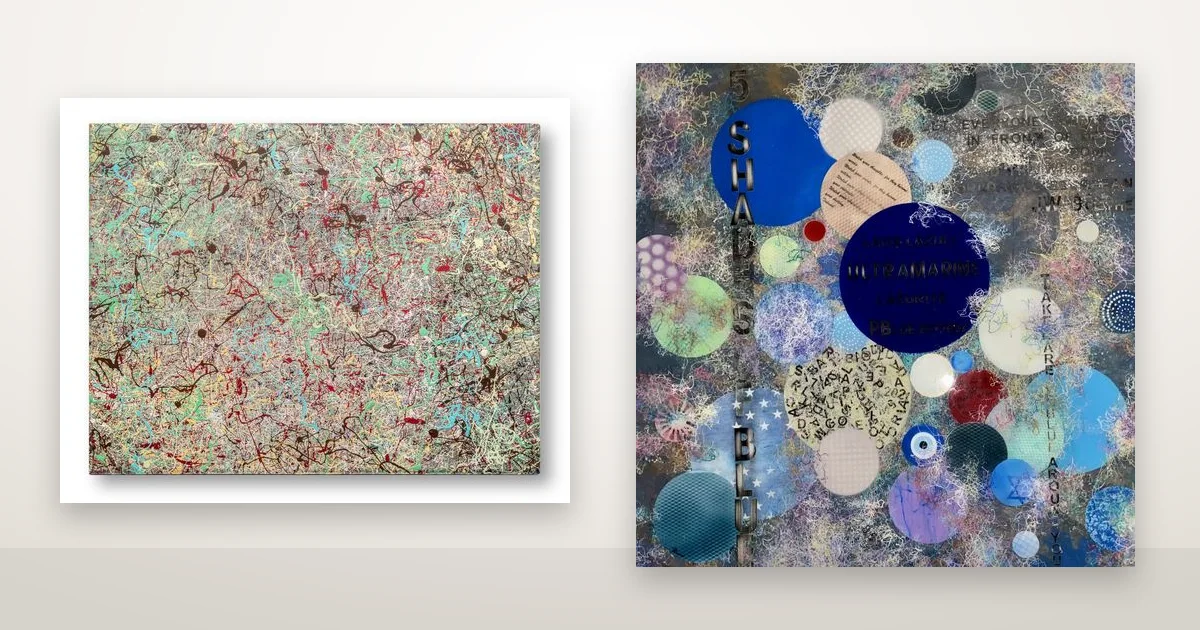
The catalogue divides along that line. Of the 61 originals on this site, 16 have a longest side of 16 inches or less. Seven are 48 inches or more. The two pieces in the images above sit at either end of that range.
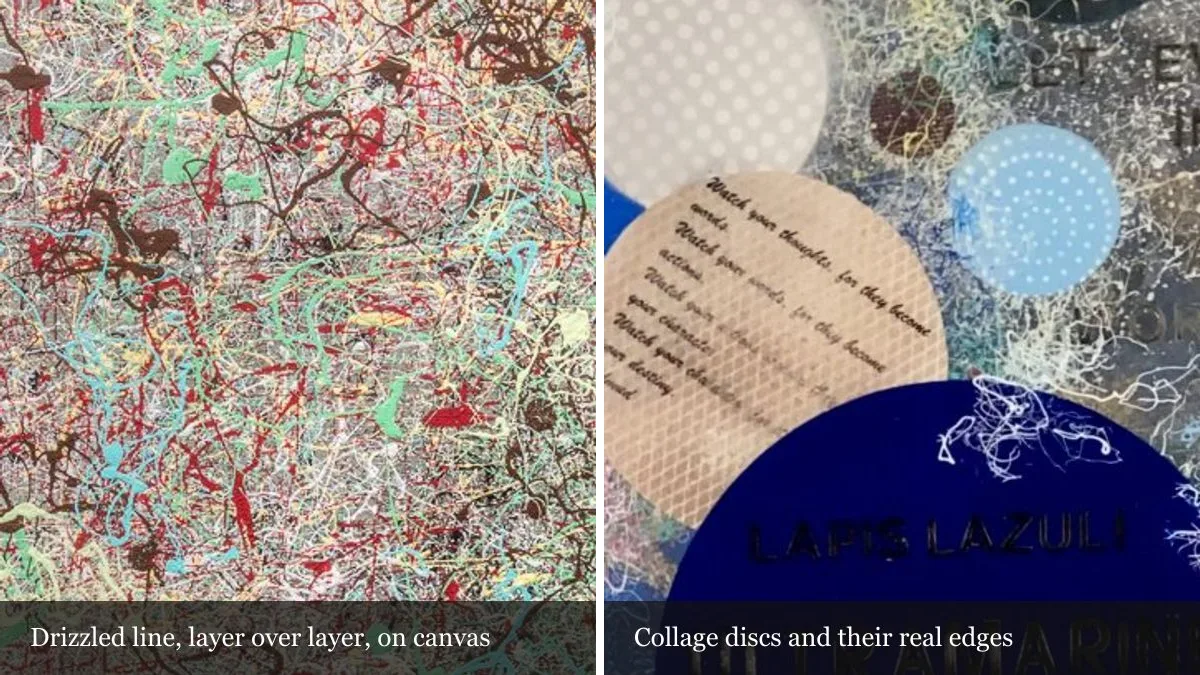
Spring Thoughts (2019, 11 × 14 in, acrylic on canvas) is the modest end. Canvas is a light support — fabric and a thin skin of paint — the line is drizzled on in fine strands, and its page names no poured coat, so there is very little material there at all. A piece this size is the one most renters can hang without thinking twice about it.
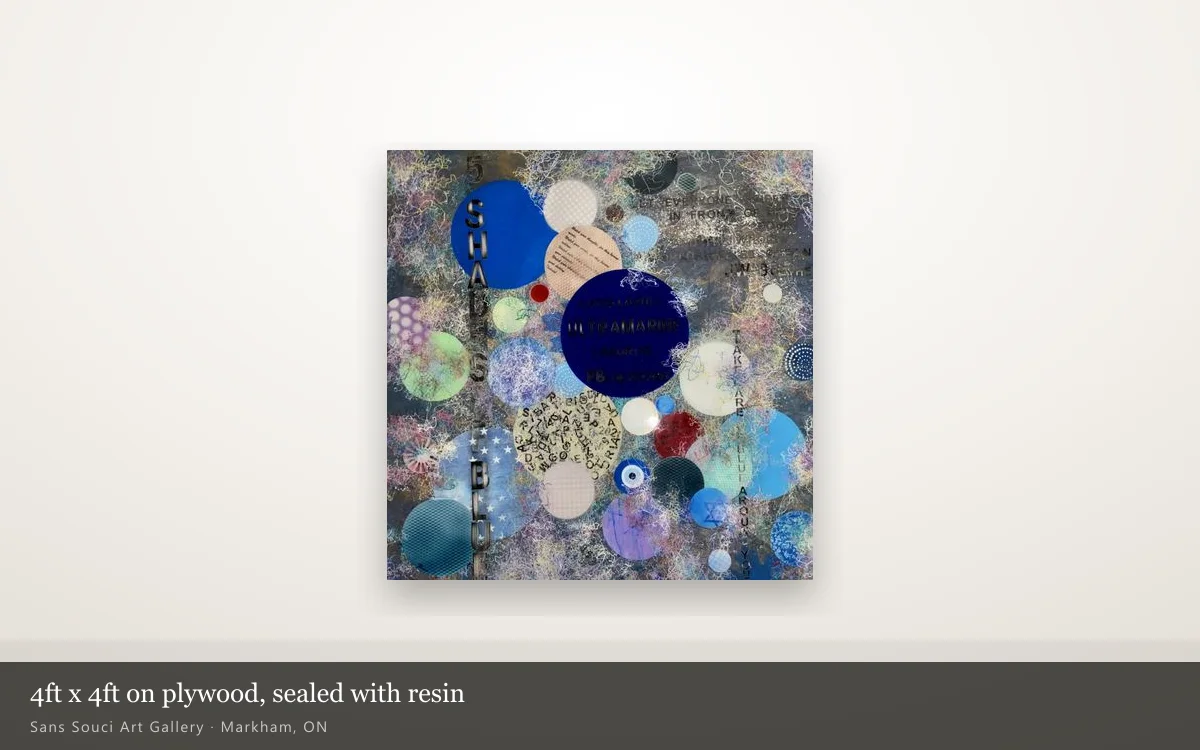
5 Shades Of Blue (2022, 4ft × 4ft, acrylic and collage on plywood, sealed with resin) is the other end. Plywood is a rigid sheet rather than a length of fabric; the collage elements — printed discs, two of them carrying the words lapis lazuli and ultramarine — sit proud of the surface with their own thickness; and the resin covers the entire face. Every one of those decisions adds material, and material is weight.
| What each one asks of a wall | Spring Thoughts | 5 Shades Of Blue |
|---|---|---|
| Size | 11 × 14 in | 4ft × 4ft |
| Support | Canvas | Plywood panel |
| Surface | Acrylic, no poured coat | Collage sealed under resin |
| Where the weight is | Fabric and a thin paint film | The whole sheet, plus the coat over it |
| In a rented flat | One small hook, one small hole | A fixing into structure, and a conversation first |
| Status | Available | Available |
What the catalogue does not tell you, and what to ask us
It does not tell you the weight. We checked all 61 pages before writing this: not one of them gives a weight in pounds or kilograms, and not one says what is on the back — wire, D-rings, a cleat, or nothing yet. Those are the two facts that decide the fixing, so they are the two questions to ask before a piece is bought, not after it arrives.
They matter because hanging hardware is rated. The Canadian Conservation Institute’s guidance on storing and displaying paintings puts it plainly: work out the maximum weight each hanging device can carry, and make sure it handles the combined weight of everything hanging from it. That applies to the hook going into the wall and to the fittings on the back of the work. The same note prefers two fixed points over a single wire, because a wire is one component that can fail on its own — and in a rental, two small hooks do no more harm than one.
Four ways to live with an original without a big anchor
If drilling is out of the question, or the piece is heavier than the wall deserves, there are four routes that people actually use. None of them is a compromise on the work itself.
- Buy at a size the wall can take. A quarter of this catalogue is 16 inches or less on its longest side. At that scale a single small hook is the whole installation, and one filled hole is the whole repair.
- Lean it. A shelf, a mantel, a sideboard, the top of a low bookcase. Our own note on Spring Thoughts says an intimate size “works on a shelf, in a narrow stretch of wall, or hung as one of a small group”. Three cautions: the bottom edge carries the whole weight, so give it something soft to stand on; a leaning work slides, so a lip on the shelf is worth more than it sounds; and one piece leaning where you can see it is not the same thing as a stack of pieces leaning in a corner. The CCI note linked above is blunt about the stack — it is not recommended, because stacked works get rubbed against each other and walked into.
- Use a picture rail if the flat has one. Older buildings sometimes carry a moulding near the ceiling made for exactly this. Hooks hang from the rail and cords drop to the work, so the wall itself is never touched.
- Choose a piece that never goes on a wall. Thirteen of the 61 works here are painted furniture and objects rather than paintings — side tables, hand-painted glass, a tissue box. Decorative Side Table 1 is worked directly onto a functional object; the rest sit in the furniture and home accents collection. Original, one of a kind, and it leaves no mark on anything.
The wall to avoid, rented or owned
The inside face of an exterior wall. The CCI note above is explicit about it: those surfaces can be cold in winter, and unprotected artwork displayed on them is prone to condensation damage. In a rented flat that is also the wall you have least control over, since insulating it is not your decision to make.
The rest of the list is the ordinary one, and it costs nothing to follow: no long hours of direct sun, nothing directly above a radiator or a heat vent, and not in a kitchen or a bathroom where fumes and humidity swing every day. Where a piece has a raised or reflective surface, the direction of the light matters as much as the spot on the wall — we wrote about that separately in where to hang a textured piece.
When you move out
Photograph the wall before you hang anything, and again after you patch it. A small hook leaves a hole that filler, a light sand and a matched touch-up close completely; the photograph is what settles the conversation if anyone asks later. Take the hooks with you rather than leaving them, and if the work has to wait somewhere between homes, keep it on its own — wrapped, not buried in a leaning stack with the mirrors and the shelves.
None of this has to be guessed at. If a piece here interests you and you are renting, ask us about it before you commit — the weight, and what is fixed to the back, are far easier to settle while the work is still with us than after it is standing in your hallway. Viewings are by appointment at the gallery in Markham.