Two materials in this catalogue behave in a way a photograph cannot report honestly: diamond dust and gold. Neither one tints a surface the way a pigment does. Both sit in it as reflective particles, and a reflective particle only shows itself when the light, the surface and your eye happen to line up. Walk past the work and it changes. A camera stands still, catches one of those moments and loses the rest.
What is diamond dust in a painting?
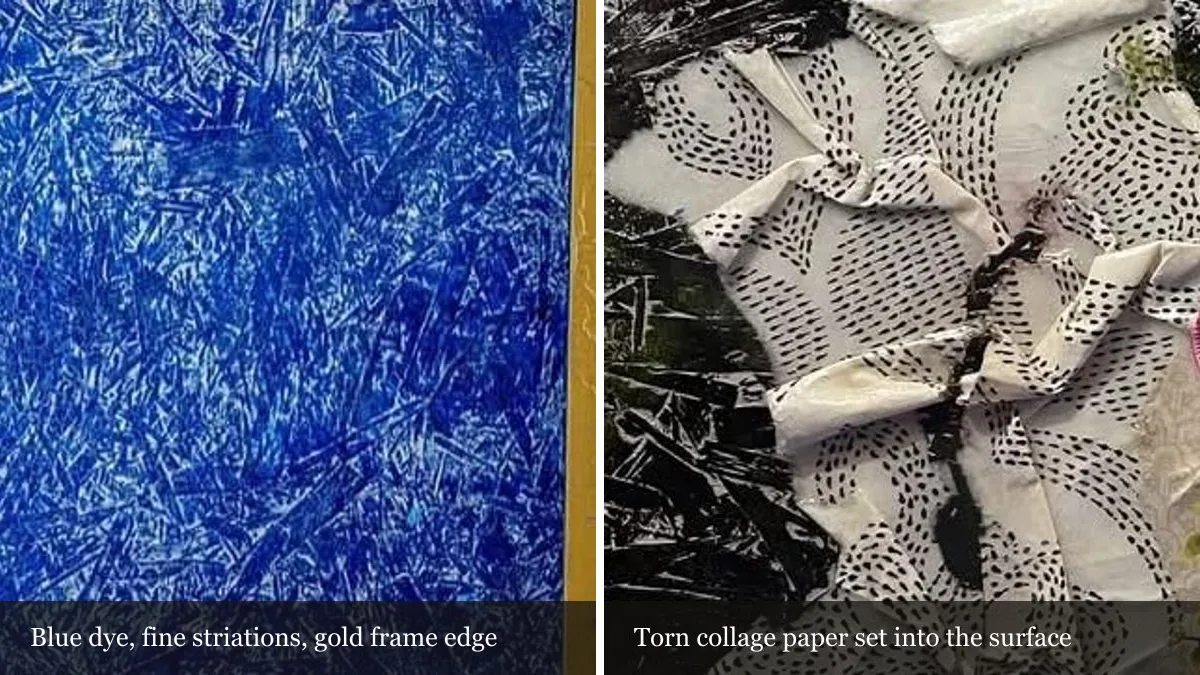
The catalogue describes it as a fine glitter of ground glass or crystal, scattered into a layer while that layer is still wet so it sets into the surface. It carries no colour of its own. In flat daylight it reads as plain texture, and it only sparks when a light source strikes it at an angle. No diamonds are involved.
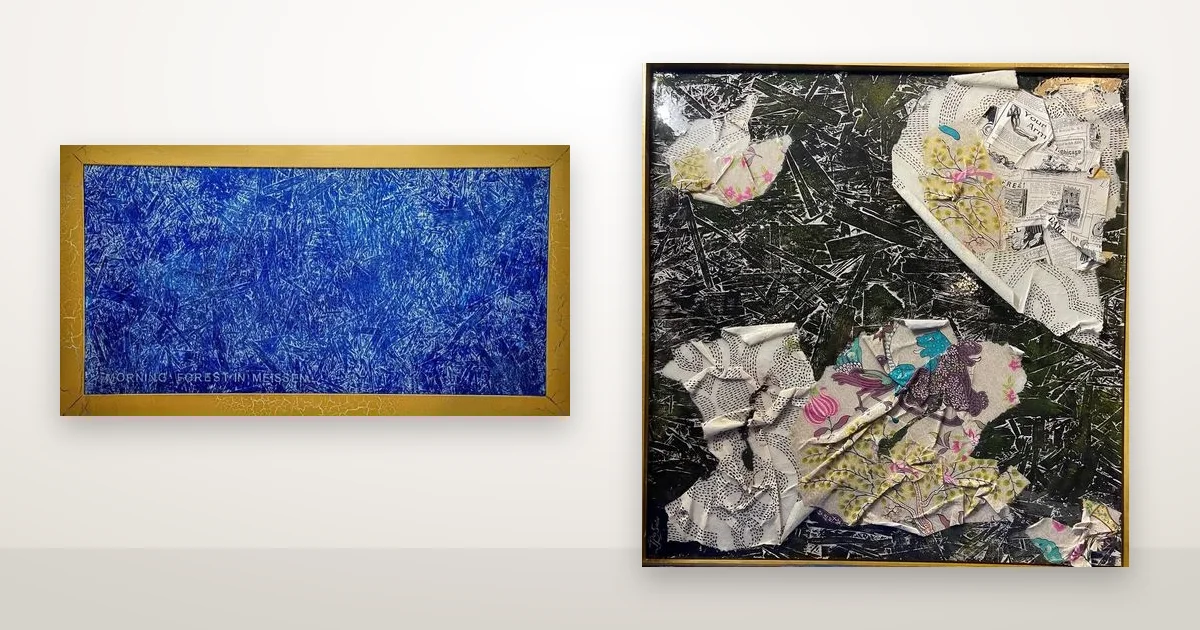
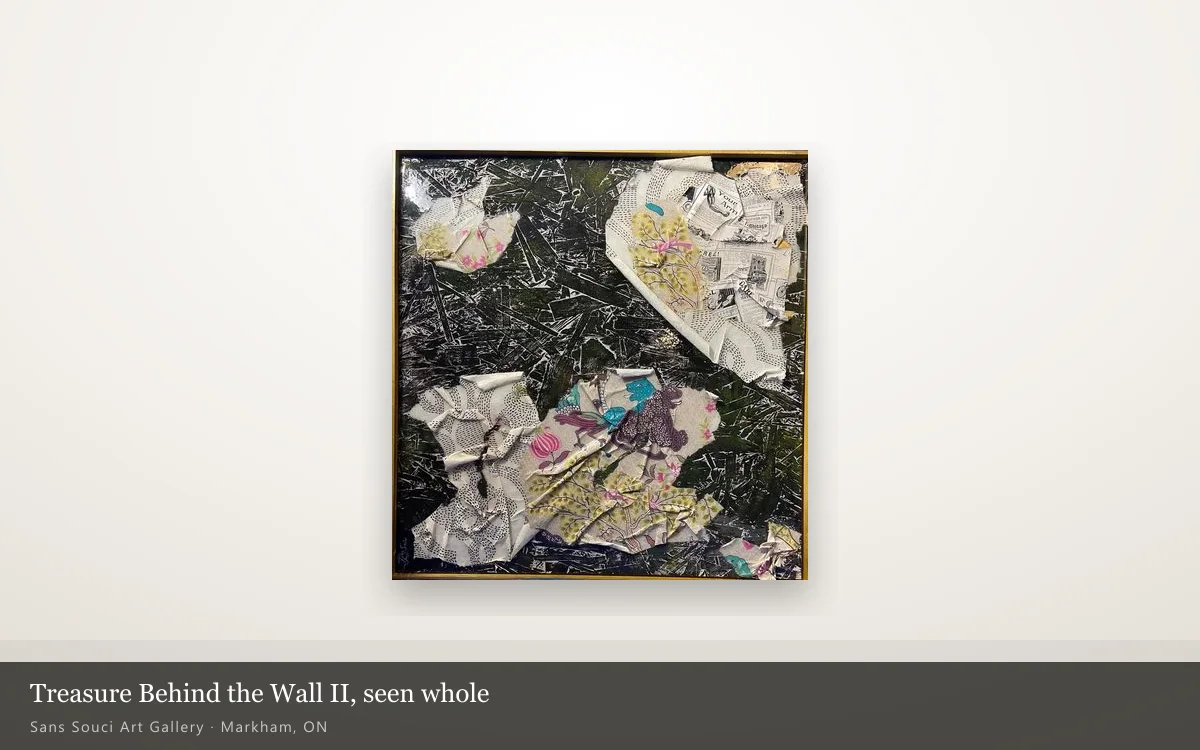
It is also rare here. We fetched all sixty-one artwork pages and read the materials line on each: diamond dust is named on exactly two. Morning Forest in Meißen (2023) lists “acrylic, natural dyes, resin, wax paste, and diamond dust on wooden board (framed)” and measures 52 × 28 in. Treasure Behind the Wall II (2024) lists “acrylic painting, collage, diamond dust on wood”. Both are available.
On the second of those the artist points at the material directly: “The shimmering diamond dust on its surface captivates anyone who takes the time to notice it.” The phrase that matters there is takes the time. From the doorway you see torn wallpaper on a dark ground. The glitter is what you get for stepping closer and moving.
Where gold actually appears in this catalogue
Gold is never listed as a material on any of the sixty-one artwork pages. It appears three times in the artist’s own descriptions instead: as gold powder, as touches of gold, and as golden pastes. So when you read the word gold here, it means a metallic particle or paste worked into the paint. Nothing is described as gilded, and no page claims gold leaf.
- Morgenwald in Meißen (2022) — “a touch of gold powder is visible here too, as a reminder of why it all started.”
- Morning Forest in Meißen (2023), a later version of the same subject — “layered textures, natural dyes, and subtle touches of gold.”
- Hamsin (2025) — “rich textures, golden pastes, and the evocative hues of rust”, where “the metallic sheen of gold juxtaposes decay with a faint glimmer of vitality.”
Two other works carry gold in the title and nowhere else: Golden Night, and Zwei Goldfische, which is German for two goldfish. A title is not a materials list. On this site the materials list is the short line printed directly under the artist’s name, and that line is the one to read.
What both of them do to light
A pigment scatters light back in every direction, which is why a matte colour looks the same from anywhere in the room. A reflective particle sends light back along one path instead. Diamond dust and metallic paste therefore do not change what colour a painting is. They change how much of it reaches you, and from where you have to be standing.
Three things follow from that, and all three are practical. The work has more than one state, and dull and lit are both true of it. A photograph can hold only one of those states, which is why both of these pieces look quieter on a screen than on a wall. And the surface the particles sit in decides how the sparkle behaves: a broad reflective face gives one large sheen that the glitter has to compete with, while an open surface leaves the glitter as the only bright event on the piece.
That difference is visible between our two examples. Morning Forest in Meißen names resin among its materials; Treasure Behind the Wall II does not. Neither page records the order the layers went on, so we are not going to guess it. What they do record is enough to compare.
| Morning Forest in Meißen (2023) | Treasure Behind the Wall II (2024) | |
|---|---|---|
| Materials as listed | Acrylic, natural dyes, resin, wax paste, diamond dust | Acrylic painting, collage, diamond dust |
| Support | Wooden board, framed | Wood |
| Size on the page | 52 × 28 in (132 × 71 cm) | Not listed |
| Poured coat named | Yes — resin | No |
| What the sparkle sits in | A broad blue field of dye and raised paste | Torn collage fragments on a dark ground |
| Status | Available | Available |
How should you light a piece with glitter or metal in it?
From the side, not head-on. The Canadian Conservation Institute’s note on track lighting puts a figure on it: as the angle between the beam and a line perpendicular to the surface grows, the light level drops, and angles greater than 60° “will accentuate surface detail and texture”. The institute raises that as an effect some displays would rather avoid. On a surface like these two it is the entire point.
- One adjustable spot, aimed from above and to one side, does more for these works than two lamps sitting flat against the wall.
- A light placed directly in front sends back one bright reflection and flattens everything around it.
- Daylight from a side window does the same job at no cost, and it moves through the day. We set out the angles in where to hang a textured piece.
- Keep the work out of long hours of direct sun whatever you choose. The CCI guidelines on storage and display for paintings set out the conditions in plain language, and the note on track lighting covers the fittings.
- Handle a piece like this by its edges. Treasure Behind the Wall II has collage elements standing proud of the ground, and anything that stands proud is what a cloth or a sleeve catches first. Routine care is in our note on looking after an original.
What to check before you buy one
See it in person, and move while you look at it. A reflective surface has a range rather than a single appearance, and the only way to know whether you like the whole range is to stand in front of the piece and change your angle. A photograph, however good, has already chosen one angle on your behalf.
- Step left, step right, crouch. Note whether there is an angle at which the piece goes flat, and whether that is the angle your sofa sits at.
- Work out where the light in the room comes from, and whether any of it can be aimed.
- Ask whether the surface is sealed. That decides how it is cleaned, and how far it shifts between daylight and lamplight.
- Ask what the sparkle is made of. On these two the catalogue says ground glass or crystal.
Both works are available and sit in the main artworks catalogue. If you want to see how either one behaves under real light, viewings are by appointment in Markham, just north of Toronto, and we would rather show you the surface than describe it — get in touch.