Buying art at a local show rarely happens in one step. At the wall you find out which painting you want to see again; the careful part of the decision (the size against your own wall, the light at home, the paperwork) usually comes after, in a quieter room. This week Sergei Troshin’s paintings hang in Vivid Passion at 105 Gibson Centre in Markham, and we use that wall below to show what to look at, what to write down and what to ask before you leave.
The show runs on weekends until Sunday, October 25, 2026: Saturday, October 24 from 1 to 8 PM and Sunday, October 25 from 2 to 8 PM, at 105 Gibson Drive, with free admission and free parking. Sixteen master-class artists and more than thirty emerging artists take part, and 10% of what sells goes to the centre’s community services.
What a show room does to a painting
A painting at a community show is seen in conditions it will never meet in your home. Four of them change what you see.
- Neighbours. Dozens of artists share one open area, so a quiet work can look faint beside a loud one, and a strong colour can look stronger than it will on a bare wall.
- Light. Shows are lit with what the venue has: ceiling fixtures, daylight from a window, or clamp lamps fixed to a display grid, which is how Sergei’s corner was lit at the Heintzman House shows in 2024 and 2025. The angle matters. The Canadian Conservation Institute’s note on track lighting recommends a beam at 60° to the horizontal and notes that angles greater than 60° accentuate surface detail and texture.
- Distance. In a busy hall you often see a work from three or four metres, over other visitors, or from a few centimetres when you finally reach it. Your living room will give you something in between.
- Time. Most people give each wall a minute or two. A painting you live with gets years.
None of this is a reason to distrust what you felt in front of a work. It is a reason to collect enough information to check that feeling later.
What to write down before you walk away
Five minutes at the wall saves a lot of guessing afterwards. Do it in this order.
- Photograph the label: title, year and medium. It is the fastest way to find the work again in the artworks catalogue, where each page lists the shows it has been in.
- Write down the size, or ask for it. A painting on a crowded wall almost always looks smaller than it is.
- Take one photograph straight on and one from the side, close to the surface. The side view records relief that a straight photograph flattens.
- Note what hangs on either side of it. If you liked it partly because of its neighbour, you want to know that.
- Write one line about why you stopped. A week later this is the note that tells you whether it was the colour, the subject or the surface.
Then take a card from the table. On this wall the cards sit on a small round table beside the Sans Souci banner, next to a short printed note headed “How the work is made”.
Two works on the wall this week
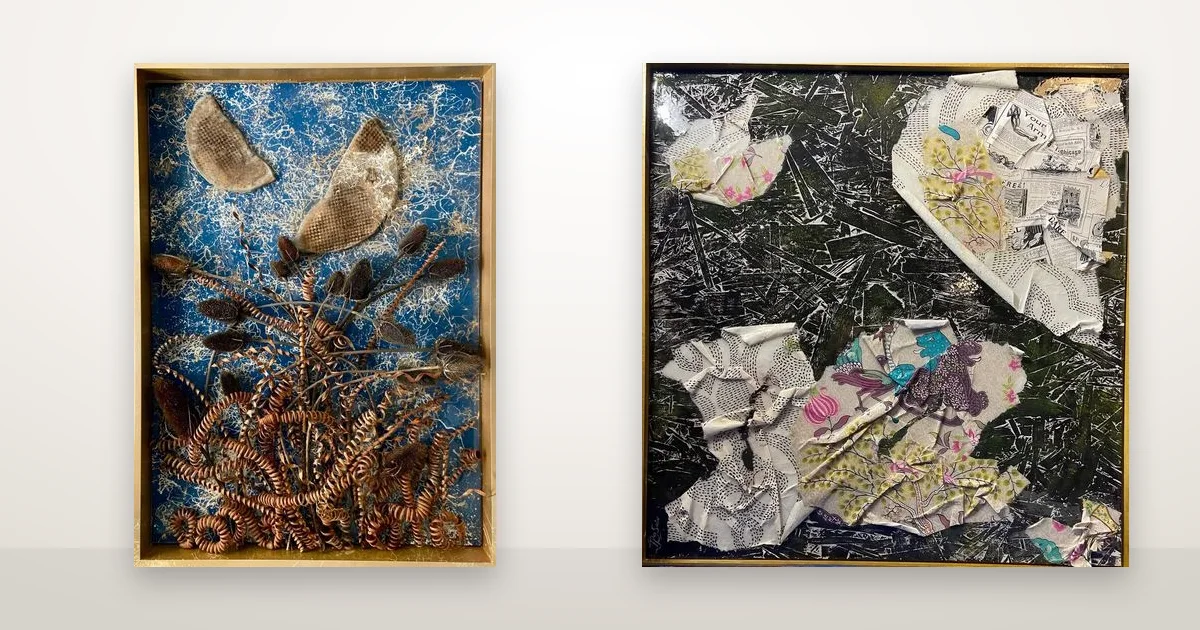
The two paintings below hang side by side at Vivid Passion, and both were at Heintzman House in April. They ask for different things when you stand in front of them.
The Choice: metal under show lights
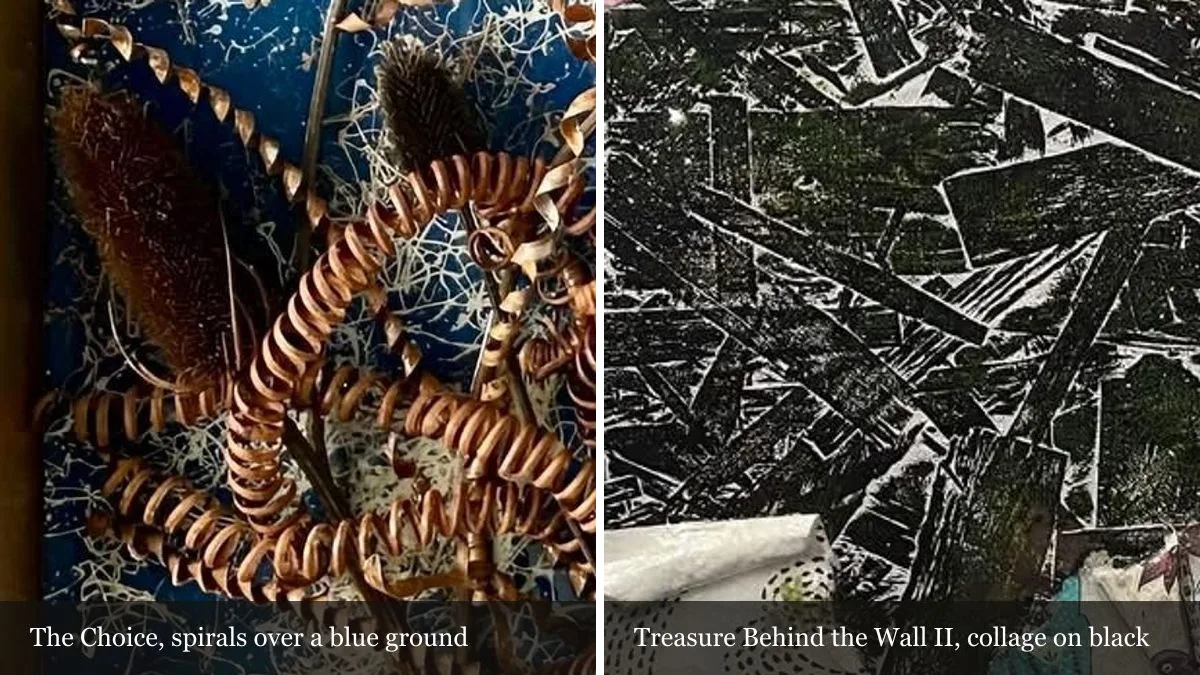
The Choice (2026) is a mixed media panel in acrylic, resin and metal elements, 15.7 by 23.6 inches, set in a deep gold-coloured frame. Copper-coloured metal spirals and dark pod shapes rise from a blue ground covered in a fine white web, and two pale half-moon shapes hang above them. The artist’s note on the catalogue page calls it a work about choosing when there is no perfect answer, and reads the two pale shapes this way:
A broken moon hangs over a restless landscape, marking a point of no return.
Sergei Troshin, on the page for The Choice
Under a lamp the metal throws shadows onto the blue and catches highlights along every coil. That is real, and it is also the lamp. Walk to one side and then the other, and look at it from where you would sit at home. If the spirals still hold your attention without the hard side light, the work will hold up in a softer room.
Treasure Behind the Wall II: a surface that needs side light
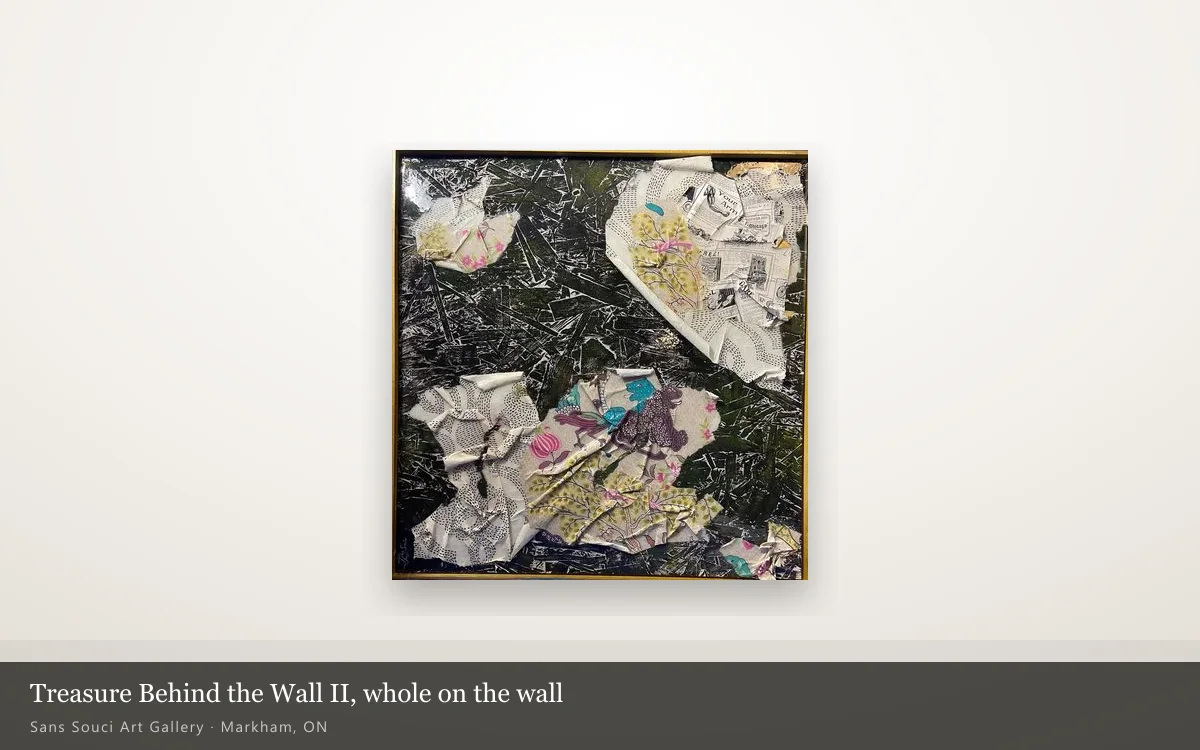
Treasure Behind the Wall II (2024) is acrylic, collage and diamond dust on wood. Crumpled pieces of patterned wallpaper and newsprint sit on a black ground scratched with white lines, and the work is set in a thin gold frame. The artist writes about walls with many layers of paper, and about the dust that rewards a slow look:
The shimmering diamond dust on its surface captivates anyone who takes the time to notice it.
Sergei Troshin, on the page for Treasure Behind the Wall II
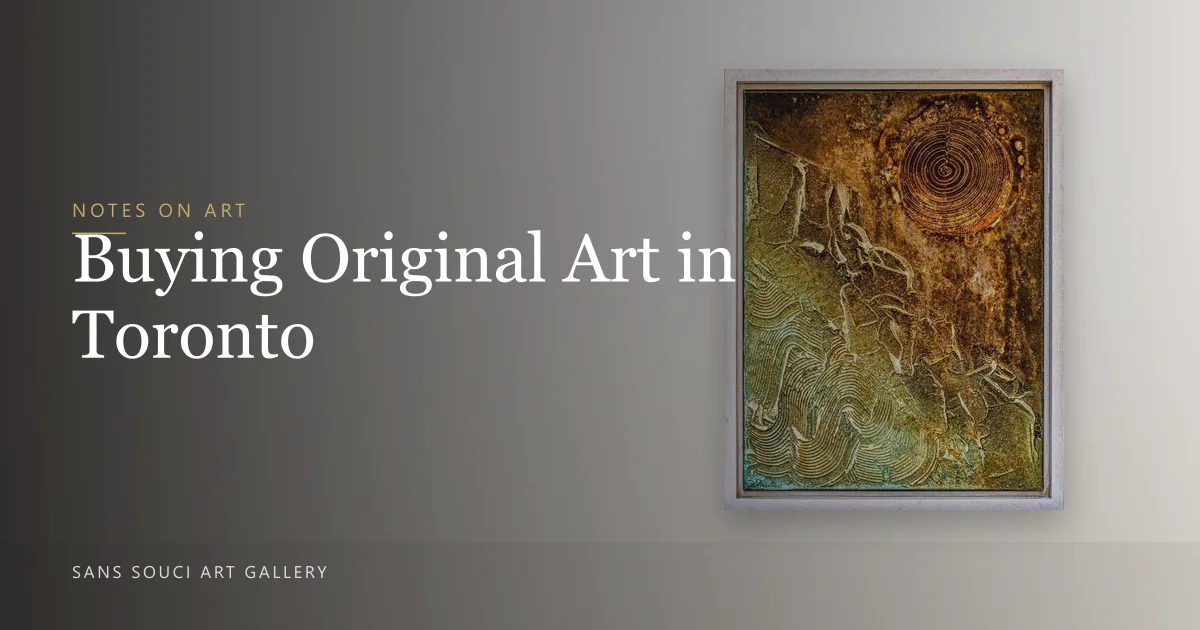
At a show this is the work to see from the side and up close. The collage sits proud of the ground, so its folds show best when light comes across the surface, and reflective particles only flash at certain angles, as we explained in our note on diamond dust and light. Look, but keep your hands off: the CCI note on basic handling of paintings says most paintings are susceptible to marking and soiling, and that painted edges are part of the work and should not be touched.
What the show can tell you, and what a studio visit adds
A show and a studio viewing answer different questions. Use both.
| Question | At the show | At a studio viewing |
|---|---|---|
| Does the work hold me? | Yes, this is where you find out | You check that it still does in a calm room |
| How does the surface behave? | Under the venue’s lamps and among other works | Under light you can move, alone on a wall |
| How big is it really? | Hard to judge on a crowded grid | Easier, and you can bring your wall measurements |
| What else is there? | Only what fits on one wall | The rest of the catalogue, by appointment |
| How is it made? | The printed note and, if he is there, the artist | Time to ask about every material on the label |
If a work stays with you after the show closes, the studio is at 473 Simonston Blvd, Markham, and viewings are by appointment.
What an “Exhibited” line records
Both works above now carry an Exhibited line on their catalogue pages: Vivid Passion at 105 Gibson Centre in October 2026, and the Heintzman House Art Show and Sale in April 2026. It is a plain record of where a painting has been shown in public. For an owner it becomes part of the work’s history, the kind of detail that belongs in your own file next to the receipt and the certificate of authenticity. Every show Sergei has taken part in, with dates and photographs from the day, is on the exhibitions page.
If you do take a painting home from a show, plan the trip before you pick it up: a blanket in a clean car, the work carried by its frame and never by the face. Our note on taking a painting home by car covers the drive itself.
Saw something at the Gibson Centre, or want to see the rest of the work in a quieter room? Send us a message or call +1 (416) 919-8331 to arrange a viewing in Markham.