Most enquiries here begin the same way. Someone has found a painting on a phone screen, likes it, and wants to know what happens next — whether there is a price, whether the piece can be seen, whether it is even still available. Buying original art in Toronto through a small gallery works differently from buying almost anything else, and very little of that difference is written down anywhere. So here it is, plainly.
Where the gallery actually is
Sans Souci Art Gallery is a studio gallery at 473 Simonston Blvd in Markham, Ontario, just north of Toronto and inside the Greater Toronto Area. There is no shop window on a busy street. Viewings are arranged by appointment, daily between 9:00 and 18:00, and the address is the studio as well as the gallery — the paintings are shown in the room where they were made.
Most galleries represent several artists and sell work they did not make themselves. That is a normal arrangement and it has real advantages — a wider choice, and staff who compare artists for a living. A studio gallery gives up the choice and gains something else: the catalogue here is one painter’s output, 61 originals to date, so a question about how a surface was built has a first-hand answer rather than a second-hand one.
Why the artwork pages do not show a price
Prices are shared on request, and there is no online checkout anywhere on this site. Every piece is one of a kind, the sizes run from small panels to four-foot boards, and shipping differs for each one — so a single number under a photograph would be incomplete for most of them. Ask about a title and the price, the availability and the delivery options arrive together.
Practically, that means one email or one phone call does the whole job. The title of the piece is enough to start with; you do not need a code, a reference number or an account. If the work turns out to be sold, that answer comes back just as quickly.
Why a viewing changes what you are looking at
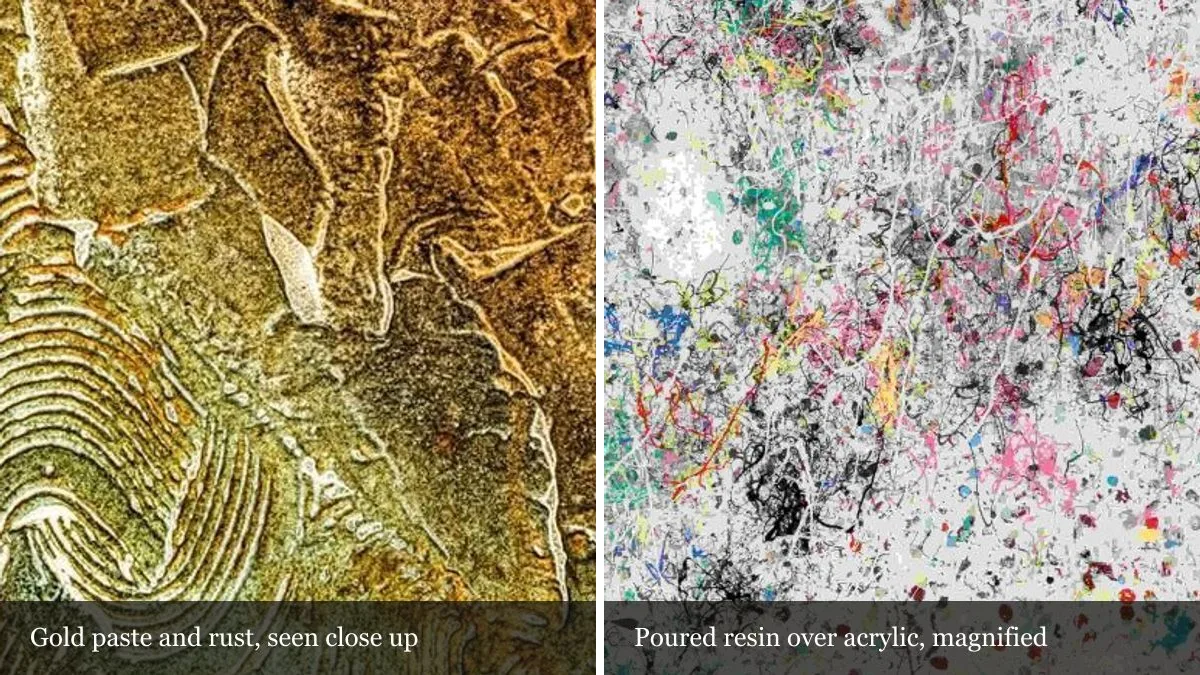
A photograph records colour well and surface badly. It flattens a raised, worked texture into a pattern, and it turns a poured resin coat into either a dull sheen or a patch of glare, depending on where the camera stood. Those are exactly the parts of a painting that move when you move.
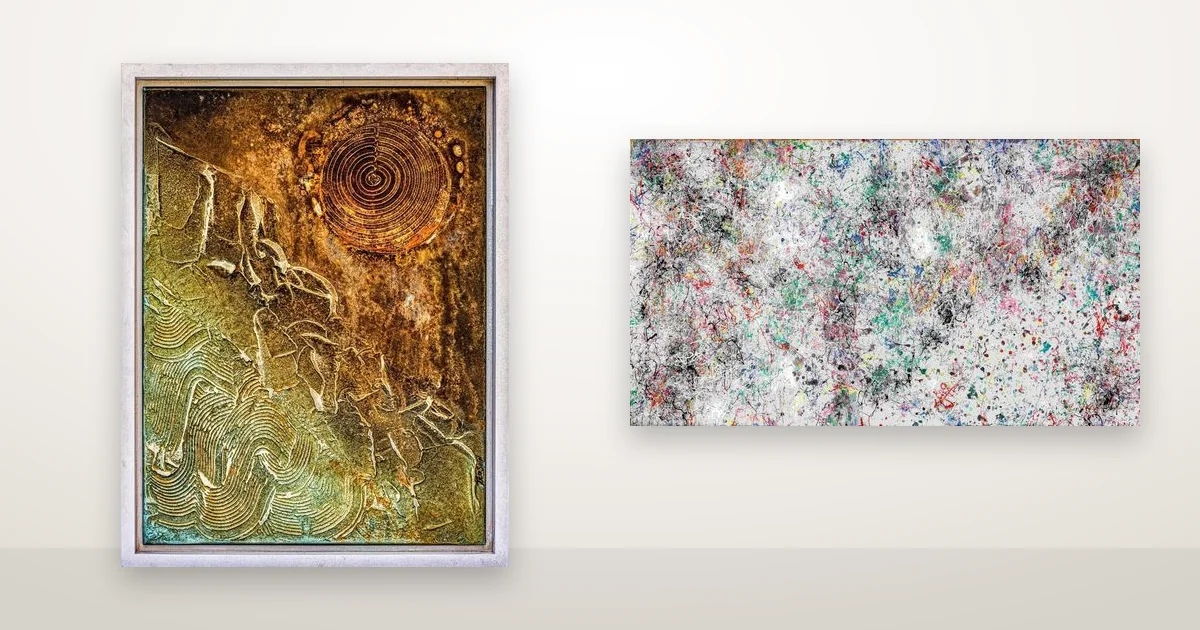
Two works in the catalogue show it from opposite directions. Hamsin (2025) is mixed media on canvas, 18 × 24 in, built up in golden pastes and rust-coloured passages around a concentric spiral. The artist’s note on its page describes an oppressive desert wind that leaves “an overwhelming sense of disorientation and unease”. With a lamp set to one side, the raised material throws its own small shadows and the spiral reads clearly across the room. Photographed straight on under flat, even light, much of that relief simply disappears.
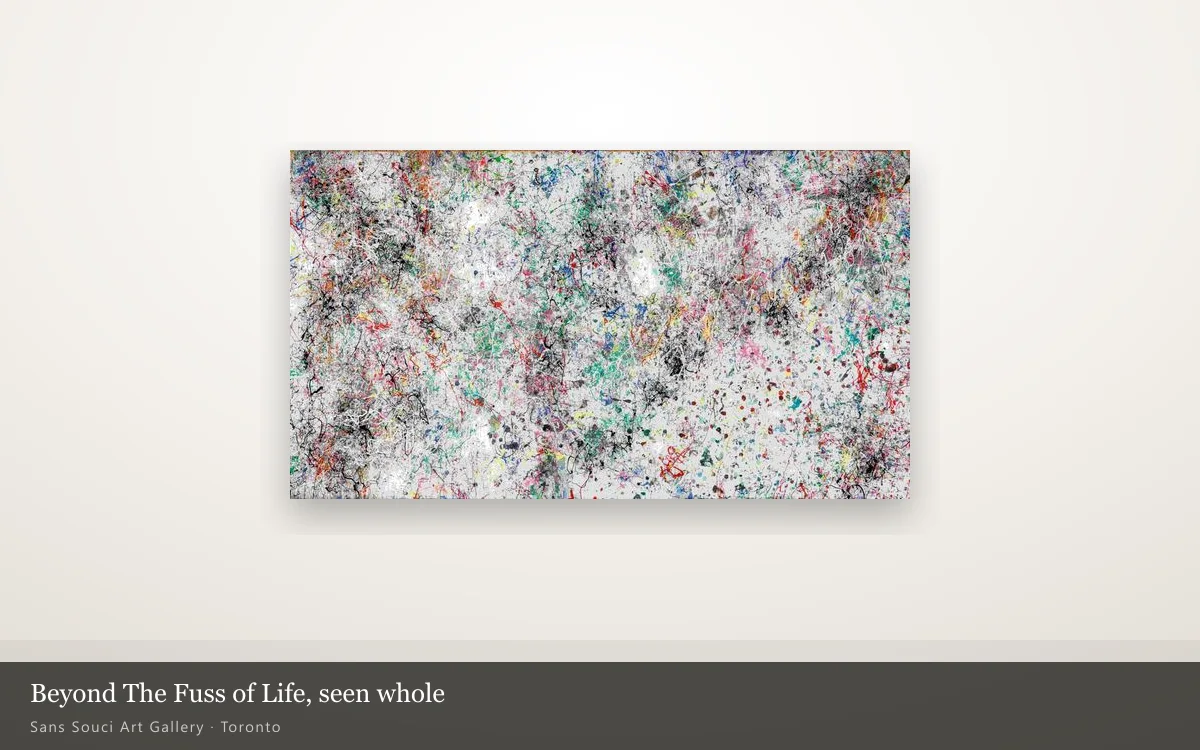
Beyond The Fuss of Life (2019) has the opposite problem. It is acrylic on a wooden board sealed under a poured resin coat — a hard, glass-like film that seals the surface and gives it a reflective front, rather like glazing without the glass. The painting under that coat is a dense scatter of coloured lines and flecks over a near-white ground, three feet wide, and the resin holds all of it behind one continuous, even face. In a room, that face collects the window and the lamps, so the whole surface shifts as you walk past it. A photograph has to pick one angle, and at that angle the sheen is either missing entirely or reduced to a single flat highlight.
| Hamsin (2025) | Beyond The Fuss of Life (2019) | |
|---|---|---|
| Materials | Mixed media on canvas | Acrylic on wooden board, sealed with resin |
| Size | 18 × 24 in (45.7 × 61 cm), upright | 36 × 20 in (91.4 × 50.8 cm), horizontal |
| Surface | Raised paste and pigment, open and matte | Poured resin, hard and reflective |
| What a photograph loses | The relief, and the shadows it casts | The sheen, and how it shifts as you move |
| Light it wants | Light raking across it from one side | Away from direct sun and facing lamps |
| Status today | Available | Sold, and still catalogued |
If you are still working out what you respond to, volume helps more than reading does. An afternoon in the collection at the Art Gallery of Ontario downtown will teach you more about your own taste than any website, this one included. Come here afterwards with a clearer question.
Available, Sold, Private Collection
Every artwork page carries one of three states. No label means the work is available. Sold and Private Collection both mean it has found its owner and is no longer for sale — and both stay online on purpose, as an archive of how the work developed. We explain the wording in detail in what the Sold and Private Collection labels mean.
So a sold piece is still worth writing about. Beyond The Fuss of Life belongs to someone else now, but it is a plain example of what a poured resin face does, and pointing at a piece is often the fastest way to describe what you want from a commission or from a related work in the same series.
What happens once you decide
The sequence is short. We confirm the piece is still available and what it costs, agree how it will reach you, and the work leaves the studio with its paperwork.
- A Certificate of Authenticity. Every artwork leaves with one, signed and sealed by the artist. It records the object rather than a valuation — here is what a Certificate of Authenticity actually records, and why it matters years later rather than on the day.
- Packing and shipping. Works are packed individually and shipped across Canada and internationally. Shipping is quoted per piece, because size, weight and framing differ every time.
- Or collection in person in Markham, which skips the shipping quote entirely.
- Commissions. If the piece you wanted is gone, a specific size for a wall or a work in the spirit of one already sold is a normal request, not an awkward one.
Making the visit worth the trip
Four things make an appointment far more useful, and none of them takes long. They are the same four we ask about when someone writes in.
- Name the titles. Tell us which pieces caught your eye — the title alone is enough — so the right works are the ones in front of you.
- Measure the wall first. Height, width, and what sits under it. Scale is the thing screens get most wrong; we wrote about that in choosing a size for a wall you cannot re-measure.
- Photograph the wall at the hour you are usually in the room. Morning light and lamp light are two different rooms as far as a textured or resin-sealed surface is concerned.
- Suggest a couple of times. Viewings run daily, 9:00 to 18:00, by appointment.
It is also fine to book a viewing without deciding anything. Someone who leaves knowing that heavy texture is not for them has learned something the photographs were never going to tell them.
The whole catalogue is on the artworks page, and if a title has already stayed in your head, write to us or call +1 (416) 919-8331. Tell us the name of the piece; we will tell you whether it is still here, and when you can come and see it.