It happens in a second, and always at an ordinary moment. A vacuum handle swings into the bottom edge. A chair goes back too far. A sleeve catches a corner while you are carrying something else across the room. What happens next is the part you control.
This is what to do if a painting is damaged in your home, written for the kind of work we sell: one of a kind, with no second copy anywhere and no reprint to fall back on.
What should you do first?
Stop, and do not touch the damaged area. Photograph the whole work, then the damage close up, in daylight, with a coin beside it for scale. Write down the date and what happened. If the piece is still hanging safely, leave it hanging. Then ask someone before anyone repairs anything.
The order matters. Photographs taken before anything is moved or wiped are the only record of what the damage actually looked like, and they are what a conservator, an insurer and we will ask for. A photograph taken after a well-meant clean records two events instead of one.
If the work does have to come off the wall — a hook has pulled out, water is still coming in — take it down with two hands on the edges and lay it face-up on a padded flat surface rather than leaning it against furniture. If anything on it is loose or lifting, leave it lying face-up until someone has looked at it.
The instinct to resist: do not clean it
Do not try to remove the mark yourself, however small it looks. The Canadian Conservation Institute's note on precautions when cleaning paintings is blunt about it: "Do not attempt to remove even a minor blemish from a painting. Inexpert attempts to clean may cause an even more unsightly spot and could result in permanent damage to the painting."
That warning matters here more than it would for an old oil painting, because 56 of the 61 pages in this catalogue name acrylic on their materials line. The same note says that "acrylic emulsion paintings, for example, do not tolerate even mild organic solvents," and that water-based cleaning can leach water-soluble components out of acrylic paint. A liquid also does not stay where you put it: it "rarely penetrates only one layer," and travels through cracks into the ground and the support underneath.
The list of things not to reach for is longer than it looks:
- Water, spirits or any household cleaner — including the ones sold as gentle, and including a cloth that is merely damp.
- A dust cloth or a feather duster on an exposed paint surface. CCI's reason is specific: threads "may catch on areas of raised paint (impasto)," and paint can be lifting in flakes too small to see from a metre away.
- A vacuum, or canned air. The note says never to use either on a painting surface: the propellant can damage paint and the air can lift flakes off an unstable one.
- Tape, glue or anything adhesive to hold a torn or lifting piece in place while you decide.
- A touch-up in matching paint. Once new material is on the surface, removing it becomes part of the job.
None of that means a piece can never be dusted. Our own product pages say to dust with a dry, soft cloth and to keep solvents, household cleaners and anything abrasive away from the surface, and on a work finished with a cured resin coat the cloth meets the coat rather than the paint. CCI's reasons — threads catching raised paint, flakes too small to see — are reasons about paint that nothing is covering. So the question is what sits between the cloth and the paint, and that is decided by how the piece was built.
Two works, two different accidents
The same knock does different things to different constructions. Two pieces here sit at opposite ends of that range.
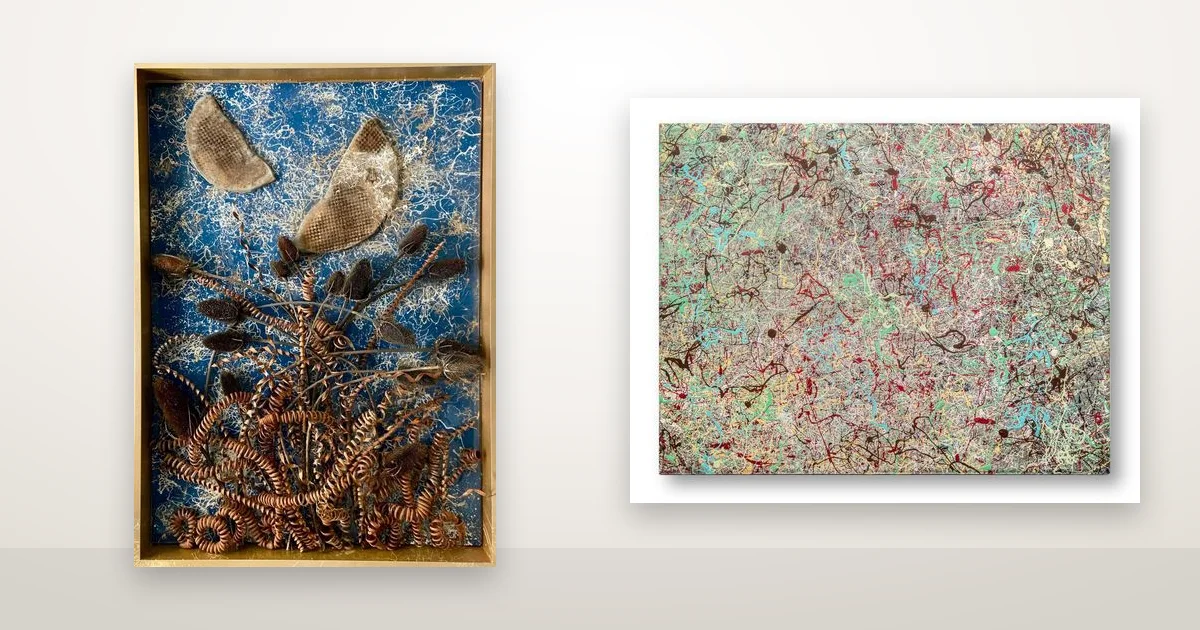
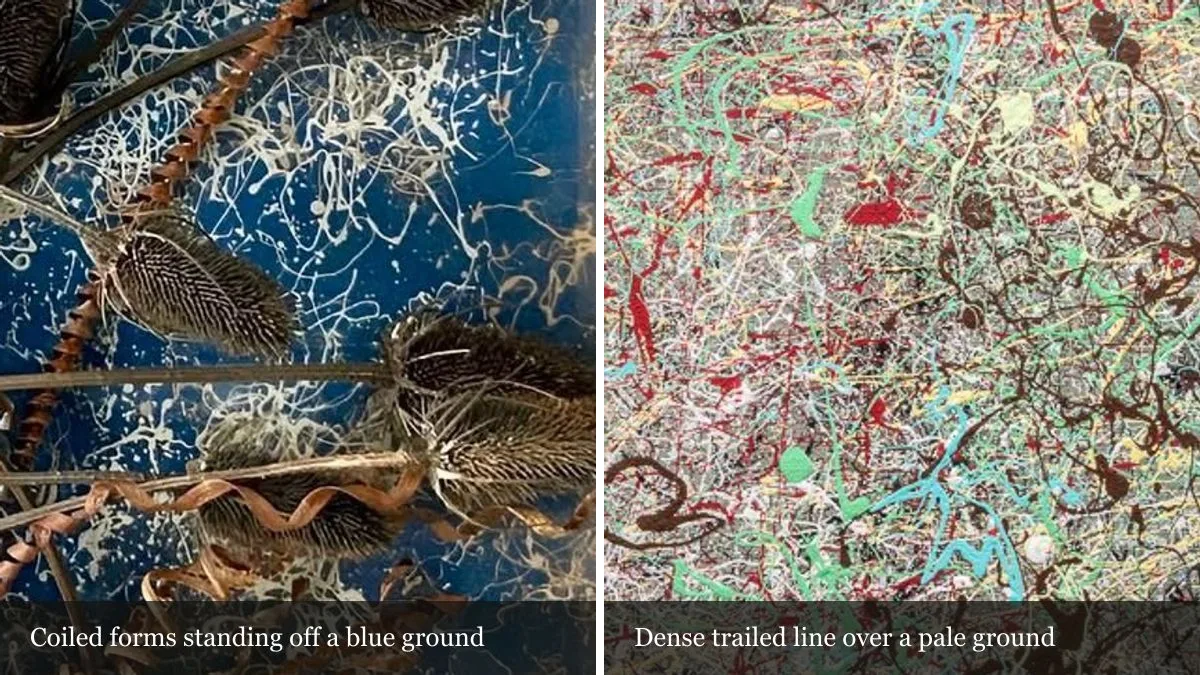
The Choice is described on its page as a mixed media installation — acrylic, resin and metal elements on panel, 15.7 × 23.6 in. Its surface carries applied parts: coils, spines and two pale slabs standing away from a deep blue ground. Its own page says what that means in practice: "Applied elements sit proud of the surface, so handle the work by its edges and lay it face-up if it is ever off the wall." They are what a sleeve, a duster or a passing box reaches first, before anything touches the paint. What the page does not say is how each one is fixed — which is the thing to ask us before cleaning around them or moving the piece.
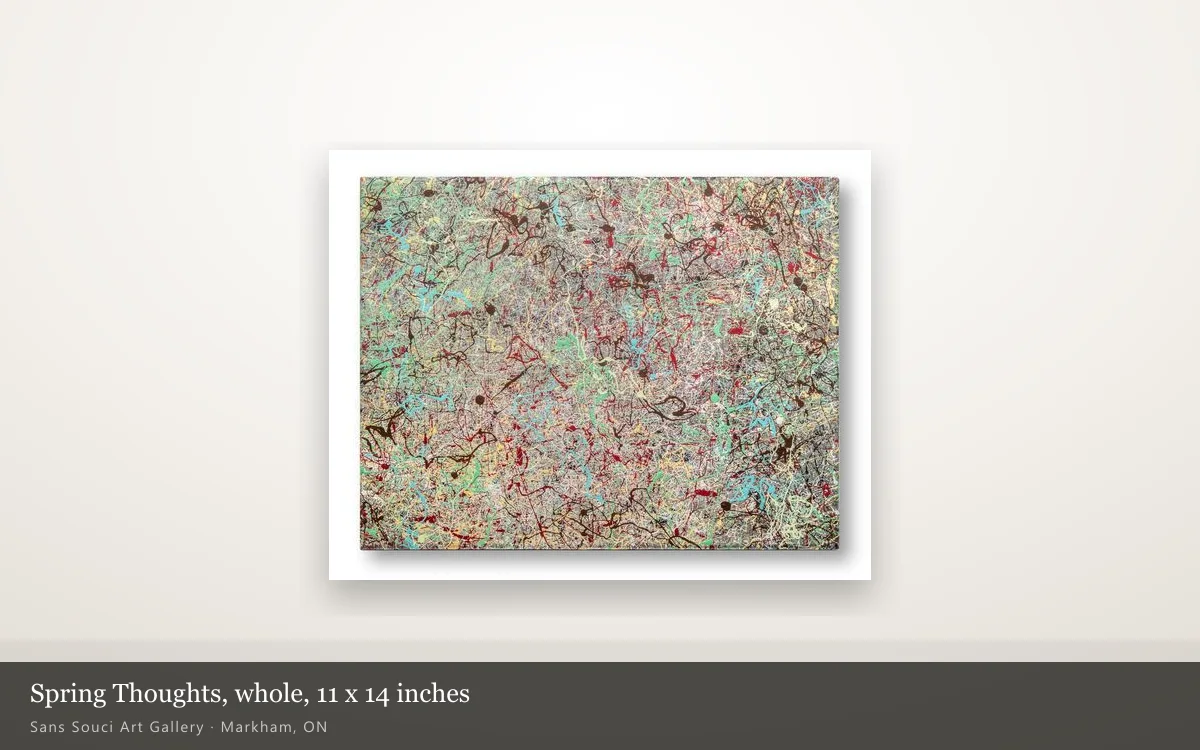
Spring Thoughts is the other case: acrylic on canvas, 11 × 14 in, a dense web of trailed brown, red, turquoise and cream line over a pale ground. Its materials line names no coat over the paint. There is no hard film between a cloth and the surface here, and canvas has give — it can be pushed through from the front, or dented from behind by something leaning against the wall.
| The Choice (2026) | Spring Thoughts | |
|---|---|---|
| Materials line | Mixed media installation: acrylic, resin, metal elements on panel | Acrylic on canvas |
| Stated size | 15.7 × 23.6 in (40 × 60 cm) | 11 × 14 in (27.9 × 35.6 cm) |
| Support | Panel — rigid, will not flex | Canvas — has give, can be pushed through |
| Face | A poured resin coat over the paint | Paint, with no coat named over it |
| What a knock reaches first | The applied elements standing proud | The paint itself |
| Off the wall | Face-up, by the edges — its page says so | Two hands on the edges; nothing on the face |
| Ask us before touching it | How the applied elements are fixed | Whether any trailed line stands proud enough to catch |
Water is the one that cannot wait
A burst pipe, an overflowing bath upstairs or a leaking radiator is the one accident where acting the same day matters. CCI's note on emergency treatment of water-damaged paintings makes the reason plain: "the effects of water contact may not occur immediately but may take minutes to hours to develop," and simple air drying "may not be suitable for most wet paintings because layers will react at different rates."
The supports it names as reacting to moisture are canvas, wood, hardboard and laminated card — near enough the whole of this catalogue. Wet canvas can shrink hard enough to crack and flake the paint on it; wood swells and warps.
What the Institute says a non-specialist can do, if expert help is not immediately available, is worth knowing before you need it. Check the room is safe to enter. Contact a conservator for advice. Move the work to a dry place — tilting it as you lift so water drains off, both hands, two people for anything large, avoiding the painted surface — and lay it face-up on a clean flat surface, on blocks 10–15 cm (4–6 in) high under the corners so air circulates on all sides. The holding conditions it gives are cool, at a moderate 40–60% relative humidity. If mould appears, get advice rather than wiping it.
It is also why a work waiting out a move should not wait in a basement, which we cover in storing a painting at home.
Who to call, and what to tell them
Call a conservator, rather than a framer, a decorator or a furniture restorer. The Canadian Association for Conservation of Cultural Property explains what conservation actually is and points anyone seeking advice to the Canadian Association of Professional Conservators, "a non-profit organization that conducts a peer-reviewed accreditation process as a requirement of membership."
The difference between that and a handy repair is written into how conservators work. Treatments should be removable later and must not contribute to future damage; a repair should stay recognisable as a repair on close examination; and the work is documented in writing and photographs, before and after. A touch-up done at home meets none of those three conditions.
Tell us as well. We know what each work is made of and how it was built, which is what a conservator needs to be told and what a photograph does not show. The Certificate of Authenticity identifies the object itself, which is what that certificate is for. Significant damage also belongs in the record you keep for insurance, set out in insuring an original you own.
The ordinary care that keeps most of this from arising is genuinely short, and we have written it down in how to look after an original. If something has already happened to a piece of ours, or to one from the artworks in the catalogue, photograph it, leave it alone and tell us what happened. We will tell you what we know about that piece, and say plainly when the answer is a conservator rather than us.