How long does a painting take? It is the question visitors ask most often in front of an original, and an honest answer is rarely a number of hours. Where Sergei Troshin writes about time on his artwork pages, he counts in days and in lines, and on the resin pieces part of the time is simply waiting for a clear coat to set before the next line can go on.
So instead of a figure, this note looks at where the time in a painting actually goes, using what the artist wrote on his own artwork pages and two available works.
On one work, Fluently Python, he simply says it "took me a while to get it done". On others he puts a measure on it: "as many lines, as many days of work". That sentence, or a close version of it, appears on 9 of the 61 artwork pages in our catalogue. We counted them this week. It is a painter's measure rather than a clock: the work is as long as the lines it holds.
Where the time in a painting goes
A finished surface holds four kinds of time. Some of it you can see, some you can only infer, and one kind leaves no mark at all.
| Kind of time | What the artist wrote | What you can see |
|---|---|---|
| The line | "The entire labyrinth of lines was drawn by hand" (DaDa 2020) | Lines crossing lines, each one laid down separately |
| The layer | "Every layer of my abstract lines is sealed with a coat of crystal clear epoxy" (Transience) | Lines that sit at different depths under a glassy face |
| The wait | "Sometimes they are up to ten floating layers there" (Transience) | Nothing directly, but every floating layer needed its coat to set first |
| The looking | "Layer by layer!", from the note on Fluently Python | Nothing. Time spent deciding leaves no trace on the surface |
The first two are the ones a buyer can read. The third is set by the material rather than the painter, and the fourth is the part every artist finds hardest to count.
Two works, two places the time went
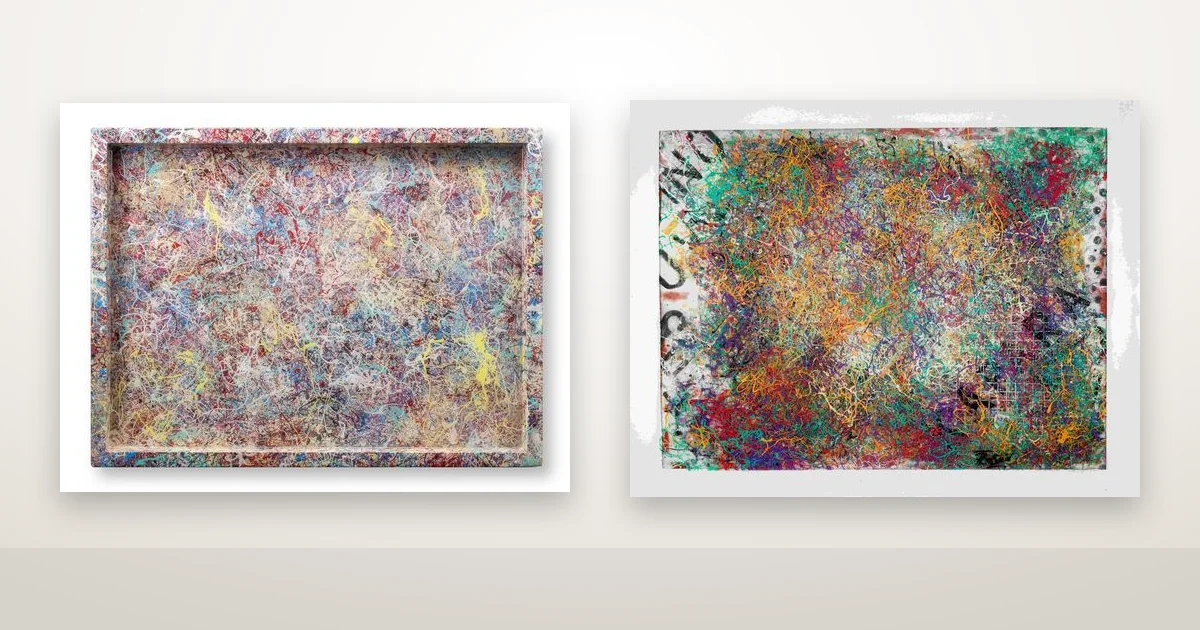
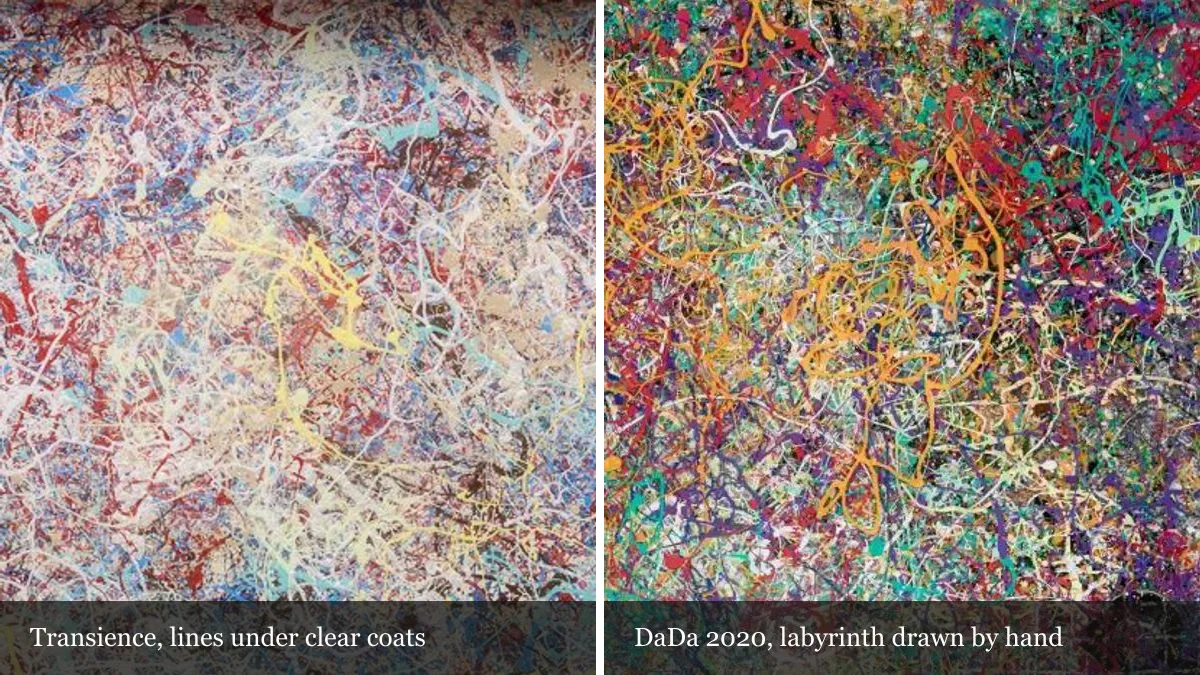
Both paintings below were finished in 2020, both are dense webs of colour, and both are available. From across a room they look like relatives. The time inside them was spent differently.
Transience: time held in sealed layers
Transience is acrylic on a wooden board sealed with resin, 12 by 16 inches. Its page carries the artist's full note: each layer of lines is sealed with a coat of clear epoxy, and there can be up to ten of these floating layers. That means the painting was not made in one pass. Lines went down, a coat went over them, the coat had to set, and only then could the next set of lines go on top. A surface built this way shows its lines at slightly different depths when you move past it, and that depth is the visible record of separate sessions. We wrote more about reading that kind of depth in our note on layered surfaces.
DaDa 2020: time spent by the hand
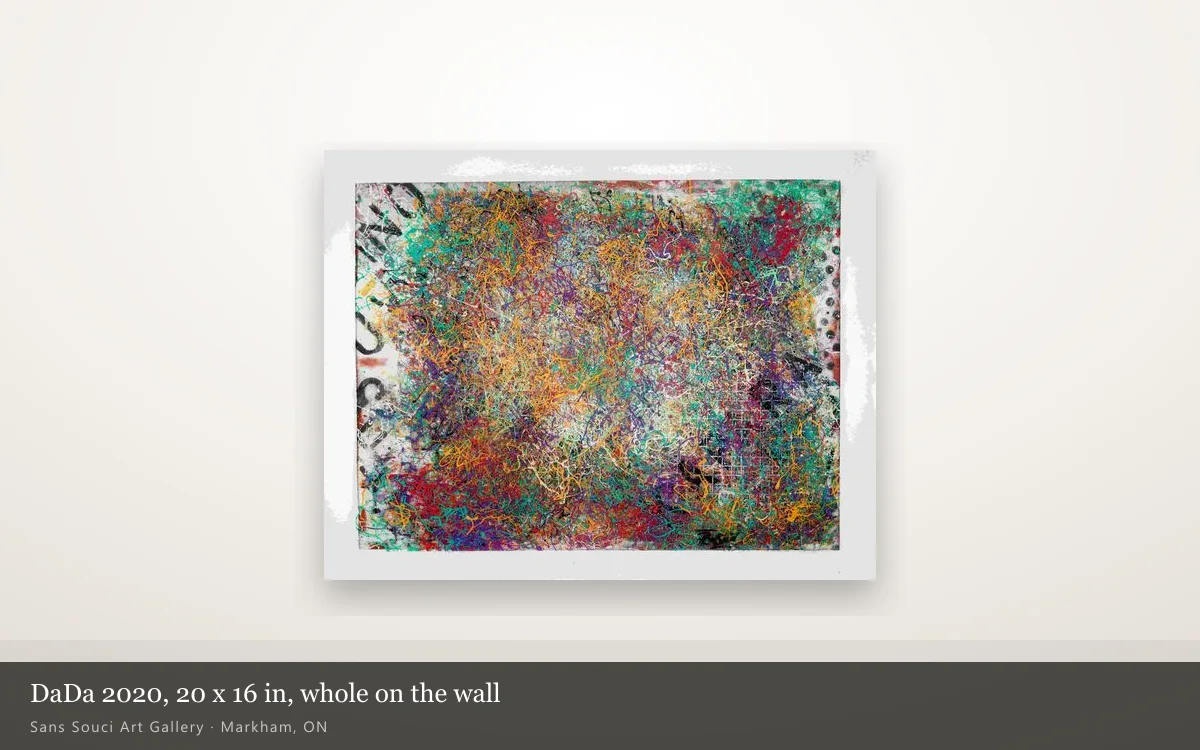
DaDa 2020 is acrylic and resin on fibreboard, 20 by 16 inches. The artist's note is about protest and "expressive nonsense", and then it turns to method: the whole labyrinth of lines was drawn by hand, and "as many lines, that many days of work it took". In its catalogue photograph you can also see stencilled letters along the left edge and a fine grid in the lower right, under the tangle. Here the count is in the line itself. The more you look, the more separate strokes you find, and each one was a decision.
Why the waiting cannot be hurried
Paint and resin set in different ways, and the slower of the two decides the pace of a layered work.
- Acrylic is quick. Tate describes acrylic as a water-based, fast-drying paint, against oil, which it calls slow-drying. The paint is rarely what keeps a layered work waiting.
- Epoxy cures rather than dries. The encyclopaedia entry on epoxy explains that the resin is reacted with a hardener and cross-links into a solid. That is a chemical reaction, so it runs at its own speed, and the same entry notes that dust from resin that is not fully cured is a health risk, which is one more reason not to work on a coat too early.
- The next lines are painted on top of the coat, so the coat has to be solid first. With up to ten layers, that wait comes round up to ten times.
This is why two paintings of a similar size can take very different stretches of the calendar. A work painted straight onto a board can be finished in a run of sessions; a work built from sealed layers is paced by its coats. Tate's entry on resin covers the material more broadly, and our note on what a resin finish does in a room covers how that glassy face behaves once it is on your wall.
How to ask the question at a viewing
"How long did it take?" usually gets a shrug, because the artist does not know which of the four kinds of time you mean. These questions get better answers, and they tell you more about the work you are looking at:
- Is this painted in one pass, or built in separate sealed layers?
- Roughly how many layers are there, and can I see the deepest one from here?
- Were the lines drawn by hand, poured, or both?
- Is there anything under the lines, such as letters, a grid or collage, that was put down first?
- Was it worked on alone, or alongside other paintings from the same period?
None of these asks for a number, and every one of them sends you back to the surface to look again. If a painting is going to live with you for years, that second look is worth more than an hour count. Commissioned work follows the same logic: the materials, not a calendar, set the pace.
If you would like to see Transience or DaDa 2020 in person and ask these questions in front of them, get in touch to arrange a viewing.