

Holiday decorations and an original painting can share a room without trouble if three things stay off the painting's wall: open flame, anything warm, and anything that touches the frame. Candles go on another wall or another table. String lights and garlands go around the room, not around the picture. And if the tree needs the wall where the painting hangs, take the painting down properly for the month instead of decorating around it.
Most homes decorate the same wall that holds their best picture: the mantel, the wall behind the sofa, the dining room. That is why December is a hard month for paintings. Below is what each decoration actually sends towards the wall, why the answer depends on the surface of the work, and how to move a painting for the season without making a new problem.
What a candle leaves on the wall above it
A candle flame makes soot. The Canadian Conservation Institute's page on fire defines it plainly: soot is finely divided carbon deposited by flames during incomplete combustion, and it is damaging to cultural property. The same institute's page on airborne pollutants notes that most dust indoors is soil and fibre from carpets and clothes, with the exception of particles from cooking and from burning candles and lamps. Its advice for any source of pollution is short: increase the distance between the source and the objects.
Soot rises with the warm air, so a row of candles on a mantel deposits most of it on whatever hangs straight above. One evening leaves nothing you can see. A month of evenings is another matter, and the lighter colours are where it shows first.
How much it matters depends on the painting's surface. A work sealed under a hard, clear coat keeps the deposit on top of the coat. An open acrylic surface does not. CCI's note on how paintings deteriorate says acrylic paints tend to attract and absorb dirt at ambient or high temperatures, and that their surfaces can be particularly hard to clean. A candle under such a painting adds both things at once: particles and warmth.

Heat from lights, a lit mantel and the flame itself
The second thing December brings to a wall is warmth in one spot. String lights wound along the top of a frame, a candle on a shelf just under the picture, a lamp set close to make the decorations glow: each warms a small part of the surface while the rest of the work stays at room temperature.
For most paint that is a slow problem. For anything made with wax it is a faster one. CCI's page on incorrect temperature lists what happens as things warm up: above 30 °C mixtures based on waxy components deform, separate and form blooms, and above 45 °C waxes soften or melt, paraffin between 47 and 65 °C and beeswax at 60 °C. Air rises from a candle flame far hotter than either figure, so a surface with wax in it should never hang above one, and a warm bulb should never rest against it.
Here is the whole season decoration by decoration.
| Decoration | What reaches the painting | What to do instead |
|---|---|---|
| Candles on the mantel or a shelf below | Soot carried up by warm air; heat close to the bottom edge | Move candles to a table on another wall, or use battery candles under the picture |
| String lights on or around the frame | Warmth at the points they touch; scratches when they are pulled off | Run them along a shelf, a window or the tree, never on the frame |
| Garland or wreath hung on the frame | Weight on the hanging point, needles and sap at the edges, wire scraping the surface | Hang it from its own hook on another stretch of wall |
| Tree right beside the painting | Branches brushing the surface, needles falling behind the frame, knocks when you decorate it | Leave a clear gap, or take the painting down for the season |
| Drinks and a full room | Splashes, elbows and shoulders in passing | Keep the bar and the buffet away from the painting's wall |
If a tradition matters more than any of this, as candles on the mantel do in many homes, the painting can go on another wall for a month. That costs nothing. Cleaning soot off an open surface is a conservator's job.
Two works, two different Decembers
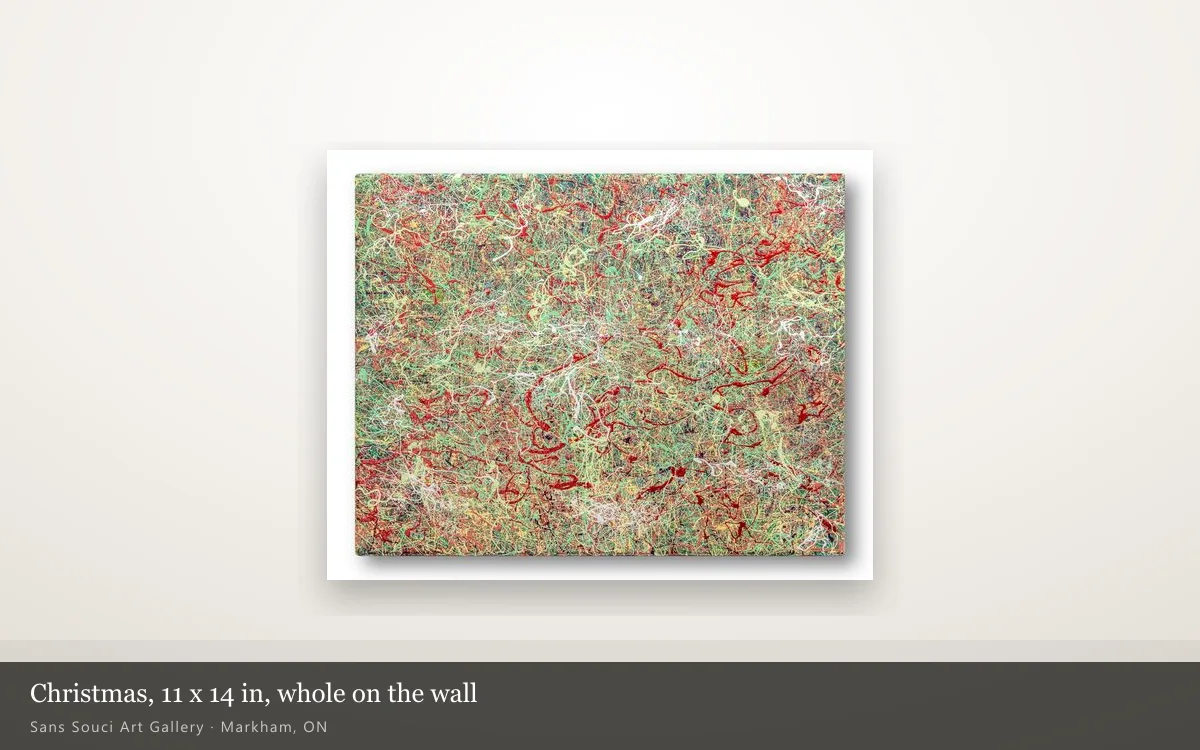
Christmas: a small open canvas
Christmas is acrylic on an 11 by 14 inch canvas, painted in 2019. Its page describes red and light green lines over a mixed ground of olive, peach and cream, with white loops on top. Its medium line names no coat over the paint, so the lines are open to the air. For this work the candle is the main concern: it is exactly the kind of surface CCI warns takes up dirt and resists cleaning. Because it is small, the easy answer is to hang it in a room with no flame at all, a hallway or a study, and let the candles have the mantel.
Morning Forest in Meissen: a large framed board
Morning Forest in Meißen is a different case. Its medium line reads acrylic, natural dyes, resin, wax paste and diamond dust on wooden board, framed, and it measures 52 by 28 inches. It is the one work in our catalogue that names wax paste in its medium line, so heat is the concern here, and so is the frame: the wide gold-coloured frame in its catalogue photograph is a tempting ledge for greenery and lights. Its size also means it cannot simply be lifted off for the evening. Plan its month before the decorations go up, not during the party. The sparkle in a surface like this is best seen with light from the side, which we wrote about in diamond dust, gold and light; a string of fairy lights across it does the opposite.
If the tree needs that wall
Taking a painting down for a month is safer than working around it, as long as the move itself is done well. CCI's note on handling says the more a painting is moved or touched, the greater the risk, so do it once at the start of the season and once at the end. Its order of work is a good one to follow at home:
- Decide where the painting will rest before you lift it. A clear spot on padding, against a wall in a room where no one will be walking, works for a few weeks. For longer, read our notes on storing a painting at home.
- Clear the route. Move chairs, boxes of decorations and the tree stand out of the way first, because a corner of furniture can pierce a canvas.
- Use two people, and a third to watch the path. CCI says most paintings, even easel-sized ones, need two handlers and a spotter, and that the weight of a framed painting is the thing people most often underestimate.
- Hold it by the sides, one hand low and one hand high on each side. Never carry it by the hanging wire or by the top of the frame.
- Set it down where it will stay, rather than handing it from one person to another.
- Note which hook it came off and how it hung, so it goes back the same way in January.
If wax, soot or a drink lands on it
Leave it alone for now. Wiping spreads soot into an open surface, rubbing warm wax pushes it further in, and a damp cloth on a sticky drink can lift what is underneath. Take a photograph in good light, keep the room cool, and read our page on what to do if a painting gets damaged before touching it. A working fireplace all winter is a separate question, covered in our note on a painting above a fireplace.
If you are planning a room for the holidays and want to talk about a particular work, or come and see one before you decide where it will hang, get in touch with us. Viewings are by appointment.