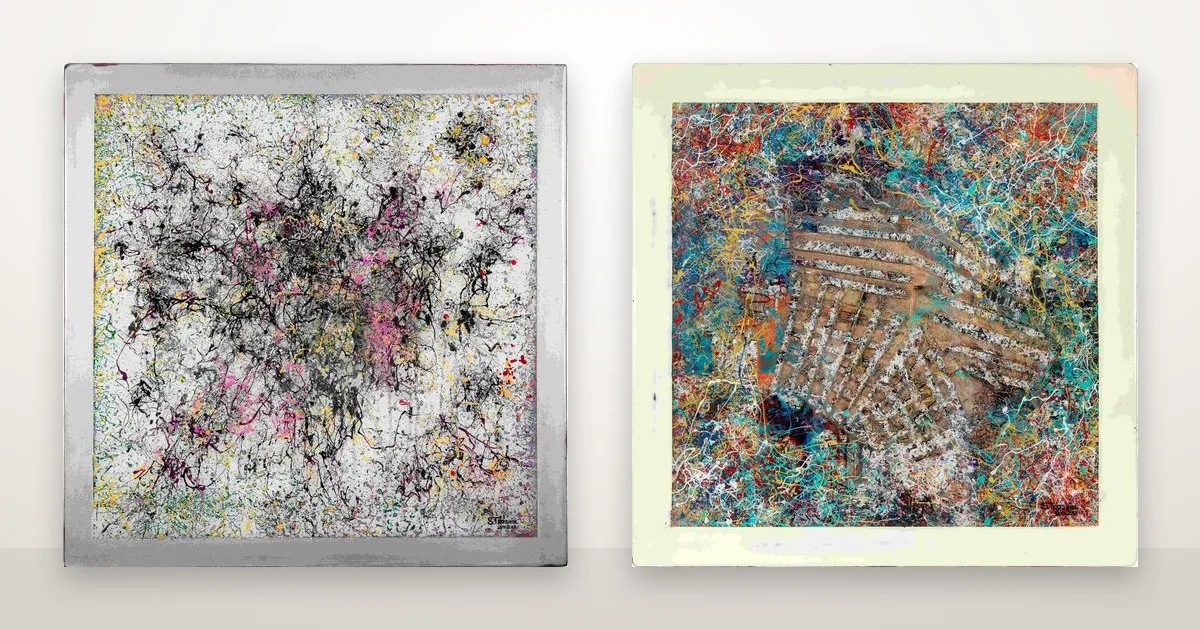
Two paintings in this catalogue match on every line a spec sheet can hold. Both were finished in 2020, both are 24 × 24 inches, both are acrylic and resin on fibreboard, and both are still available. If you were gifting original art from a list of measurements, you could not tell them apart. One of them is a single sentence about early summer light. The other is a diary entry about tears and ancient stones.
What actually goes wrong when you give original art
Rarely taste. What goes wrong is practical: the recipient has no free wall, the piece is the wrong size for the room they actually live in, or the subject is heavier than the occasion. Behind those sit the steps of buying from a gallery: a sale is confirmed in writing, and art pieces are sold as final.
All four are checkable before you commit, and none of them requires you to guess what someone likes.

Two 24-inch squares, same everything, opposite gifts
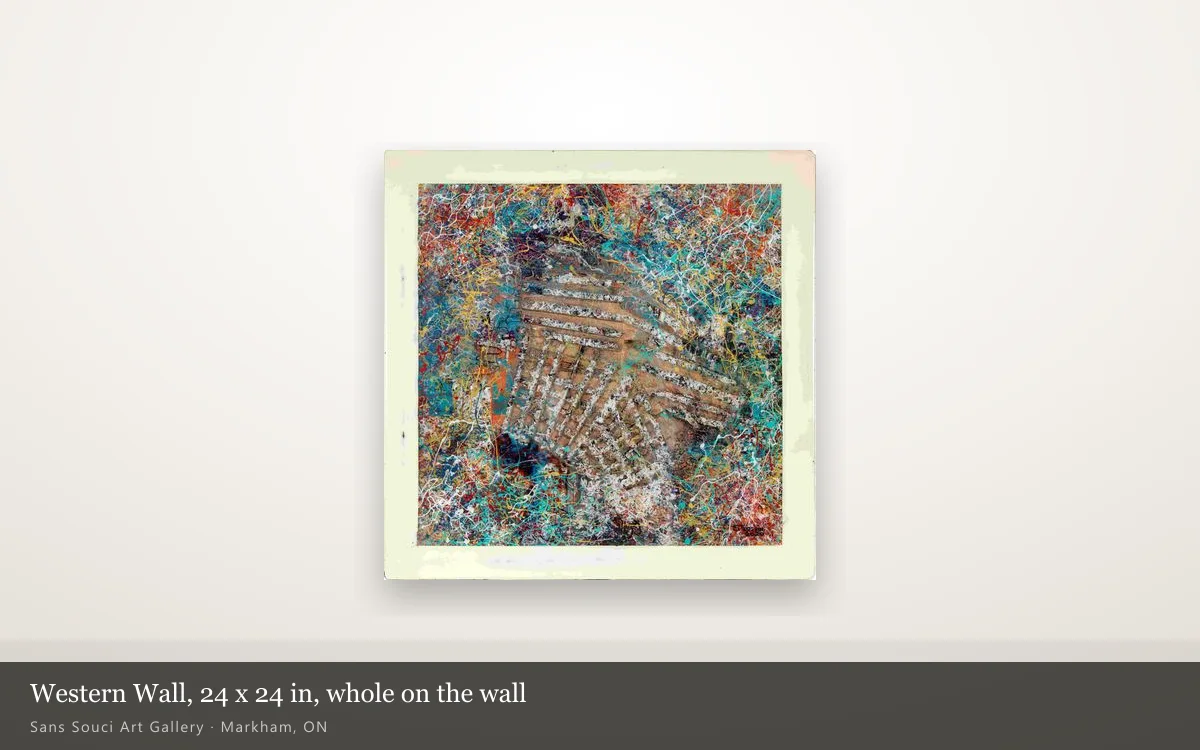
White Night and Western Wall are the pair. Every field either page records is identical. The one thing that differs is the thing no spec sheet carries: what the artist wrote underneath.
Of White Night, Sergei Troshin writes one sentence, and it is a question: “Have you ever experienced White Nights when you could see all colors of early summer in its beauty? I have!” It asks the viewer for a memory and hands them nothing to carry.
Western Wall is taken from his diary. “I am painting The Wailing Wall and touching its stones that are a witness of the ages… I can feel your energy. I can hear the pain and cries! I am not hiding my tears. I am proud of you, my people!” That is a magnificent thing to own. It is a difficult thing to receive from someone who has not thought about whether you wanted it.
| The same on paper | White Night | Western Wall |
|---|---|---|
| Year | 2020 | 2020 |
| Size | 24 × 24 in (61 × 61 cm) | 24 × 24 in (61 × 61 cm) |
| Materials | Acrylic, resin on fibreboard | Acrylic, resin on fibreboard |
| Surface | Poured resin face | Poured resin face |
| Status | Available | Available |
| What the artist wrote | One question about early summer light | A diary entry written at the Wailing Wall |
There is a second half to this, and it matters more than the pair itself. We counted before writing: 34 of the 61 works on this site carry a description written by the artist. The other 27 carry none. For nearly half the collection there is no statement to read at all. If your gift depends on the story, check first that there is one.
The three things you can check without asking them
A wall, a size and a light source. Those three decide whether a gift gets hung or leans behind a door for a year, and you can settle all of them from one visit to their home or from memory. Taste is the thing you cannot check from outside, so settle the three you can first.
- Is there a free wall at all? Not a wall they could clear, but a wall that is already empty. Without one, the painting waits in its wrapping until they decide what comes down, and that decision can take months.
- What size does that wall take? This catalogue runs from 11 × 14 inches to 60 × 80. Sixteen of the 61 works have a longest side of 16 inches or less; seven are 48 inches or more. Those are two entirely different gifts. If you want the tape-on-the-wall method, we set it out in choosing a size for a wall you cannot re-measure.
- Where does the light come from? Both works above have a poured resin face, which is reflective. Hung opposite a window, a surface like that mirrors the room back at you for part of the day. Where to hang a textured piece covers what that means in a real room.
There is also a way to skip the wall question entirely. Thirteen of the 61 pieces here are painted furniture and objects rather than paintings (side tables, a tissue box, hand-painted wine glasses), and they sit in Furniture & Home Accents. They are still originals, still one of a kind, and they ask nothing of a wall.
How buying a gift from the gallery works
Every piece is one of a kind, so the gallery answers your questions before anything is sold, in a message, on the phone or in the room with the painting. The steps below come from our Terms of Use page, in plainer words.
- A sale exists once we have confirmed it with you in writing. Ask for that confirmation before you plan the evening around the piece.
- The pages are kept up to date by hand, so a work can be reserved shortly before its page says so. If you have a date to hit, put it in your first message.
- Art pieces are sold as final, which is the gallery's stated policy. Settle the size, the palette and the wall before you pay, and if a swap matters to you, raise it before the sale is confirmed.
- Prices and shipping are quoted per piece on request, because size, weight, rigidity and framing differ for every work. Import duties and taxes outside Canada are paid by the buyer.
- A commission chosen together with the person receiving it is one of the best things this gallery does. It is agreed in writing, it takes as long as the technique takes, and the deposit is normally non-refundable once work has begun; how commissions actually work sets out the sequence.
The handover, and the paperwork that goes with it
Every original leaves the studio with a Certificate of Authenticity, signed and sealed by the artist. Pass it on with the work. It is the document that supports provenance, and it is what gets asked for years later for insurance, a valuation or a sale; we covered what a certificate actually records separately. If you would like the recipient named on the certificate rather than yourself, ask us before it is sealed.
Then there is the physical handover, which is where gifts get damaged. The Canadian Conservation Institute’s note on basic handling of paintings is blunt about the moment almost everyone gets wrong: do not hand a painting to another person. Put it down where they can lift it themselves, in a controlled way. The same note says never to carry a painting by its hanging wire, by the top of its frame, or by any one side alone. A wrapped painting passed across a table in a room full of people is exactly the situation it describes.
Two more things are worth saying out loud when you give it. First, how to look after it: the American Institute for Conservation publishes plain-language guidance on caring for artwork at home, and for a resin face it comes down to a dry soft cloth, no household cleaners and no long hours of direct sun. Second, that buying the work transfers the object and not the copyright. The images, and the right to reproduce them, stay with the artist.
If you would rather not guess at all
Bring them with you. Viewings are by appointment at the gallery in Markham, and an hour in front of the actual surfaces turns a guess into a decision made by the person who has to live with it. Photographs cannot settle it: a screen shifts colour and flattens a poured resin face, which is why two 24-inch squares that look interchangeable in a listing are unmistakable side by side on a wall.
If the surprise is the whole point, tell us the room, the wall and the occasion, and we will talk it through with you before you come. We are at 473 Simonston Blvd, Markham, open daily 9:00 to 18:00. Ask us about a piece and we will tell you how big it really is, what the artist wrote about it, and whether he wrote anything at all.