A signature on a painting is the artist's own mark, and it usually says two things: who made the work, and that the maker let it go as finished. It is useful, and it is worth knowing where it sits on a work you own. But it is one line of evidence, not proof on its own. An original painting does not stop being original because the name is hard to find, and a name in the corner does not make a copy into an original. What settles the question is the whole record around the work, and the signature is one entry in that record.
We looked at what our own catalogue says about signatures, because it gives real examples rather than rules. Five works by Sergei Troshin have the position of the signature written into the note on their page. Two of them come from the same series and the same year, and they are signed in opposite corners. That small fact explains most of what a collector needs to know.
What a signature on the front can and cannot tell you
The habit of signing grew out of the market. The encyclopaedia entry on art forgery describes how painters began to mark their work once its value came to depend on who had made it, how those marks turned into signatures, and how false signatures followed almost at once: in the 16th century, imitators of Albrecht Dürer's printmaking added signatures to their prints to raise their value. A name has been easy to copy for five hundred years. So read it for what it is.
- It names the maker in the maker's own hand, which helps anyone who meets the work later without its papers.
- Many painters sign last, so a name often marks a work the artist considered finished.
- Its corner, colour and size are part of the surface, so they belong in any description of the work.
- It cannot, by itself, tell you the work is authentic. Paint can be added to any corner.
- It says nothing about the condition of the work, its materials or what it is worth.
The strength comes from agreement. A signature that matches the artist's other works, on a surface that matches the materials listed for the piece, sold by the gallery that represents the artist, with a written record that names all of it, is hard to argue with. Each part alone is weak.
Five works whose notes say where the name is
These are the works in our catalogue where the “About this piece” text records the signature. We have copied the wording as it stands on each page.
| Work | Corner | How its page puts it | Status |
|---|---|---|---|
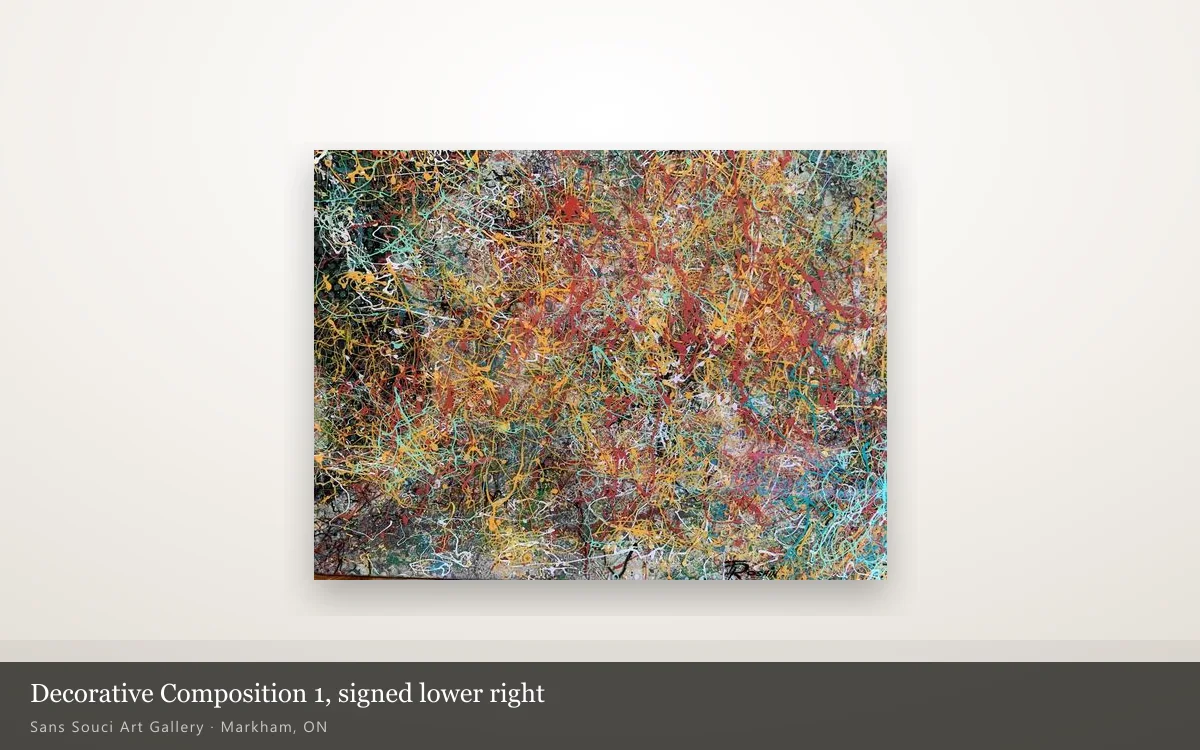
| Decorative Composition 1, 2020 | Lower right | “signed lower right” | Available |
| Decorative composition 2, 2020 | Lower right | “the signature with the year 2020 is painted in the lower right corner” | Sold |
| Decorative Composition 3, 2020 | Lower left | “Signed in black in the lower left corner” | Private collection |
| Joy, 2019 | Lower left | “Signed in the lower left corner” | Sold |
| Under Media Cobweb, 2019 | Lower right | “Signed lower right” | Available |
Three on the right, two on the left, all at the bottom. One note adds the year beside the name, another records the colour of the ink. None of that is decoration. Each detail is something an owner can check against the painting on the wall.
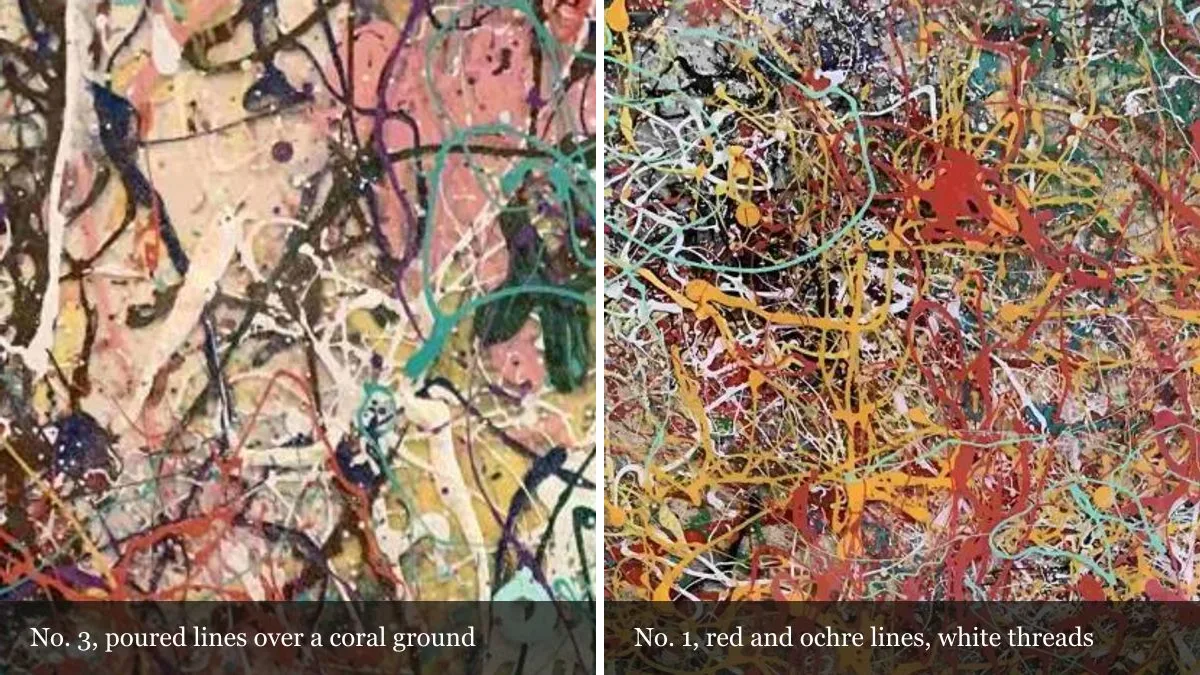
Same series, opposite corners
Decorative Composition 3
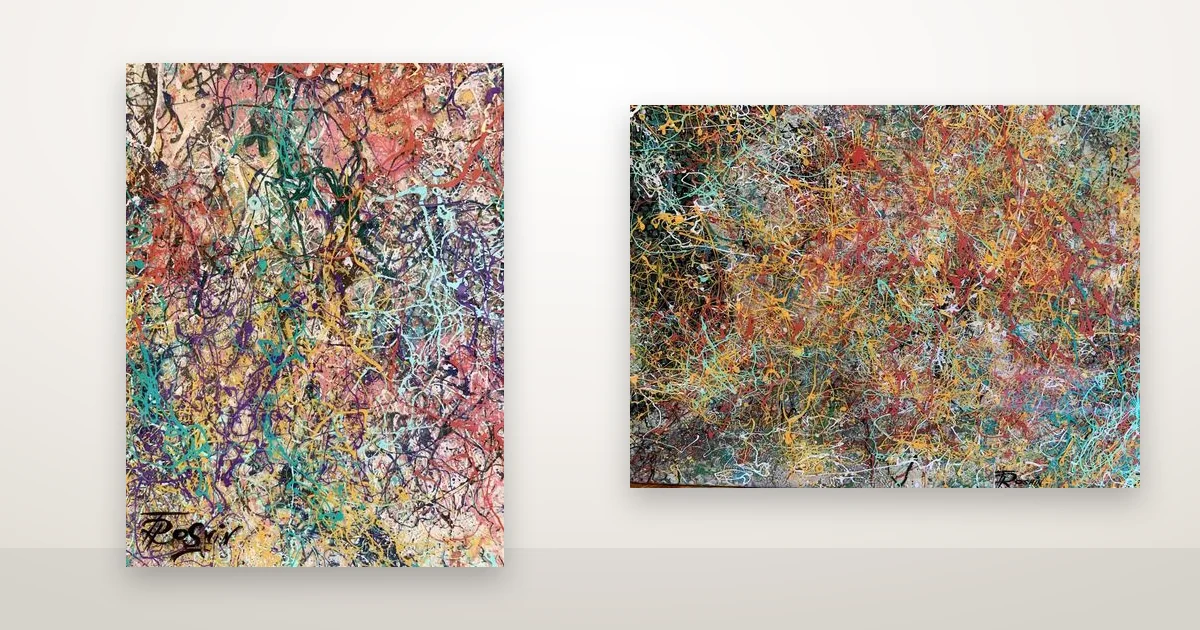
Decorative Composition 3 is acrylic on hardboard sealed with resin, 16 inches wide by 20 high, painted in 2020. Coral and salmon pink hold the left side, turquoise and violet the right, with ochre and dark lines running through both. The name is large, in black, in the lower left corner, and in the catalogue photograph it is the darkest mark in that part of the surface. This work has gone to a private collection, so it stays on the site as part of the artist's archive.
Decorative Composition 1
Decorative Composition 1 is the same size turned on its side, 20 by 16 inches, with the same materials and the same year. Red, ochre and mint green lines are poured densely across a dark ground, with white threads on top, and its page notes that it is one of four Decorative Compositions painted in 2020, each with its own palette. Here the signature sits lower right, smaller, and it almost disappears among the lines along the bottom edge.
These are two paintings from one series, by one artist, in one year, and the name sits in a different place on each. A rule like “this artist always signs lower right” would have marked one of them as suspect. That is why a corner is a fact to record for each work, never something to assume from the others. It also matters when you hang a piece. If you have ever wondered which edge is the top of an abstract painting, the signature is one of the clues we went through in which way up an abstract painting goes, and it only works if you know where it was meant to be.
Writing the signature into your own record
Museums treat a signature as part of the identity of a work, not as a guarantee. The Canadian Conservation Institute's note on condition reporting for paintings opens its identification section with the artist, title, medium, “signature and date, if present”, then the dimensions. The Object ID standard from the International Council of Museums, a tool for inventorying a collection, lists “inscriptions and markings” as one of its nine categories, next to materials, measurements, title, date and maker. You can keep the same kind of record at home on a single page.
- Write down the exact words or letters of the signature as you read them, even if they are only partly legible.
- Note the corner, the colour and roughly how far it sits from each edge, in centimetres or inches.
- Add any date, number or dedication painted near it, and anything written on the back or the edges.
- Take one close photograph of the signature with a ruler beside the edge of the work, so the scale is fixed.
- Keep that page with the invoice and any certificate that came with the work, and save a copy away from the house.
Object ID's own last step is the same idea: keep the documentation in a safe place. We wrote about the rest of that record, from photographs to replacement value, in insuring an original you own, and about the paper that names the work and its maker in what a certificate of authenticity records.
When the name is hard to find
On densely poured work like these, the signature can be the same colour as the lines around it, and under strong overhead light a sealed surface can hide it in glare. Neither is a sign of anything wrong. Tilt your head, or look at the corner with light coming from the side, and the letters usually come out of the lines. A work with no visible name on the front is not automatically doubtful either. Some artists sign on the side or the back so the front stays clear.
What you should not do is rub, wet or clean a signature to test it. It is part of the painted surface, and anything that would harm the paint will harm the name with it.
Decorative Composition 1 and Under Media Cobweb are both available, and viewings are by appointment. If you would like to see where the signature sits on a work before you decide, or to ask how a particular piece is marked, send us a message.