Most first-time buyers stand in front of a piece for a long time asking the wrong question. They ask whether it is a good investment, or whether it matches the sofa. Neither one tells you anything useful about choosing your first original artwork — the piece you will actually live with, in your own hallway, at seven in the morning and again at midnight.
What should actually decide it?
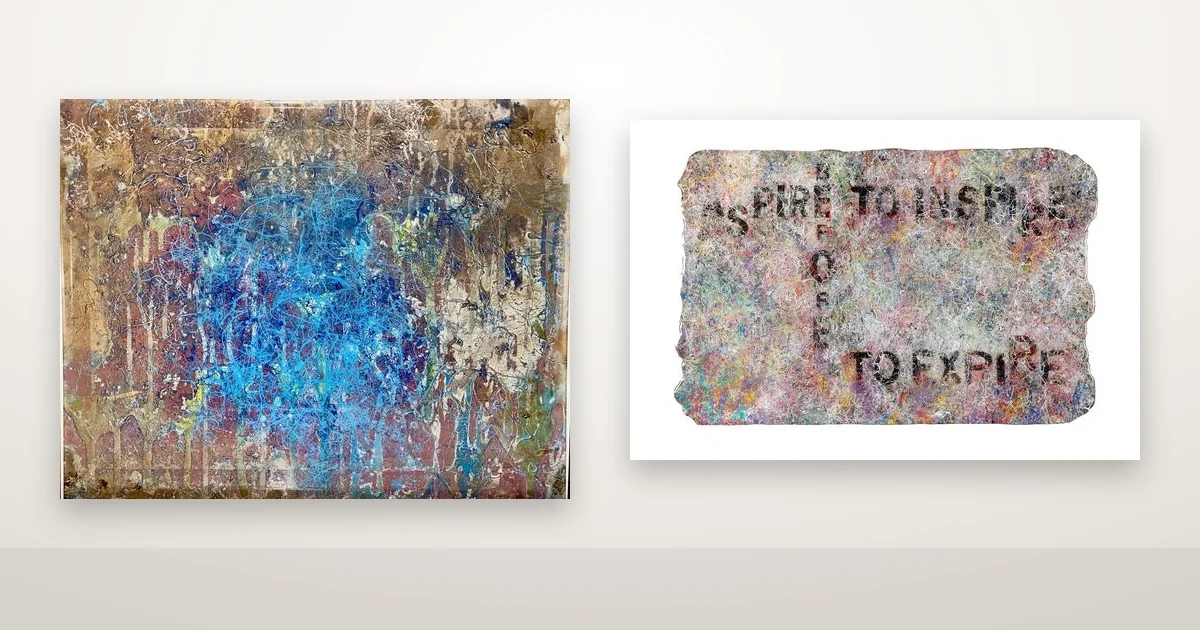
Choose the piece you keep coming back to before you can explain why, not the one that scores best on paper. An original earns its place in a room by holding your attention days later — the way Infinity and Aspire to Inspire do, for very different reasons.
That is a strange thing to say to someone about to spend real money, but it holds up. A print or a reproduction can be evaluated on colour and size alone, because there is nothing else to it — one is identical to the next. An original is one surface, built by one person's hand, and it behaves differently depending on the light in the room, the time of day, and how close you stand. You cannot fully judge that from a thumbnail. You judge it by noticing that you keep looking.
There is also a quieter kind of anxiety in a first purchase: the fear of choosing wrong. It helps to remember that nothing here is being sold as a safe, neutral choice. Sergei Troshin's work leans into texture, layered materials and colour that does not apologise for itself — a first piece from this gallery is closer to a decision about what you want to live with than a decorating exercise. That is not a reason to hesitate. It is a reason to trust the piece that actually held your attention over the one that simply matched.
Scale changes the decision more than most people expect
A mid-scale, upright piece and a wide, room-filling one ask for completely different commitments — not just different wall space, but a different relationship with the piece day to day. Neither is the safer choice; they simply do different jobs.
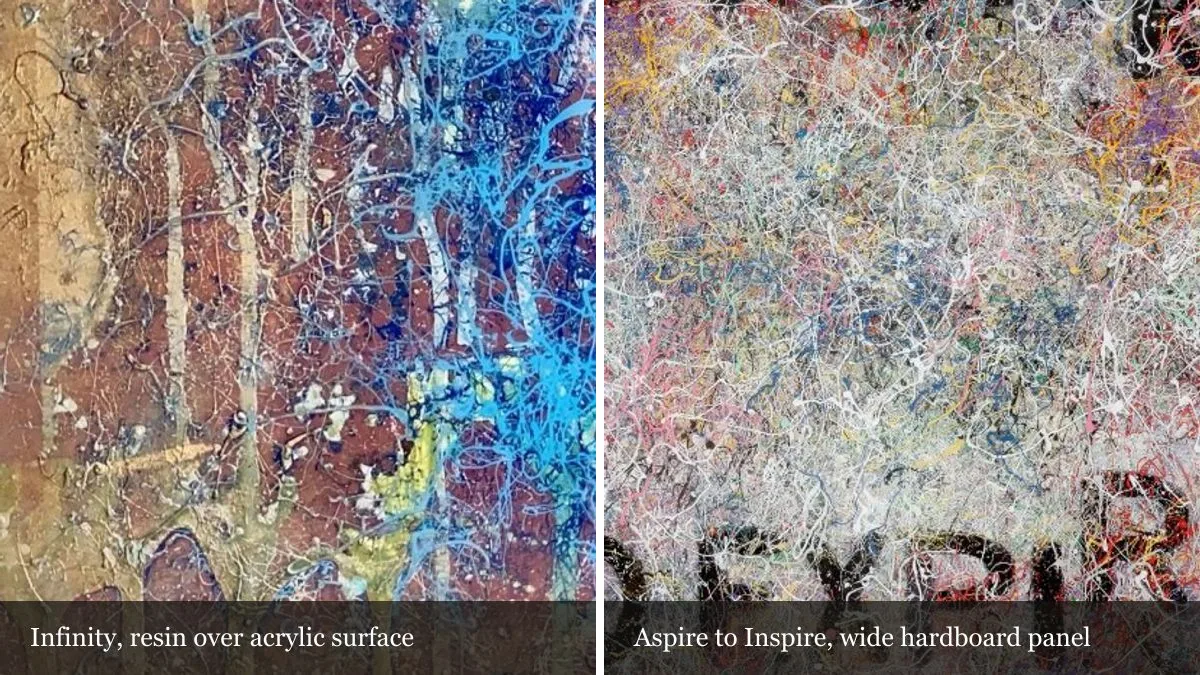
Infinity is acrylic on board, sealed with resin, at 16 × 20 in — a rigid board that keeps a heavy, poured surface from flexing. It is built to hold its own section of wall above a console, a desk or a bedside, without needing anything else around it. Aspire to Inspire is the opposite kind of decision: acrylic and resin on hardboard, 38.6 in wide by 25.4 in high, dense and rigid enough to carry heavy layers across a much bigger surface. It reads as a statement the moment you walk into the room, not something you notice on a second look.
Before you fall for either kind, measure the actual wall — not the room, the wall — and stand where you will stand most often. A piece that is right at arm's length in a gallery can read completely differently across a living room.
| Infinity | Aspire to Inspire | |
|---|---|---|
| Size | 16 × 20 in | 38.6 × 25.4 in |
| Format | Upright, self-contained | Wide, room-scale |
| Support | Board | Hardboard |
| Best first move | A single wall you already have | A wall that can carry a focal point on its own |
A short checklist before you commit
Four things matter more than taste alone before a first purchase: the actual wall, the light it gets, the surface's upkeep, and what comes with the piece. Skipping any one of them is how a piece that looked perfect in the gallery looks wrong at home.
- Measure the wall, not the room. Bring the exact width and height, not an estimate.
- Stand where you will actually stand. A hallway view is closer and shorter than a living-room view.
- Check the light. A resin-finished surface like both pieces here has a reflective face — direct sun ages the clear coat and can throw a glare depending on where a piece hangs. Tate's glossary entry on resin explains what the coat is actually doing to the surface.
- Ask what comes with it. Every original here leaves with a Certificate of Authenticity, signed by the artist — ask to see how that is documented before you decide.
- See it in person if you can. A screen compresses texture and colour depth the same way it compresses everything else. Viewings are by appointment; a photograph is a starting point, not the decision itself.
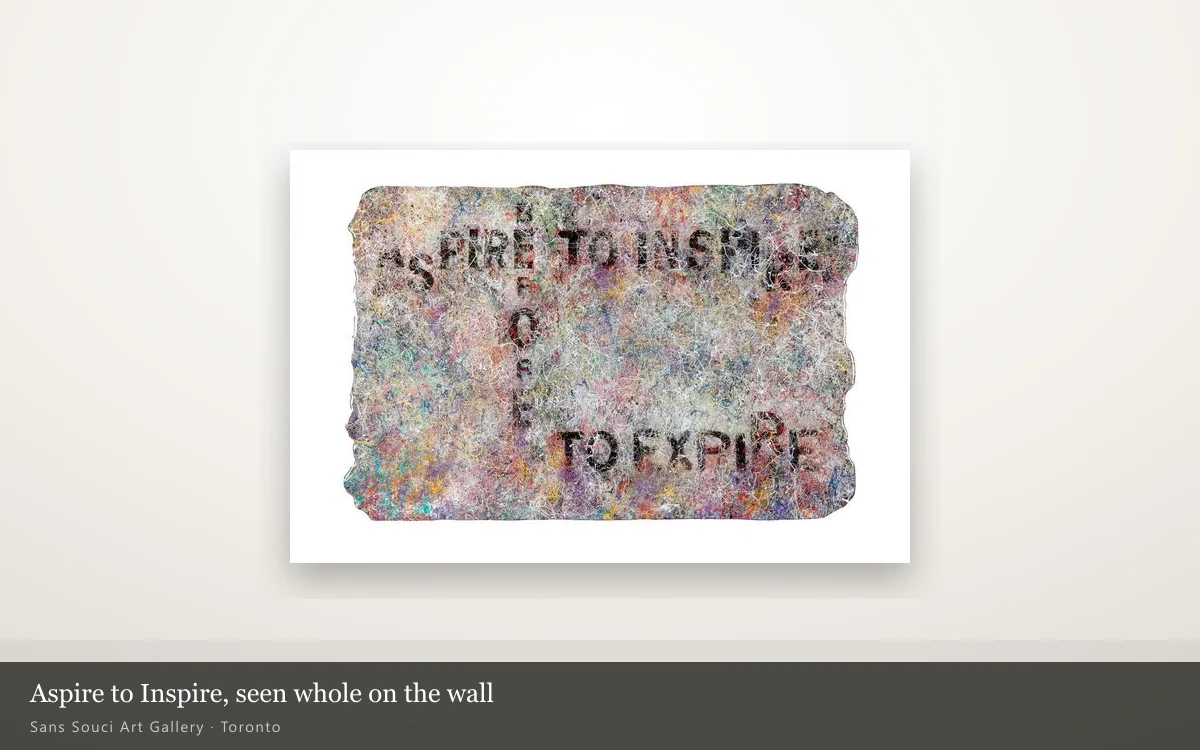
What to ask before you decide
Ask about price, availability, and care in that order, and ask them directly — there is no online checkout here on purpose. Every piece is one of a kind, so prices are shared on request rather than listed, and the gallery would rather answer your questions first than have you guess from a page.
It is worth asking what a piece needs once it is on your wall, too. A poured resin surface is hard but it scratches like any gloss finish — a dry, soft cloth is enough, never a household cleaner. Room conditions do more than any single cleaning habit: stable temperature, stable humidity, and no direct sun. The American Institute for Conservation publishes plain-language guidance on caring for artwork at home that is worth reading before, not after, a piece arrives. We go into more of this in What a Resin Finish Really Does, comparing how the same coat reads across two very different scales.
Neither Infinity nor Aspire to Inspire is a safe, generic choice — that is rather the point. A first original is not meant to match everything; it is meant to be the one thing in the room you never stop noticing. Come see the full range in the Artworks collection, or if a piece has already caught your attention, get in touch and we will answer the practical questions honestly, including the ones about price.