People apologise to us in the gallery. Someone stands in front of a painting for a long minute, then turns and says: I like it, but I do not really understand it. The apology is not needed. Living with art you do not understand yet is the ordinary way this starts, and it is not a reason to walk away from a piece you keep coming back to.
Can you buy a painting you cannot explain?
Yes. A wall does not ask you for an interpretation, it asks you for attention. The honest test before you buy is not whether you can say what a work means, but whether it still holds you when you are not trying to decode it. If you look away, look back, and there is something you have not finished with, that is enough to go on.
What people usually mean by I do not understand it is I cannot say a sentence about it. A sentence is a poor measuring stick. Plenty of paintings people have loved for decades never got summarised, and the summary would not have added anything if it had. The useful question is narrower and easier to answer honestly: does this hold my eye, and do I want it in the room I actually live in?
Three different things people call understanding
The word does at least three jobs at once, and separating them takes most of the difficulty out. Only the third one has to be answered for you to live well with a painting, and it is almost always the last to arrive.
- What it shows. The subject. In abstract work there often is not one. Tate defines abstract art as art that "does not attempt to represent an accurate depiction of a visual reality but instead uses shapes, colours, forms and gestural marks to achieve its effect". If a work is not depicting something, then failing to identify what it depicts is not a failure of yours.
- Why it was made. The artist's reason. Sometimes it is written down on the page, sometimes it is not, and it is never the whole story. We wrote separately about where the subject of an abstract work is actually recorded.
- Why it holds you. Your reason. This one is yours to find, it takes months rather than minutes, and it frequently turns out to be about colour, or scale, or one small area you did not consciously notice in the gallery.
If you are choosing a first original and want the practical version of this, our note on how to choose your first artwork covers the ground before the money.
What an artwork page can tell you, and what it leaves to you
Less than people expect, and that is deliberate rather than careless. Of the 61 originals in our catalogue, 34 pages carry a note from the artist and 27 carry nothing beyond the title, the materials and the size. Three real pages show how differently that record can behave.
| Work | What its page gives you | What it leaves to you |
|---|---|---|
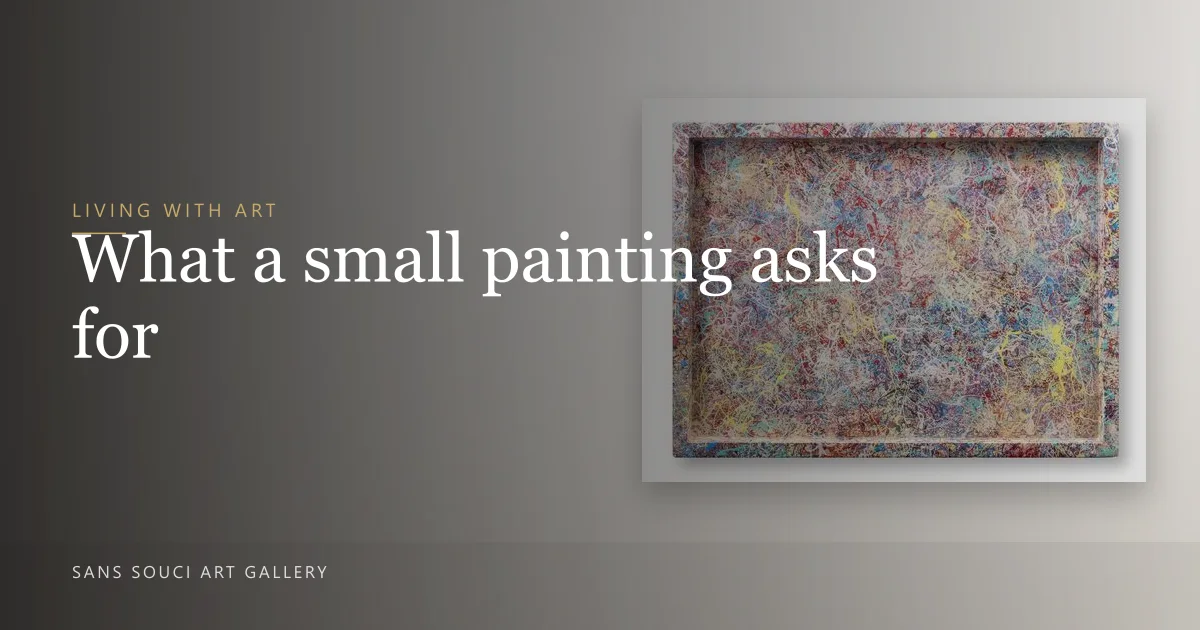
| The Power of the Abstract (2022) | Acrylic on paper, sealed with resin, 40 x 60 cm — and a description written as a poem, the only one of its kind in the catalogue | Everything a poem leaves open. It names colours and what they are for, not what the painting is |
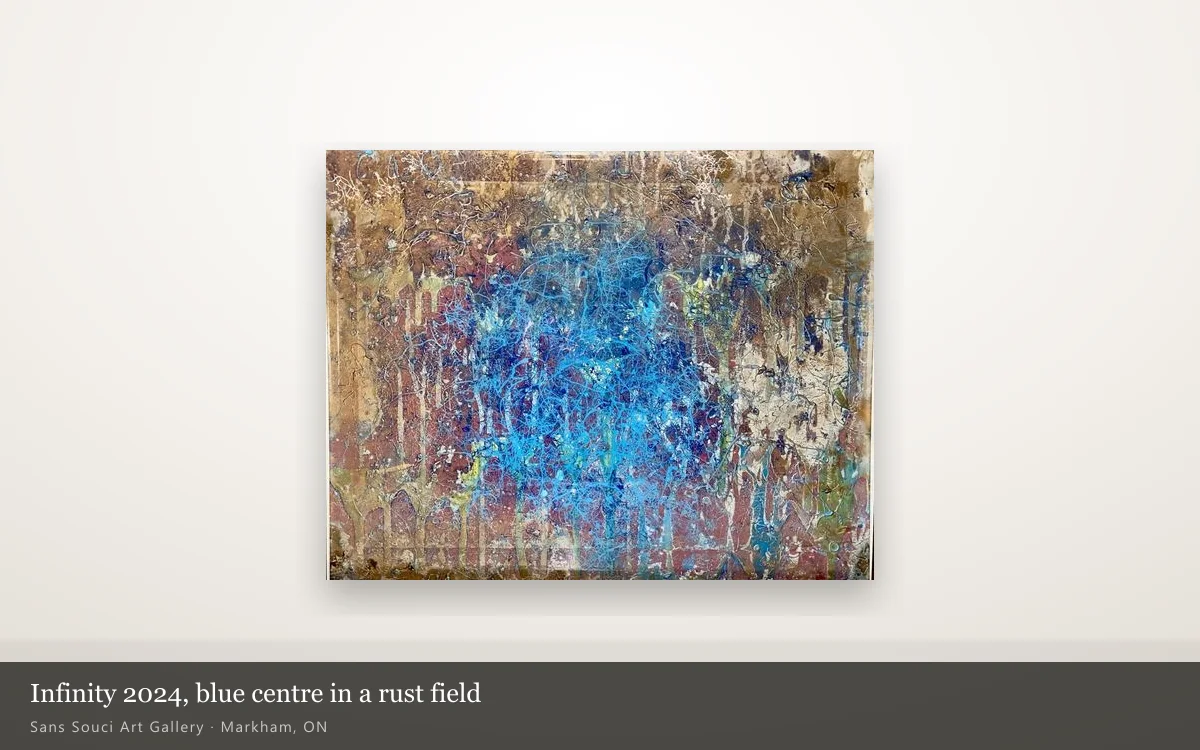
| Infinity (2024) | Acrylic on board, sealed with resin, 16 x 20 in. No description at all | All of it. A title, a material, a size, and the surface itself |
| Fluently Python (2022) | A note that opens "What is this about? It's about nothing! Even so, it took me a while to get it done." | The question, handed straight back to you by the person who made the work |
The poem on the first of those is worth a moment, because it is the case people find most confusing. It reads as a recipe for colours rather than an explanation of a painting: "I'll blend the pink of peonies with tea roses, And stir their softness into honey's amber glow." Nothing in it tells you what you are looking at. Setting a poem beside a picture is an old form — ekphrasis, the written description of a work of art, has been a technique in poetry since classical antiquity, and one of its classical purposes was to evoke a strong emotional response in the reader. That is what this text does. A poem set next to a painting is a second work, not a key to the first.
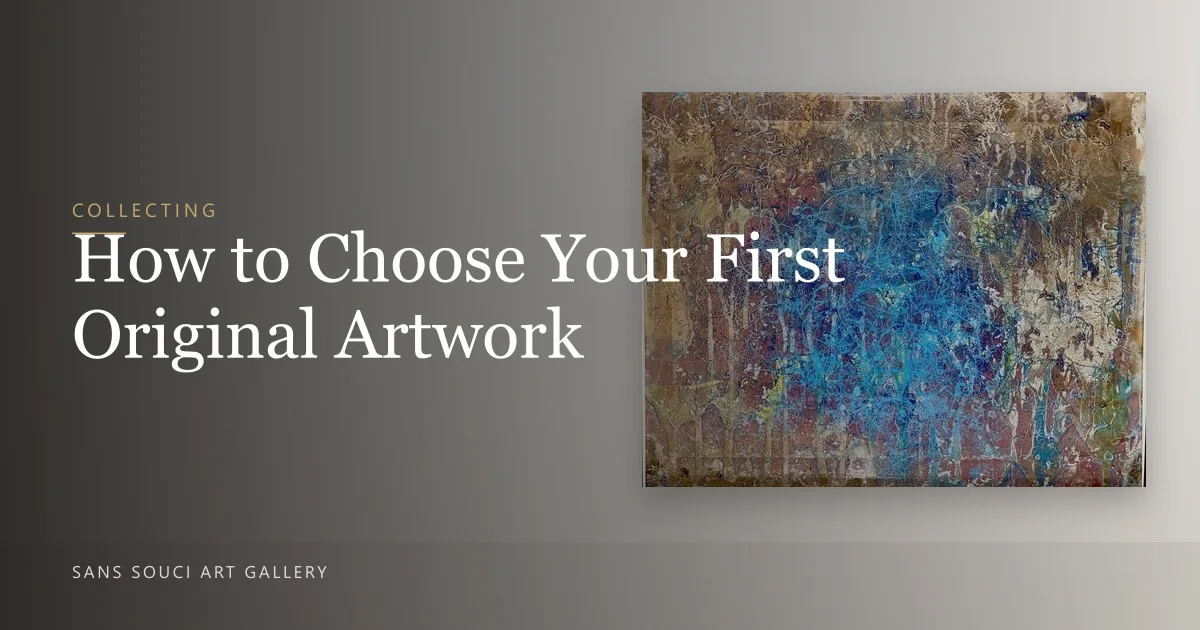
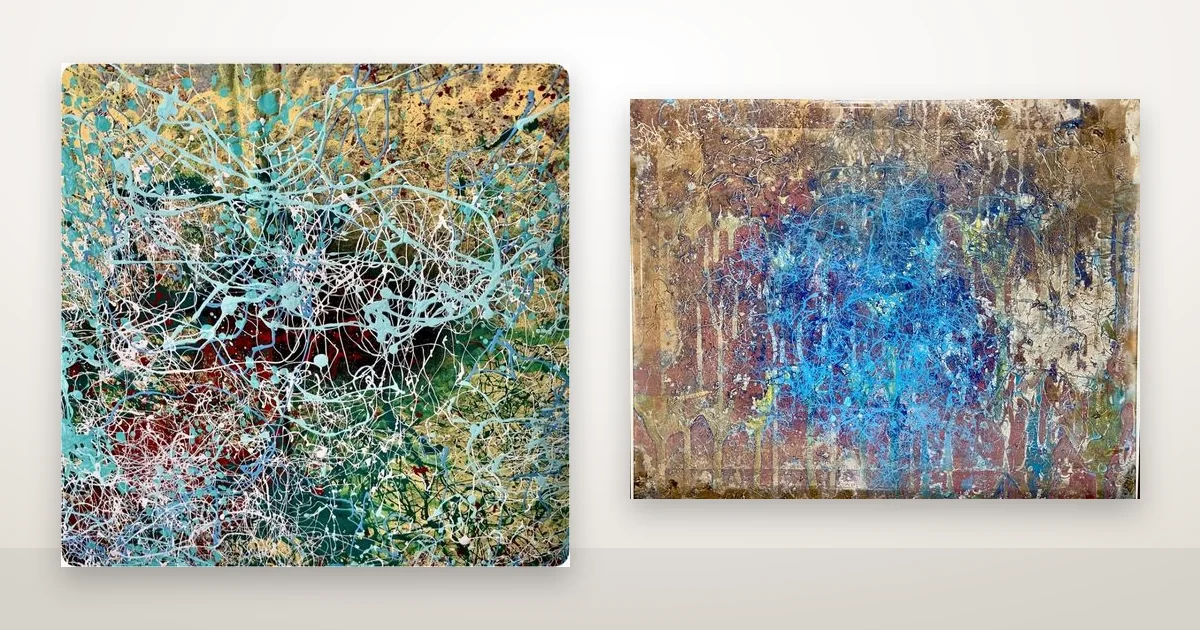
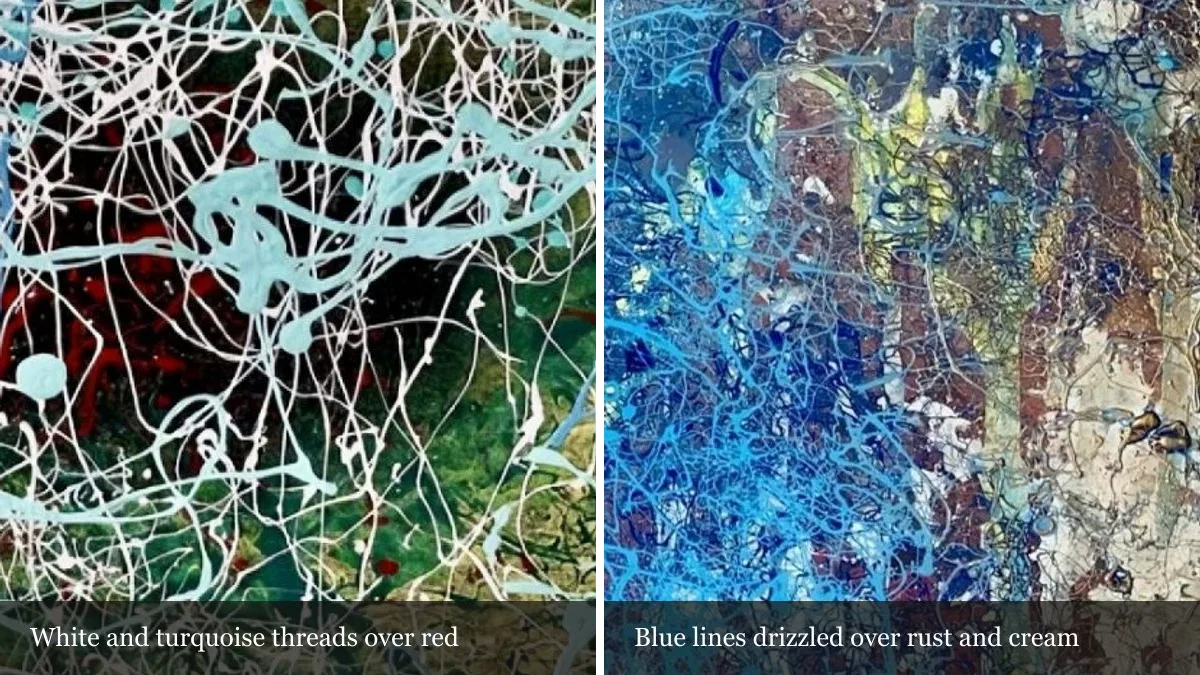
Infinity is the opposite case, and the more common one here. Its page states the material, the size, and nothing else. What you can see is a tangle of bright blue drizzled line at the centre, opening out into a rusted ochre and cream field with a great deal of visible working in it: ridges, pale flecks, darker runs down the surface. Whether that centre reads as light, or water, or an opening in a wall, the page does not say. Twenty-seven of our pages are like this. Where the artist has not written a note, we do not write one for him.
What actually changes once it is on your wall
The change is not that an answer arrives. It is that the question gets smaller and more specific, which is a much better place to be. Four things we hear from people again and again, in roughly this order.
- For the first week or two you see the whole thing. The composition, the overall colour, the shape it makes against the wall. This is the view a photograph gives you, and it is the one that wears out first.
- Then you stop seeing the whole and start seeing areas. One corner, one colour that only appears in three places, the single line that runs the full width. This is where most people's real attachment forms, and it is a part of the work no listing photograph ever showed them.
- The daylight keeps re-editing it. A resin-sealed surface like these two behaves differently at nine in the morning and at six in the evening, which is the whole subject of why the same painting looks different at 9am and 6pm. A piece you did not understand in a gallery under fixed lighting is a slightly different piece four times a day at home.
- The title stops being a label and becomes a question. Infinity, Truth, The Power of the Abstract: on the wall these read as something the work is arguing with, not as a caption you failed to match to the picture.
Two practical things help. Hang it on a wall you walk past rather than one you sit and face, because glances over months do more than staring for an hour. And move it once, after a season: a different wall and a different light will tell you whether your interest was in the painting or in that particular spot.
Not understanding is not the same as not liking
This is the one distinction worth being strict about, because the two feel similar in a gallery and behave nothing alike at home. A work you do not understand keeps you asking. A work you do not like makes you tense, and you will find yourself arranging the room so that you do not face it. The first gets better with time. The second does not.
An honest check, a month in: do you look at it on purpose, or only by accident? If you have caught yourself standing in front of it without having decided to, the confusion is the good kind. If you have not looked at it deliberately in weeks, no amount of explanation will repair that, and you were right to notice. Confusion is not the warning sign. Avoidance is.
None of this is helped by rushing. Our catalogue of originals is online, with the materials named on every page, and the way the work is made is set out on the page about the artist and the gallery. But these are physical objects with poured, raised and scraped surfaces, and a screen loses most of that. You are welcome to come and stand in front of one in Markham, by appointment, without arriving with an interpretation ready. If a work has stayed with you since you closed the tab, that is already the signal worth acting on — write to us and we will tell you what we know about it, including where the page says nothing.