Choosing art for a home office means choosing for two walls, not one. The wall in front of your desk is the one you look at between tasks, from arm’s length, for hours a day. The wall behind your chair is the one your colleagues see on every video call, through a small lens with a lamp usually sitting right beside it. A painting can be right for one of those walls and wrong for the other, and the reason is mostly geometry.
Below we take the two walls one at a time, with two works from the catalogue: a bare acrylic canvas for the wall you face, and an epoxy-sealed panel for the wall behind you.
The wall you face is read up close
At a desk your eyes rest about a metre from the wall, sometimes less. At that distance you see texture, single lines, the edge of a drip. A large painting seen that close is only a patch of it; you never get the whole thing in view without leaning back. That is why a small work, which most rooms make hard to place, fits a work room well: the desk sets the short viewing distance that a small painting needs. We wrote about that relationship in what a small painting asks for.
The second thing that matters here is surface. The painting in front of you sits beside a screen, and between the two your eyes keep moving. A matte surface stays the same wherever your head is. A glossy one can pick up the window or the desk lamp and show it back to you every time you look up, which on this wall happens all day long.
Blue, White: a cool canvas at reading distance
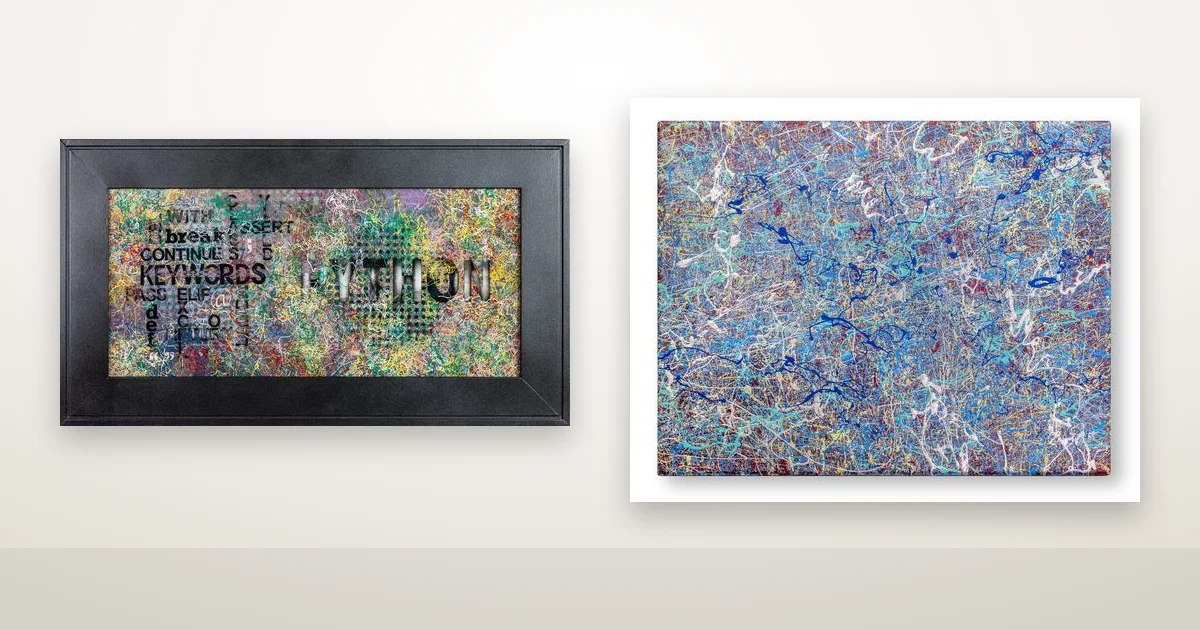
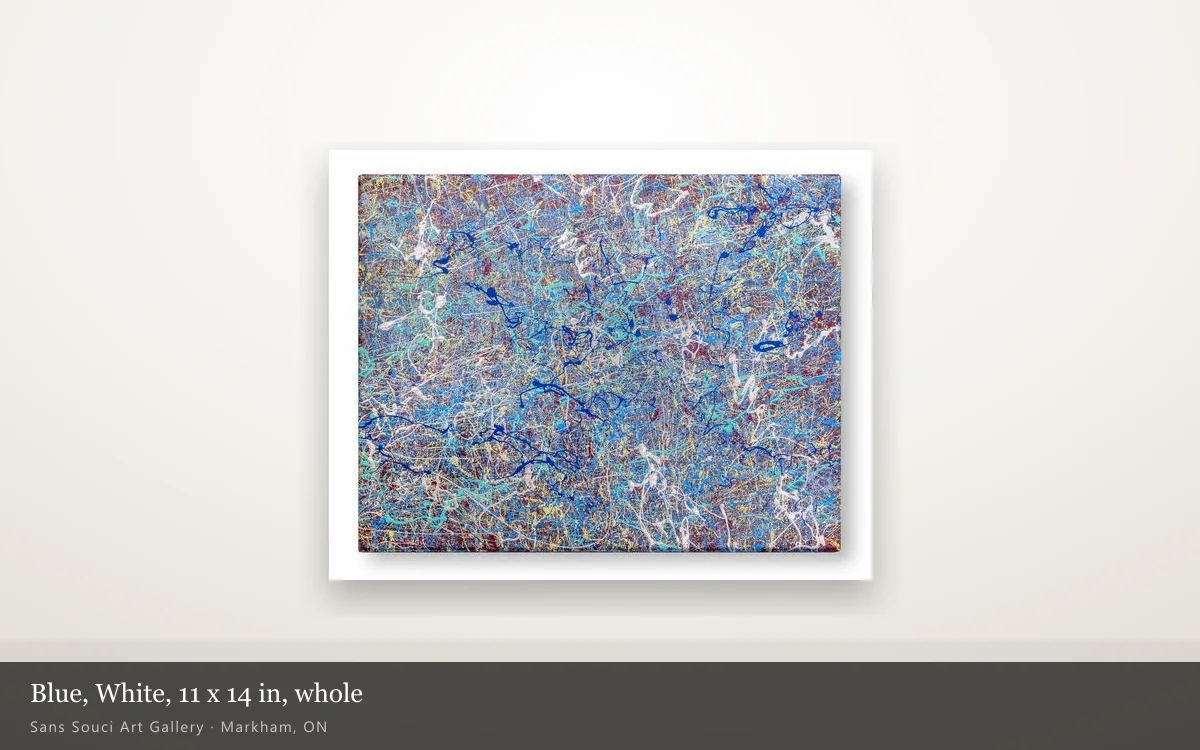
Blue, White (2019) is acrylic on an 11 by 14 inch canvas, with no coat named on its page. Light blue and turquoise lines cover the canvas, heavier cobalt strokes and white loops are laid over them, and a few threads of red and ochre show underneath. Its catalogue page says the palette stays cool from edge to edge.
At a metre that last point is what you notice. There is no single focal point pulling at you while you work, and there is always another line to follow when you look away from the screen. Because the paint sits on bare canvas without a poured coat, the surface scatters light instead of mirroring it, so a lamp beside your monitor shows up as brightness on the paint, not as a hot spot.
Why the lamp beside your webcam lands in a glossy painting
Most video-call advice says to avoid glossy surfaces behind you and then leaves you to move lamps around until the glare goes away. There is a simpler way to think about it. A glossy surface such as poured epoxy reflects light the way a mirror does. The law of reflection says a ray leaves a surface at the same angle to the surface as it arrived, on the opposite side. The same article explains that matte paint reflects almost entirely in a scattered way, while glossy paint reflects a larger part of the light in that mirror-like way.
Now picture the usual home set-up. The webcam sits on top of the screen, and the ring light or desk lamp sits close to it so your face is lit. A painting hangs flat on the wall straight behind your head, facing the camera. Light from the lamp travels to the painting almost square on and comes back almost square on, which is exactly where the lens is. The camera sees the lamp in the painting. Move the lamp off to one side and the reflection leaves at the same angle to the other side, out of the frame.
Museums deal with the same geometry from the other direction. The Canadian Conservation Institute’s note on track lighting places the beam at 60° to the horizontal so that visitors do not get glare and unwanted reflections. In a gallery the eye is the camera. At a desk, your webcam is.
A five-minute check from your own chair
Do this before you hang anything heavy, and ideally before you choose the work at all.
- Sit where you sit for calls, with the camera at its usual height, and open the camera preview.
- Turn on every light you use for calls, and open the blinds the way they are on a working morning.
- Hold a framed mirror, a glossy magazine or a sheet of glass flat against the wall where the painting would go. Whatever bright shape appears in it on screen is what a resin face will show.
- Slide the stand-in sideways along the wall. When it is no longer straight behind your head, the bright shape moves away from the lens; note how far you had to go.
- If the painting has to stay centred, move the light instead: put it to one side of the screen rather than above or behind it, and check the preview again.
Repeat once in the late afternoon if a window is in the room. The sun moves; your lamp does not.
Fluently Python: an epoxy panel for the wall behind you
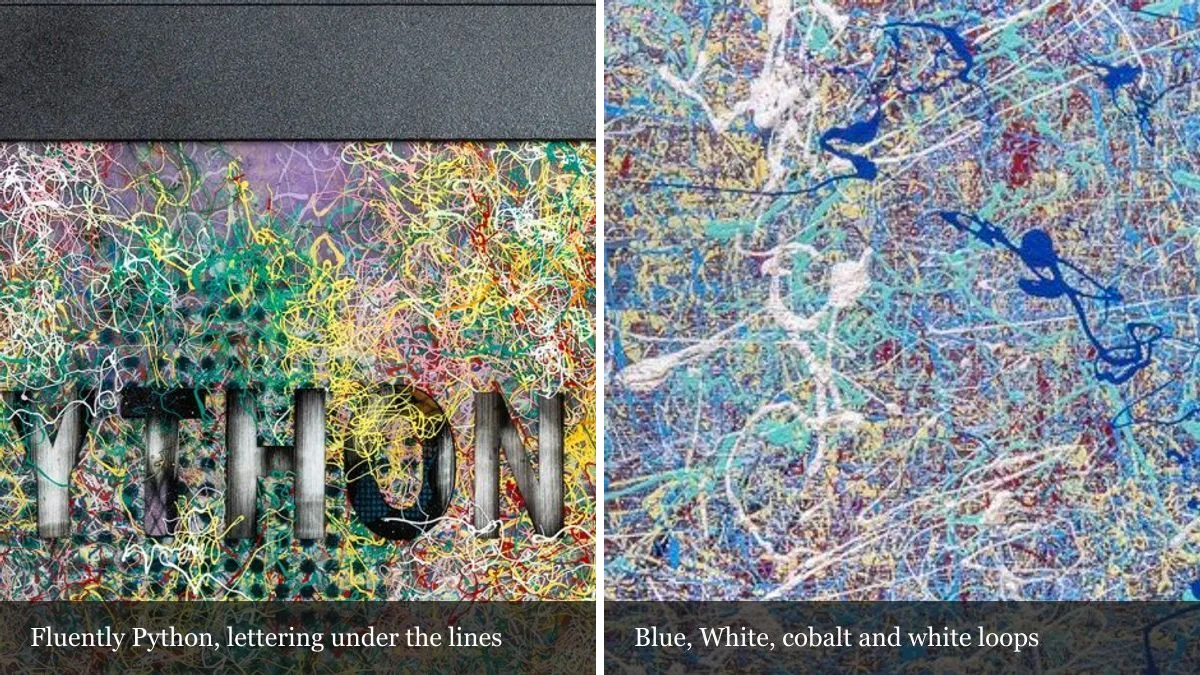
Fluently Python is acrylic on hardboard sealed with epoxy, 36 by 20 inches. In its catalogue photograph it sits in a wide black frame. Python keywords such as break, continue, elif and def are printed across the left half in black letters, the word PYTHON runs across the right half, and a dense web of coloured lines is laid over all of it. The artist’s note on the page explains where it came from:
Python is a multi-paradigm programming language. I don’t “speak” Python but this is all about Python right here.
Sergei Troshin, on the page for Fluently Python
Behind someone who writes code all day, that is a painting with something to say. It is also exactly the kind of surface the check above is for. The epoxy is what gives the colours their depth, and it is a mirror for any lamp placed square to it. Hung a little to one side of your chair, with the light beside the screen rather than on top of it, the colour and the lettering read clearly on camera. We describe what a poured coat does to a surface in more detail in what a resin finish really does.
The two walls side by side
| Question | Wall you face | Wall behind you |
|---|---|---|
| Who looks at it | You, between tasks | Everyone on the call |
| From how far | About a metre | Through a webcam, as a small part of the frame |
| What reads | Single lines, texture, small colour changes | Large shapes, strong colour, lettering |
| Example here | Blue, White, 11 by 14 in, bare acrylic on canvas | Fluently Python, 36 by 20 in, acrylic sealed with epoxy |
| Where the light goes | Anywhere; the matte surface scatters it | Beside the screen, never square to the panel |
The desk lamp adds hours of light
A work room has one care point that a living room usually does not: a lamp that is on for a full working day, five days a week. The Canadian Conservation Institute’s page on light, ultraviolet and infrared defines the dose of light on a surface as intensity multiplied by time, and describes fading as utterly irreversible. A lamp angled at the painting so it looks good on camera does the same work as a little extra sun, every day.
So point task lights at the desk and your face, and let the painting take what spills over. If a work needs its own light for calls, put it on a switch you turn off with the computer. And keep both walls out of the path of direct sun from the window, which matters more than any lamp; we set out why in what direct sun costs a painting.
If you would like to see how an epoxy face and a bare canvas behave next to each other before you decide, both works are available and viewings are by appointment at the gallery, 473 Simonston Blvd in Markham. Send us a message or call +1 (416) 919-8331 to arrange a viewing.