Crackle in a painting can be two very different things. Sometimes the artist put it there, and it is as much a part of the work as the colour. Sometimes it is the paint telling you that something went wrong. Two works in our catalogue carry crackle on purpose, and both of their pages say so in writing. That written line is the first thing to look for on any painting you are thinking of living with.
The second thing is time. A crack that was there on the day the work arrived and looks the same five years later is part of the surface. A crack that was not there, or one that has grown, opened or lifted, is news. Most of what you read about cracks online is written by restorers about old oil paintings on canvas. Our works are acrylic on wood or fibreboard, often under a poured resin coat, so we have kept only what applies to them.
What conservators call each kind of crack
The Canadian Conservation Institute publishes a glossary for condition reports on paintings (CCI Note 10/11). It is worth knowing a few of its words, because they are the ones a conservator will use if you ever call one. Here they are with what each tends to mean for the person who owns the work.
| CCI term | What you see | Usual cause | For an owner |
|---|---|---|---|
| Drying cracks | Wide gaps with rounded or sloping edges, sometimes showing a lower layer | Paint shrinking as it dried | CCI notes they are usually stable and do not spread. Photograph them and keep watching. |
| Mechanical cracks | Cracks with sharp edges, over the whole surface or in one area | Movement or too much stress in the layers | If they are new, have a conservator look before anything else is done. |
| Concentric cracks | Rings or a cobweb around one point | A blow or pressure on the front or the back | Something hit it. Find out what, so it does not happen again. |
| Diagonal cracks | Lines running in from a corner | Often a painting dropped on its corner | Compare with your first photographs. Corners take the knocks. |
| Crazing | A very fine network in a varnish, which turns cloudy | A brittle varnish layer | It sits in the coating, not the paint. Ask before you clean it. |
| Cupping and lifting | Islands of paint with raised edges, flakes coming away | Layers separating | This one cannot wait. Do not press it flat. |
What the glossary lists is the damage. The crackle an artist builds into a surface is not on that list at all, which is exactly why a buyer needs it written down somewhere else.
Two works where the cracks are the design
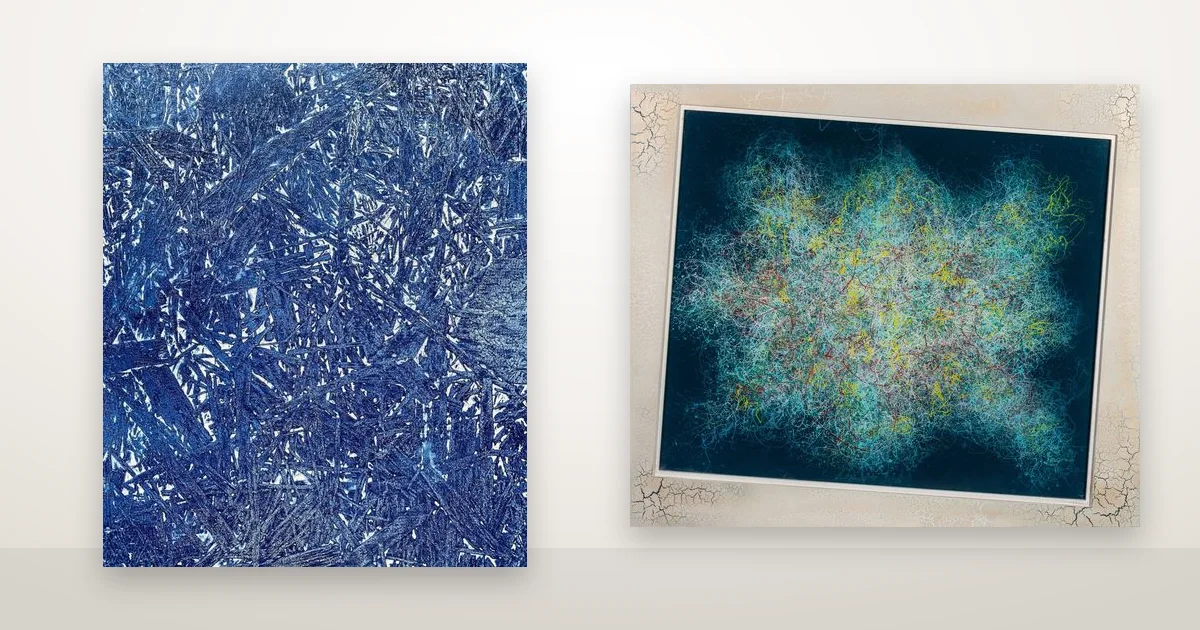
Morgenwald in Meißen, 2022
Morgenwald in Meißen is a four foot square of natural dye, acrylic and resin on wood, a deep porcelain blue worked into the grain of the board. Sergei Troshin's note on its page ends with the reason for its crackle:
If we look closely, we will notice a slight crackle on the surface. This was necessary for binding my idea to the theme of antique porcelain while emphasizing the abstract mysterious labyrinths of the azure porcelain forest covered with dew.
Sergei Troshin, on the page for Morgenwald in Meißen
The reference makes sense once you know the word comes from ceramics. In the encyclopaedia entry on craquelure, a fine network of cracks in a ceramic glaze is often a desired effect and is called crackle, while crazing is the name kept for a defect. The painting borrows the wanted kind. We wrote about the porcelain town behind it in Meissen blue and the Saxon forests. Note the word the artist chose, too: slight. You find it by looking closely, not from across the room.
Dream Ocean, 2022
Dream Ocean is acrylic on fibreboard sealed with resin, 32 by 34 inches. A cloud of turquoise, white, yellow and red threads floats in a navy field, and around it runs a wide cream border with a crackled texture. Its page describes that border as a built-in frame. Here the crackle does not cover the work. It surrounds it.
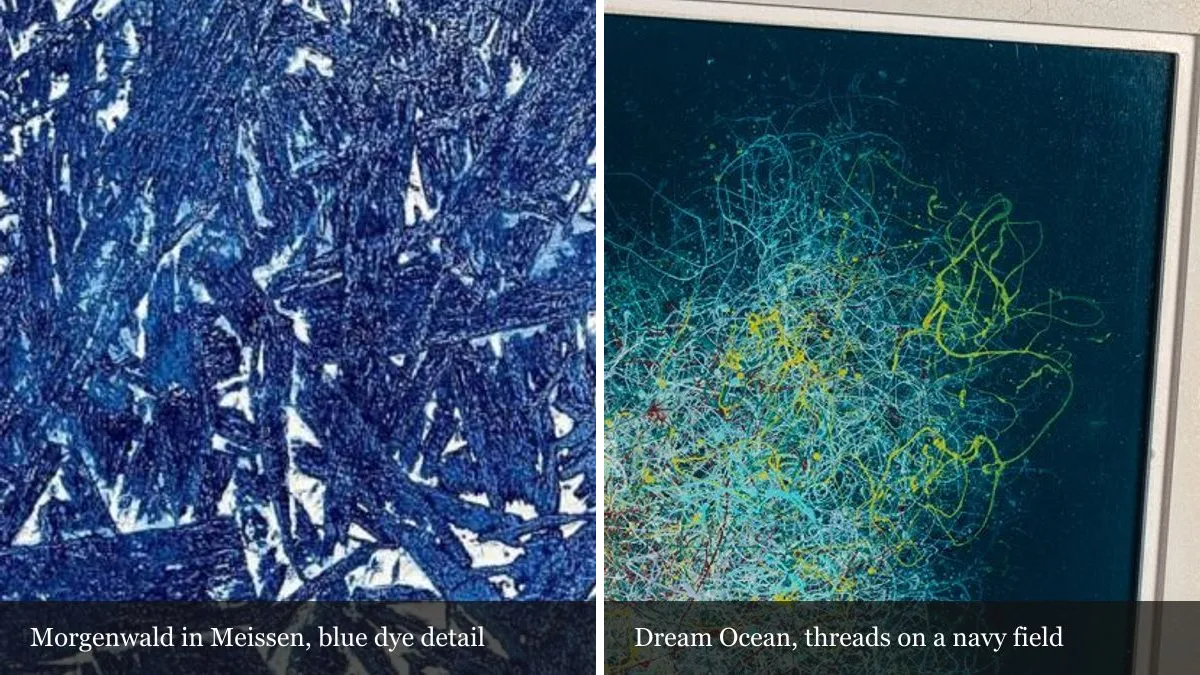
Look at Dream Ocean in its catalogue photograph and the cracks in that border are darkest and densest at the four corners. Now look back at the table. Diagonal cracks at the corners are what a conservator writes down after a painting has been dropped. The same pattern is the design on one work and a sign of a fall on another, and no one can tell which from the cracks alone. Only a record can.
Why acrylic on a panel cracks for its own reasons
The encyclopaedia says the word craquelure is used most often for tempera and oil paintings, and that the cracks can come from drying, shock, ageing, intentional patterning or a mix of all four. For an acrylic painting the thing to watch is the cold. The Canadian Conservation Institute's page on incorrect temperature says artists' acrylic paints are leathery and tough at room temperature but enter their glassy phase below 5 °C, and that acrylic paintings then become more vulnerable to shocks and blows. Oil paint, by the same page, only gets there below minus 30 °C.
Five degrees is an ordinary Ontario winter day, and it is the inside of a parked car, a garage, an unheated hallway or a moving truck. A knock that would do nothing to an acrylic painting in July can crack one in January. If a work has to travel in the cold, warm the car before the painting goes in, as we describe in how to carry a painting by car.
Make a record on the day it arrives
Museums keep condition reports for the same reason. CCI's note on condition reporting says a report should record any feature that is distinct from an undamaged condition, cracks first among them, and that reports kept systematically document any changes over time. You do not need a museum form. A phone and ten minutes will do it.
- Photograph the whole work straight on, in daylight, with nothing reflected in it.
- Then photograph every crackled area up close, once with the light from the side so each crack throws a small shadow.
- Photograph the four corners and the edges, whether you see cracks there or not.
- Save the text of the work's page with the photographs, so the line that says the crackle is intended stays with the pictures.
- Put the date on the folder, and keep it with the Certificate of Authenticity.
- Once a year, take the same close-ups from the same spot in the same kind of light, and compare them side by side.
The side light matters more than the camera. A crack with a lifted edge throws a longer shadow on one side, and that is the change you are looking for.
Signs a crack is new
- It is not in your first photographs, or it is longer or wider than it was.
- The edges of the paint on either side have curled up, even slightly.
- The cracks form rings around one point, as if something pressed or struck there.
- You find small flakes of paint on the wall ledge or the floor below.
- A crack appeared after a move, a very cold day in transit, or a change of wall.
If you see any of these, leave the surface alone. Do not press a lifted flake back, glue it or wipe the area. Take the photographs, keep any pieces that came off, and read our note on what to do if a painting gets damaged before calling a conservator.

Both works are available, and viewings are by appointment. If you would like to see the crackle on Morgenwald in Meißen or the border of Dream Ocean in raking light before you decide, send us a message and ask which areas of the surface are crackled by design.