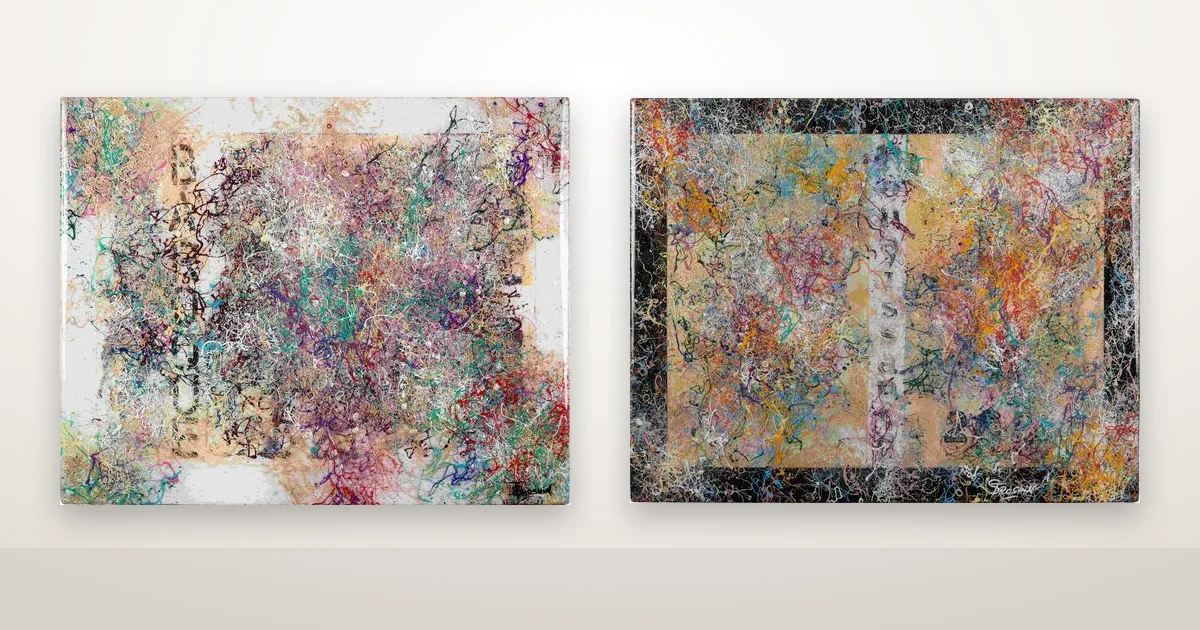
Three panels in our catalogue are named after art movements: Baroque 2020, Renaissance 2020 and DaDa 2020. They are abstract paintings, so none of them looks like a seventeenth-century altarpiece or a 1916 Zurich collage. This post sets out what each movement was, what the artist says he took from it, and what you can actually see on the three surfaces, so the names work as a guide rather than a puzzle.
Three panels made the same way
All three were completed in 2020, all three are acrylic and resin on fibreboard, and all three measure 20 by 16 inches. Each is a dense web of trailed paint over a painted ground, sealed under a poured resin face, and each carries the same sentence from the artist about how long it took. What changes between them is the ground, the colour and the lettering underneath the lines.
That makes them a fair comparison. When the support, size, year and method are fixed, the differences you see are decisions about colour and structure, and the title is the artist's account of where those decisions came from.
What each name meant before it became a title
Each of the three words names a real period, and the definitions below are the ones Tate's art glossary gives. The artist's own reading of each period follows, quoted from the artwork's page.
Renaissance, from about 1400
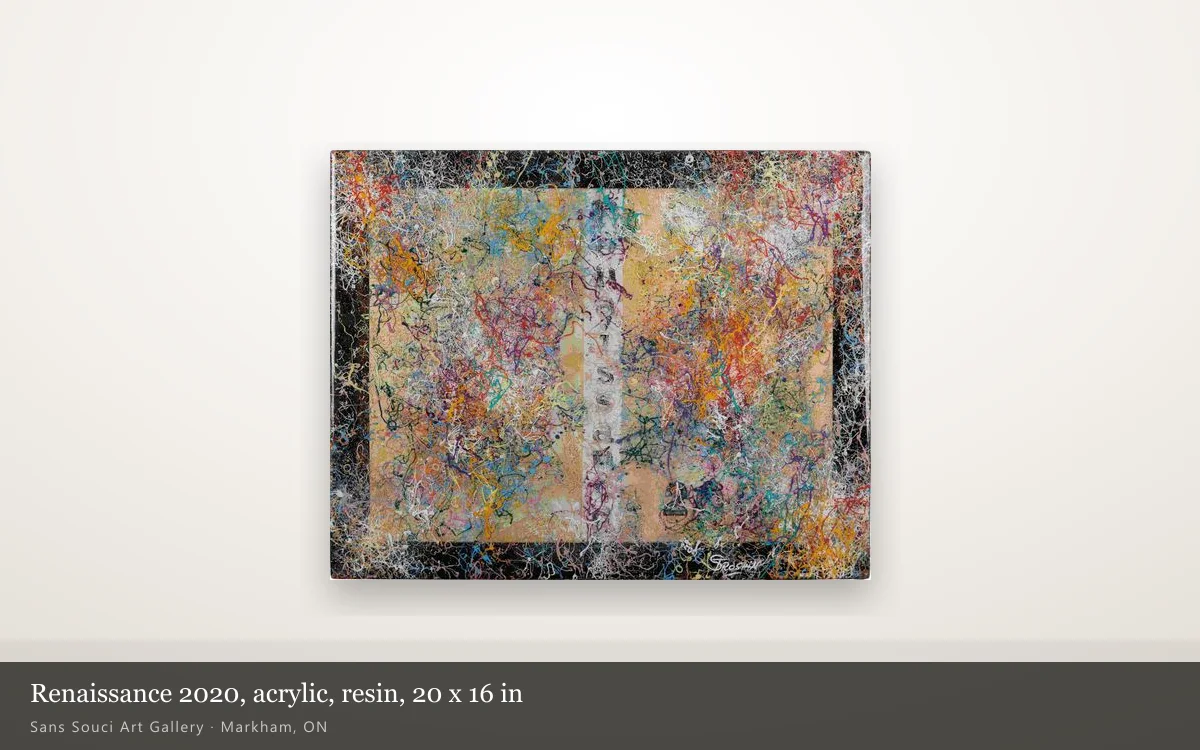
Tate's glossary entry on the Renaissance describes a revival of art in Italy from about 1400, driven by the rediscovery of classical art and culture, with its peak in roughly 1500 to 1530 in the work of Michelangelo, Leonardo and Raphael. The artist's note on Renaissance 2020 starts from Leonardo and colour:
"Leonardo da Vinci created a new color system. He believed that there are 6 primary colors: Red, Yellow, Green, Blue, White, Black."
The note then gives a meaning to each colour, from red for excitement to black for power and formality, and ends: "Inspired by the music, art and science of Renaissance, I weaved my abstract vision of that time." We quote it as he wrote it. It is his starting point, and the painting is built on colour accordingly.
Baroque, the seventeenth century
The same glossary calls Baroque the dominant style in art and architecture of the seventeenth century, at its height in Rome from around 1630 to 1680, and names its dynamic movement, bold realism and direct emotional appeal. The artist's note on Baroque 2020 picks out much the same qualities:
"The Baroque style used contrast, movement, exuberant detail, deep color, grandeur and surprise to achieve a sense of awe."
Realism is the one quality on Tate's list that an abstract panel cannot borrow, and the note does not claim it. What it takes is movement and density.
Dada, 1916 onwards
Tate's entry on Dada describes a movement formed in Zurich during the First World War as a reaction against the war, whose art, poetry and performance were often satirical and nonsensical, and which set out to destroy traditional values in art. Its founder, the writer Hugo Ball, opened the Cabaret Voltaire in 1916. The artist's note on DaDa 2020 is the only one of the three written as a protest rather than a description:
"No logic, no reason, and no aestheticism of society! Instead, expressive nonsense, irrationality and my protest for society protests!"
Note the year in the title. A painting completed in 2020 and named after a movement born from a crisis in 1916 is a reading of its own year, which is what the note says it is.
The three side by side
Everything in the last three columns comes from the catalogue photographs and the artist's notes. Where the photograph does not settle something, the table says so.
| Baroque 2020 | Renaissance 2020 | DaDa 2020 | |
|---|---|---|---|
| Period named | 17th century, Rome | Italy, from about 1400 | Zurich, from 1916 |
| What the note takes from it | Contrast, movement, deep colour, surprise | Six colours and a meaning for each | Nonsense, irrationality, protest |
| Ground | Pale grey with a large tan block | Tan field inside a black painted border | Pale ground, almost fully covered |
| Line colour | Mostly pink, white, plum and teal | Red, orange, white, teal, blue and purple, with the tan showing through | Orange, teal, purple and red, densest of the three |
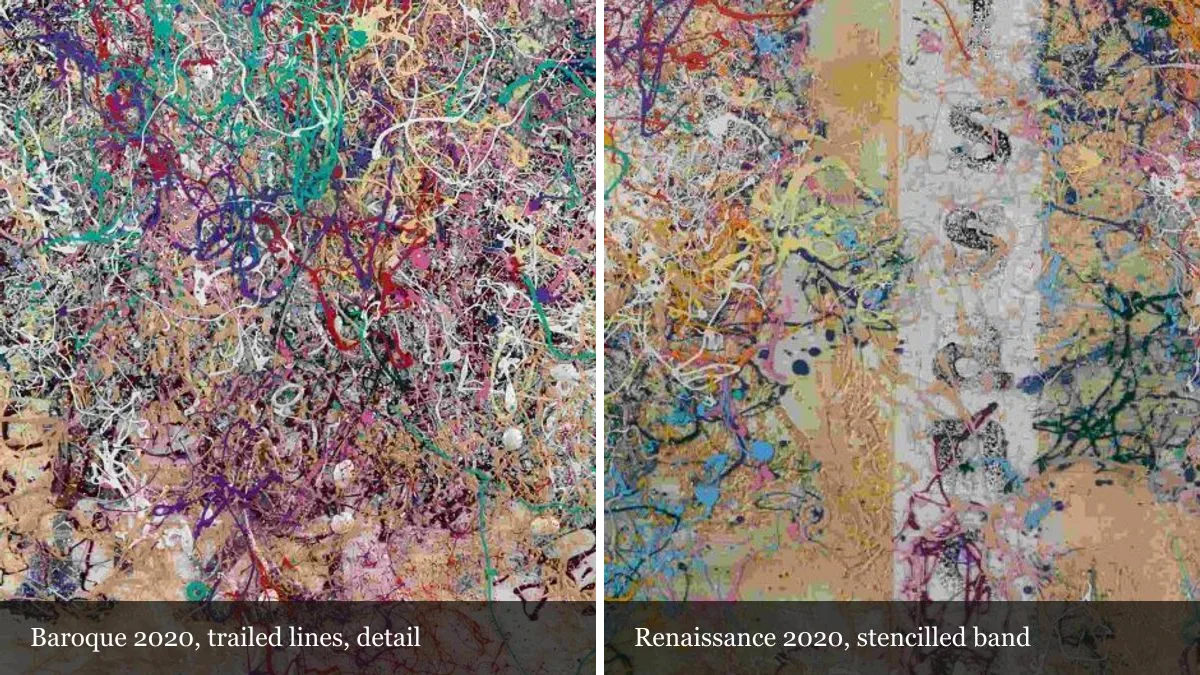
| Lettering under the lines | A vertical column at left; the top letter, B, is clearly legible | A pale grey band down the centre; two S's are legible | Large black letter forms turned on their side at the left edge; we cannot read them as a word |
| Other structure | None beyond the tan block | The black border frames the whole surface | A white grid lattice in the lower right |
| Stated depth | 0.3 in | 0.1 in | 0.1 in |
The lettering is worth a closer look in person. In the photographs it sits under the trailed paint and under the resin, so it reads as an earlier layer rather than something added on top. We would not claim more about what the letters spell than the photographs show, and the table keeps to that.
What a borrowed name can tell you, and what it cannot
A movement in a title is a statement about a starting point. It is not a style label you can check against a textbook, and it is not a claim that the painting belongs to that period. Four practical points follow from these three panels:
- Read the note before the title. All three pages carry a note that says what was taken from the period. The title alone would leave you guessing; the note tells you whether to look for colour, movement or attitude.
- Look for the quality, not the period look. Baroque 2020 has no figures and no realism. Look instead for the contrast and density its note names.
- Compare like with like. Because the three share size, support and method, the differences between them are the artist's choices. Set side by side, they show what a title actually changed.
- Ask what the year adds. All three titles end in 2020. On DaDa 2020 the note makes the year part of the meaning; on the other two it reads as the date of a reinterpretation.
We have written about titles more generally in what a title tells you, and about the notes themselves in what an artist's note does and does not do.
How long the lines took
Each page ends its note with a version of the same line. Baroque 2020: "The whole labyrinth of lines was drawn by hand. This work has lasted as many days as there are lines in the painting." Renaissance 2020: "The entire labyrinth of lines was drawn by hand. As many lines, as many days of work!" DaDa 2020: "As many lines,that many days of work it took!"
Take it as the artist's description of a slow, repeated process rather than as a count you could verify. What it does tell you is that the density of these surfaces was built up over a long period, line over line, which is also why the three can look so close in a thumbnail and so different at arm's length.
Seeing them, and the two that have sold
At the time of writing, Baroque 2020 and Renaissance 2020 are marked Sold on their pages and remain in the catalogue as part of the artist's archive. DaDa 2020 is the one of the three you can still ask about, and it can be seen with the rest of the artworks at 473 Simonston Blvd in Markham, by appointment. If one of the sold panels is the one that speaks to you, Sergei Troshin takes commissions; we explained how that works in how commissions actually work. Either way, get in touch and we will arrange a time.