In October 1953, abstract paintings hung in the windows of Simpson's, a Toronto department store, next to modern Danish furniture and reproduction French Provincial pieces. The display was called Abstracts at Home. Seven of the painters in it went on to form Painters Eleven, the first abstract painting group in Ontario. If you are looking at abstract art in Toronto today and deciding whether abstraction belongs on your own wall, that window, seventy-three years old, is still a useful place to begin.
Who were Painters Eleven?
Painters Eleven were eleven abstract painters active in Ontario from 1953 to 1960. Seven of them first appeared together in a Toronto store display; the eleven showed together for the first time at Roberts Gallery in Toronto in 1954, and disbanded in 1960. They are associated with Abstract Expressionism, and they are credited with making English Canada's art-buying public more used to it.
The facts in this post come from the encyclopaedia entry on Painters Eleven, which lists its sources. The window display was assembled by William Ronald, who worked at Simpson's as a commercial artist, with seven painters: Jack Bush, Oscar Cahén, Tom Hodgson, Alexandra Luke, Ray Mead, Kazuo Nakamura and Ronald himself. A meeting at Alexandra Luke's cottage in Oshawa added four more: Hortense Gordon, Jock Macdonald, Harold Town and Walter Yarwood. Harold Town named the group.
The group's short history, year by year:
| Year | What happened |
|---|---|
| 1953 | Abstracts at Home, Simpson's, Toronto: paintings shown beside furniture |
| 1954 | First exhibition as a group, Roberts Gallery, Toronto, arranged by Jack Bush. The entry calls it the first major commercial exhibition of non-objective art in Toronto |
| 1956 | Exhibition with the American Abstract Artists at the Riverside Museum, New York. Oscar Cahén dies in a car accident the same year |
| 1957 | Third exhibition; by then, the entry says, they had established Abstract Expressionism in Canada. William Ronald resigns after moving to New York |
| 1959 | A National Gallery of Canada touring show, seven venues |
| 1960 | The group formally disbands |
What they had in common, and what they did not
The only thing all eleven shared was a commitment to abstraction. They did not share a style. Decades separated the youngest from the eldest. Some had studied at the Ontario College of Art, two had attended summer schools run by the painter Hans Hofmann, and others were self-taught. Before their paintings sold, they earned a living as commercial artists, in advertising or as art teachers.
That matters to anyone looking at abstract work now, because it removes one common assumption: that abstraction is a single look you either like or do not. Eleven people working in the same city, in the same years, under the same label, produced work different enough that the group never pretended to a common vision. When you look at abstract painting, you are looking at one person's decisions, not at a genre.
We should be plain about one thing. Sergei Troshin, whose work this gallery shows, is also self-taught and also came to painting after years in other work, as the page about the artist explains. That is a coincidence of biography, not a lineage. Nothing on this site connects his work to Painters Eleven, and we are not suggesting a connection.
Three things the 1950s description names, and how to look for them now
The encyclopaedia entry quotes a description of the group's paintings: "rich colour and creamy impasto and impulsive spontaneous line", often with "an introspective note". Those are four separate things, and each is something you can look for in any abstract painting, including the two in our catalogue discussed below:
- Colour. How many colours, and how much of the surface each one holds.
- The body of the paint. Whether the surface is flat or built up. Impasto means paint laid on thickly enough to stand off the surface.
- Line. Whether lines were drawn deliberately or thrown, trailed or poured, and whether you can follow any one of them from end to end.
- The note. Whether the work carries a mood or subject beyond its surface, and where that comes from: the title, the artist's words, or the painting alone.
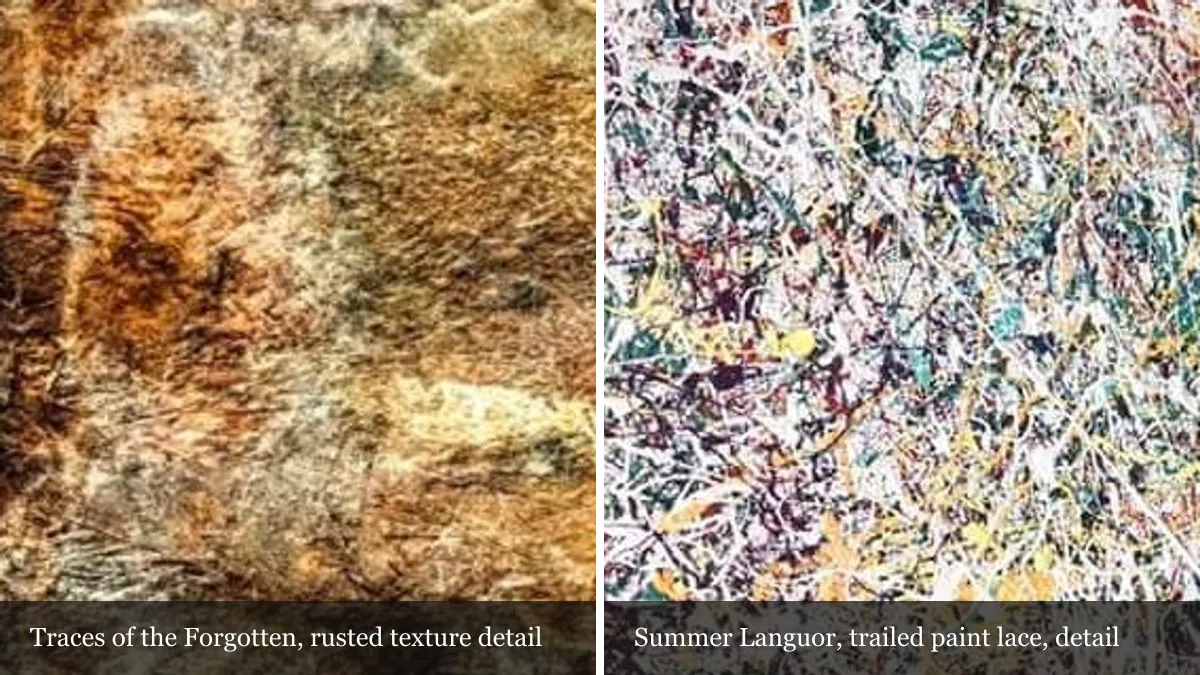
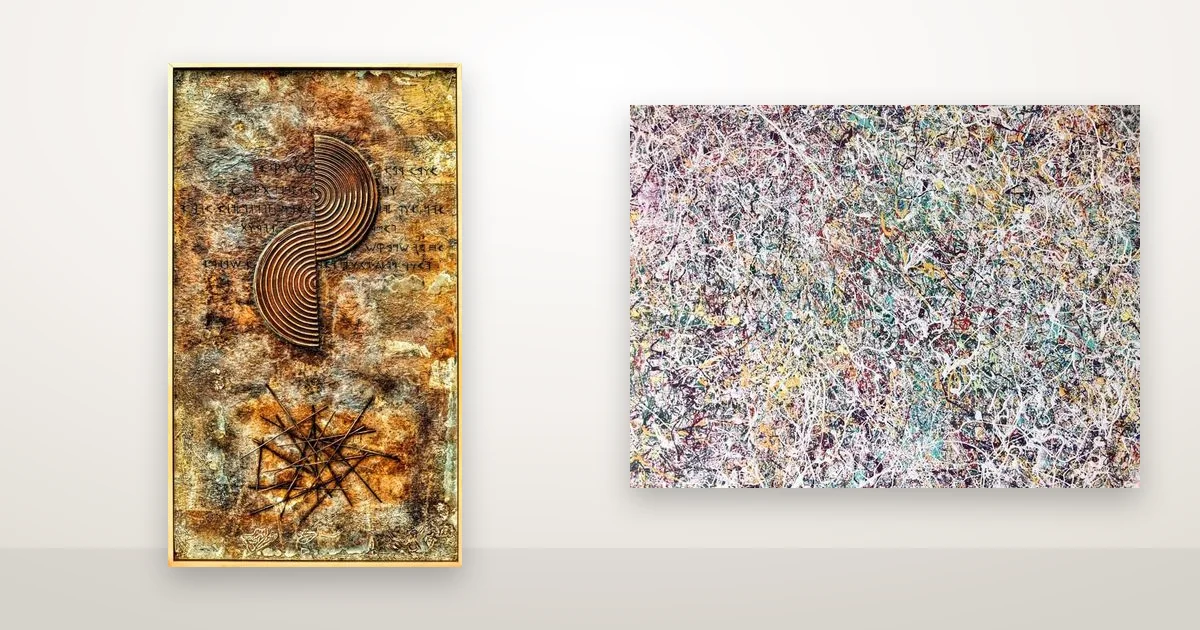
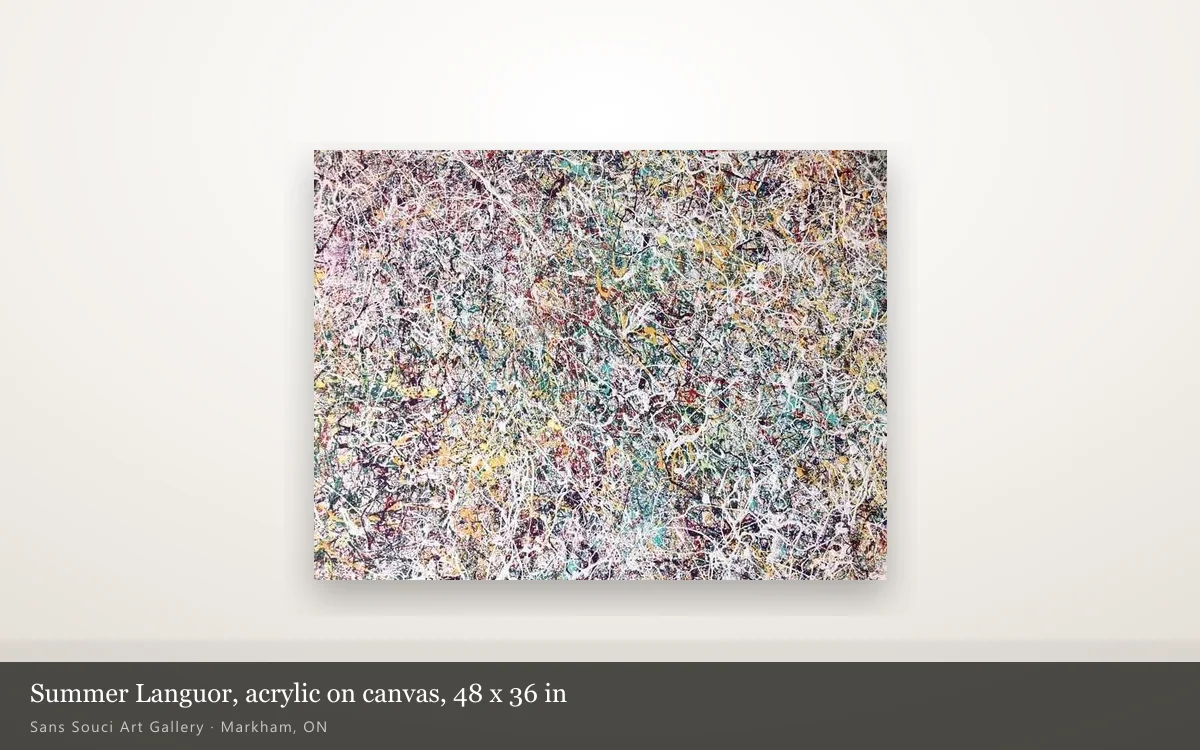
Summer Languor is almost entirely line. It is acrylic on canvas, 48 by 36 inches, completed in 2020, and the surface is a dense web of trailed white, green, yellow, plum and pink paint with no single line you can follow for long. The artist describes how it was made on its page: "I didn't paint it: I was making a piece of paint lace, spinning it, weaving it." Of the four things in the list, it answers line and colour directly. There is no image in it and no symbol. Its note, if you find one, comes from the title and from standing in front of it.
Traces of the Forgotten, from 2025, works the other way. It is mixed media, 30 by 48 inches, and in the photograph the surface is a mottled field of rust, ochre and grey, with a circle split into two offset halves of concentric rings, a cluster of crossed dark strokes below it, and faint script-like marks across the upper half. Here the note is stated in words. The artist's description on its page reads: "A fractured circle, rusted textures, and scattered metallic remnants evoke lost wholeness and the erosion of cherished values." Of the four things in the list, this one answers body and note first, and line only in the crossed strokes.
Two works by one painter, then, at opposite ends of the same four questions. On its own, the word "abstract" tells you very little until you ask what the painter did with colour, paint, line and meaning.
Why "Abstracts at Home" is still the right test
The 1953 display did not hang abstract paintings on a bare gallery wall. It put them next to furniture people might own, in a shop window people walked past. The question it asked was not "is this art?" but "could this live in a room like yours?". That is still the most practical question a buyer can ask.
It is also why we show work the way we do. A painting is easier to judge next to a sofa or a table than on a screen, which is why viewings here happen by appointment, in a room, under real light. Some of the work goes a step further than the Simpson's window did: the pieces in Furniture & Home Accents put the abstract painting on the furniture itself, which we wrote about in art on things you use.
The reception history is worth knowing too. According to the same entry, the group's first exhibition was met with "confusion and disdain", and even after its New York show in 1956 the group was still disparaged in Toronto. Today its work is held by public galleries across Canada. If an abstract painting leaves you unsure at first, you are in good company, and it is not a reason to rule it out. We wrote about that in living with a piece you do not fully understand yet, and about the assumptions people bring to abstraction in what abstract art is not.
Where to see their work near Toronto
The largest collection of Painters Eleven work is held by The Robert McLaughlin Gallery in Oshawa, east of Toronto. Its current programme includes Stories in Ink: Illustrations by Oscar Cahén, running from June 13, 2026 to January 3, 2027. Note what that show is: Cahén's magazine illustrations, more than three hundred of them between 1950 and 1957 according to the gallery, rather than the abstract paintings the group is known for. It is still a way to see how one of the eleven handled line and colour in commissioned work.
The Art Gallery of Ontario has given major exhibitions to three members: Jack Bush in 1976, Harold Town in 1986, and Kazuo Nakamura in 2004 and again in 2024. What either museum has on its walls on a given day changes, so check its own listings before you go.
Seeing their work first is not a requirement for buying anything, here or elsewhere. But an afternoon in front of large abstract paintings from the 1950s trains the eye in exactly the four questions above, and it commits you to nothing.
Seeing the two works here
Both paintings discussed above are in the catalogue, alongside the rest of the artworks. The gallery is at 473 Simonston Blvd in Markham, inside the Greater Toronto Area, and viewings are by appointment. If you would like to stand in front of Summer Languor or Traces of the Forgotten and ask the four questions yourself, get in touch and we will arrange a time.