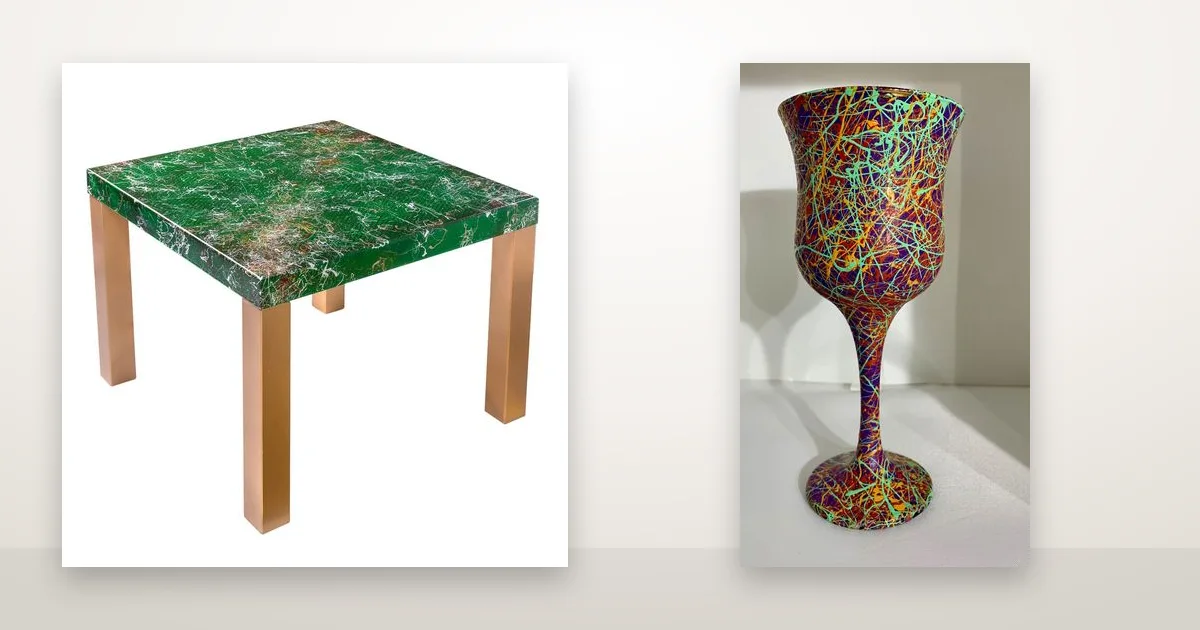
Thirteen of the 61 originals in this catalogue are not on a wall. They are a side table, a tissue box, a wine glass — objects that already had a job before any paint went on them. That changes almost nothing about what they are, and quite a lot about what the surface has to survive. A painting is asked to be looked at. A table is asked to be looked at and then to hold a cup.
What is actually in Furniture & Home Accents?
Thirteen works, all completed in 2020. Nine carry a materials line saying the painting is on furniture, three are hand-painted wine glasses and one is a tissue box. Two of the thirteen have found owners; the other eleven are available. It is the only part of the catalogue where the support is a finished object rather than a blank one.
They are not a sideline or a cheaper tier. Each is a single object that will not be made again, each leaves the studio with a Certificate of Authenticity signed by the artist, and none of them is a print. The terms are the same as for anything in the main artworks listing: price on request, no online checkout, viewing by appointment. On the nine furniture pieces the page says it in one line — the surface is worked directly onto an object made to be used, not onto a blank support.

Three different finishes, three different care instructions
Across the thirteen there are three ways the paint has been sealed, and each behaves differently under use. The finish is not decoration; it is the layer that meets the world. Writing about furniture, the Canadian Conservation Institute describes a finish as a discrete coating that protects the wood from soiling, gives it some moisture resistance and alters how the surface looks.
- Epoxy, poured thick. On Green Glamor 1, a square side table, the artist's own note describes a "textured imitation of snakeskin, hidden under multiple crystal clear coats of epoxy". The same note, with small differences in wording, appears on five of the nine furniture pieces. Its materials line does not name the finish at all — only the artist's description does.
- Resin. The hand-painted tissue box is listed simply as "Acrylic, resin". A poured resin coat cures to a hard, glass-like film that deepens the colour underneath and seals it. Hard is not the same as invulnerable: its page says plainly that the resin face scratches like any gloss surface.
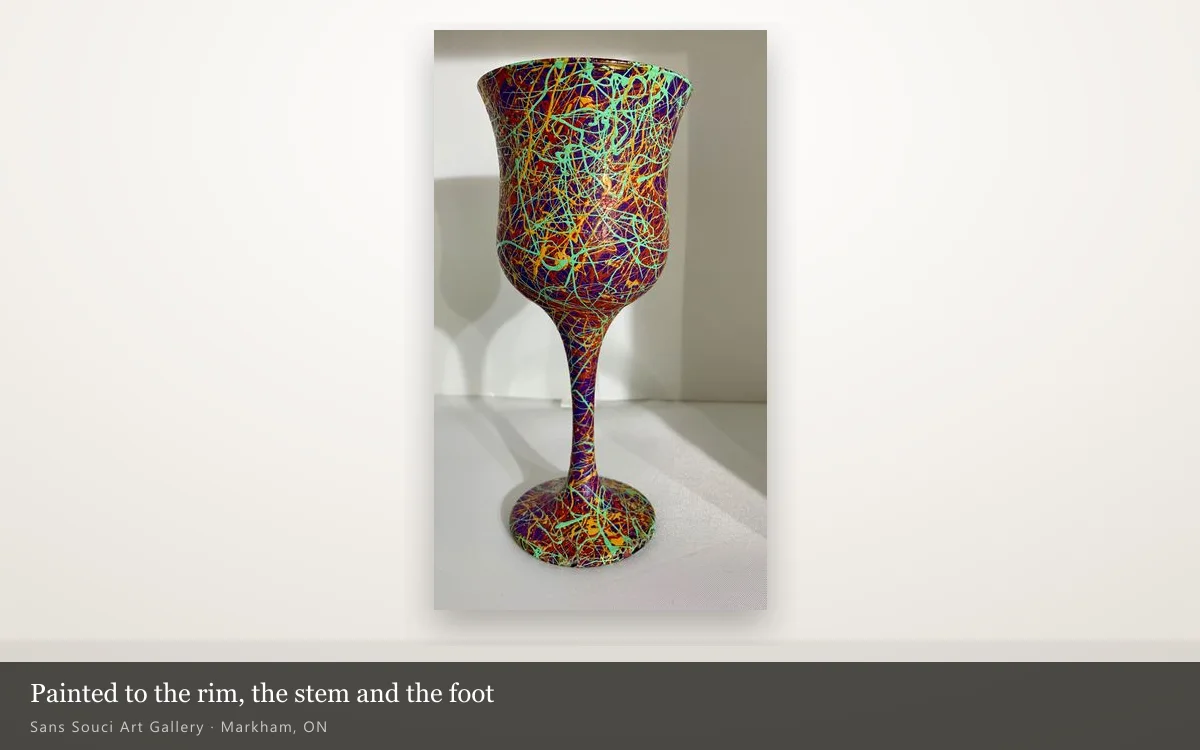
- Varnish, thin. The three wine glasses are the only works in the whole catalogue finished with varnish — a thin protective coat over the finished paint, which evens out the sheen and shields the surface from dust and handling. A thin coat over the paint is not the same proposition as a poured layer with body of its own.
Those are not interchangeable, and the care line on each page already reflects the difference.
| Work | Materials line, as printed | What its page says about care | Measurement given |
|---|---|---|---|
| Green Glamor 1 — a square side table | "Acrylic, abstract painting & texture work on furniture!" | Out of direct sunlight, away from radiators and humidity, dusted with a dry, soft cloth | None |
| Hand-painted Tissue Box | "Acrylic, resin" | Scratches like any gloss surface. A dry cloth only — no solvents, no household cleaners, nothing abrasive | None |
| Hand-painted Wine Glass (II) | "Acrylic, sealed with varnish" | "The varnish layer is there to be cleaned: a dry, soft cloth is enough, and water or solvent is not" | None |
What changes when the surface has a job
Three things, and none of them is a reason to avoid the piece. They are simply the conditions a painted object lives under, and each has an answer that costs nothing.
- Horizontal surfaces collect liquid. Writing about traditional varnish and lacquer finishes on furniture, the CCI is blunt: water "usually produces rapid and obvious damage", and it names the two culprits — spilled drinks, and plant pots or vases left standing on a horizontal surface. That guidance is written for older finishes, but on the varnished pieces here it applies directly, and a tray or a coaster is the whole preventive measure for any of them.
- Light is the slow one. The breakdown of the binders in paint is driven mostly by light, visible and ultraviolet, which is why the CCI advises minimising both the intensity of the light falling on a painted surface and the number of hours it falls. A side table standing in a south window all afternoon collects far more of it than a painting on the opposite wall.
- Abrasion is the one a wall never gives. Gloss shows every scratch, and a scratch in a clear coat is not a mark on top of the colour — it is a mark in the layer that protects the colour. Set things down rather than sliding them, and when the piece has to move, take hold of it somewhere other than the painted face.
Everything after that is the ordinary routine for any original: stable temperature, stable humidity, no direct sun, a dry cloth and nothing else. We set that list out in full in how to look after an original, and what a hard poured surface actually does to colour and light in what a resin finish really does.
Can you actually use it?
The catalogue does not promise you can, and the care line on each page is where that answer already sits. Not one of the 61 pages describes a piece as food-safe, dishwasher-safe or made to be washed. The wine glass page says a dry cloth is enough and that water and solvent are not — read as a care instruction, that is also the answer about drinking from it.
Conservation guidance on decorated glass says the same thing from the other direction. Plain, undecorated glass in good condition can be washed in clean, lukewarm water; before washing anything decorated, the CCI advises checking first that painted, gilded or printed designs are not coming off and are not soluble in water. On Wine Glass (II) the paint runs over the outside of the bowl, down the stem and across the foot — the whole surface a hand and a sink would reach. It is an object to look at, not tableware.
There is a second gap worth naming, because it is the one that catches people out: none of the thirteen states a size. Of the 61 pages on this site, 47 give a measurement; the fourteen that do not are these thirteen and one wall piece. So before you decide where a side table goes, ask us for its height, width and depth — and while you are asking, ask what the object was before it was painted, and which of its surfaces carry paint. Our note on what to ask a gallery before you buy covers the rest of that conversation.
The group is small, it is all from one year, and it is the part of the catalogue that loses most in a photograph: a thick clear coat over a worked surface has depth, and depth is exactly what a photograph flattens. You can see what is available in Furniture & Home Accents, and if a piece interests you, write to us — we will send the measurements and answer the use question honestly for that particular object. Viewings are in Markham, by appointment.