A self-taught artist is someone who learned to paint without going through an art school or an academy. The word tells you how the person learned. It tells you nothing about how the painting in front of you was made, what it is made of, or whether the artist has kept working for ten years or ten weeks. Those are the things a buyer needs, and most of them can be read on the page of the work itself. This note separates the word from two others it gets confused with, shows what our own artist page means by it, and puts four questions to two paintings made five years apart.
Three words that get used as one
Self-taught, naive and outsider are often printed side by side as if they meant the same thing. They answer three different questions: how the artist learned, what the work looks like, and where the artist stands in relation to galleries and museums.
Self-taught
This one is about training and nothing else. It is a fact from a biography, like a date of birth. A self-taught painter can work in any style, show in galleries, take commissions and write about the work. The word does not describe a look, so you cannot spot a self-taught painting by its surface.
Naive art
This one describes a look. Tate’s glossary entry on naive art calls it “simple, unaffected and unsophisticated” and says it is “characterised by childlike simplicity of execution and vision”. The same entry says the term usually refers to artists with no formal training, and names Henri Rousseau as the most famous naive artist of modern times. So naive artists are usually self-taught. It does not run the other way: plenty of self-taught painters make work that is dense, layered and anything but childlike.
Outsider art
This one is about position. Tate’s entry on outsider art uses it for art “often produced by people who have not trained as artists or worked within the conventional structures of art production”, and gives the art of children, psychiatric patients and prisoners as the usual examples. The French artist Jean Dubuffet collected such work under the name art brut, raw art. An artist who exhibits, runs a studio gallery and answers a buyer’s email is working inside those structures, with or without a diploma.
What the word means on our artist page
On our page about Sergei Troshin it means one thing: he did not study painting at a school. The page gives the rest of the route in a sentence.
“His background is in German studies and linguistics, and he spent many years teaching and working in other professional fields before devoting himself to art.”
Sans Souci Art Gallery, About the artist
The same page says there is no art school in the story, that the surfaces are “built by experiment rather than by received method”, and that he has exhibited in Canada and internationally. By the three definitions above that is a self-taught artist. It is not naive art, because the work does not have that look, and it is not outsider art, because the work is shown and sold in the ordinary way.
What you can check without a diploma
A diploma would tell you where someone studied. It would not tell you how one painting was built. For that you read the page of the work: the year, the size, the Medium line and the note from the artist. Every one of the 61 works in our catalogue has a year and a note from the artist on its page, so the same questions can be put to any of them. Here they are put to two.
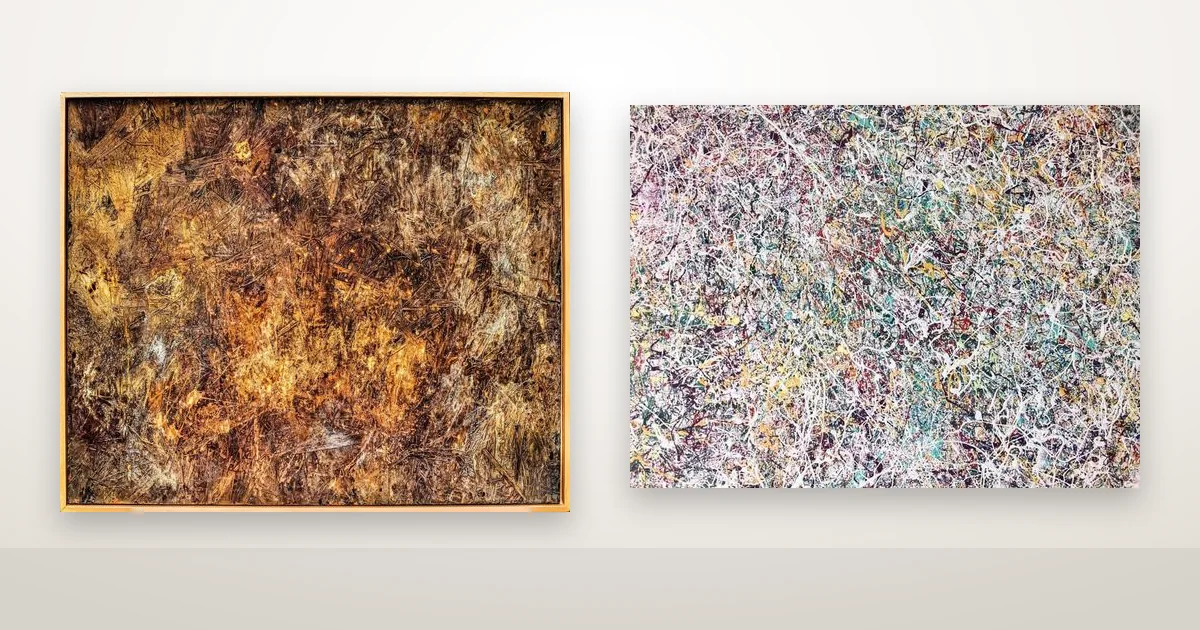
| What you can check | Summer Languor | Whisper |
|---|---|---|
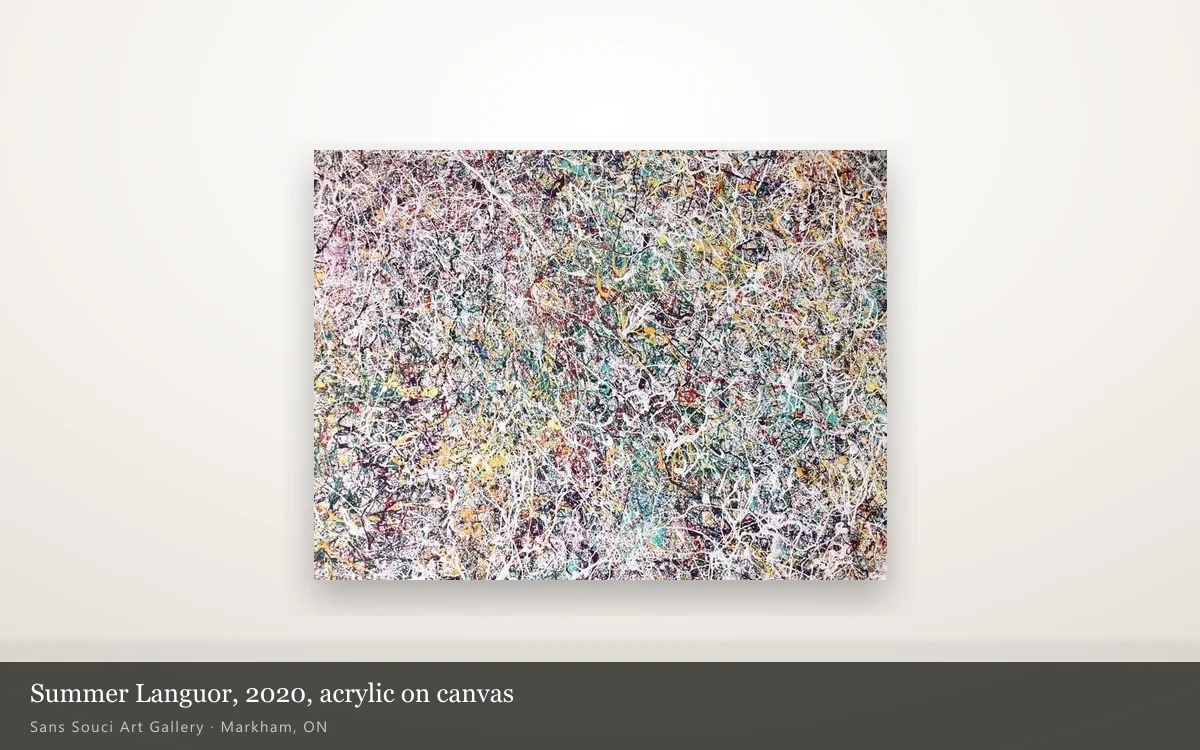
| Year and size | 2020, 48 × 36 in | 2025, 32.7 × 42.9 in |
| Medium line | Acrylic on canvas | Mixed media on panel |
| Does the note say how it was made? | Yes. Paint handled as thread: spun and woven, in his words. | It names the materials he chose, wood and rust, and why. |
| Does the note say what he was after? | A technique. He calls it his favourite style. | A subject. The note opens with a verse from Exodus. |
Two works, five years apart
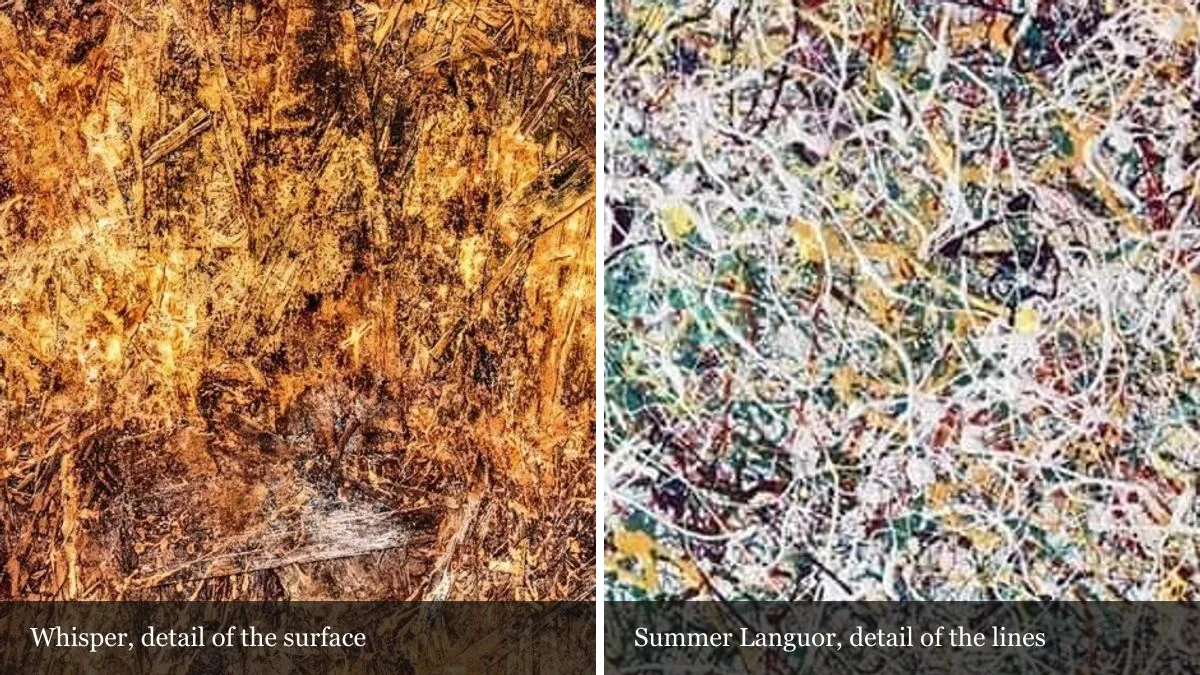
Summer Languor is from 2020, the year most of this catalogue was made: 37 of the 61 works carry that date. Its note is about method. “I always chose different painting techniques,” it begins, and then: “I didn’t paint it: I was making a piece of paint lace, spinning it, weaving it.” Look at the detail above and you can see what he means. No brush mark is visible. Thin lines of white, yellow, green and dark red cross over and under each other, and the picture is the web they make. This is what the artist page means by experiment, and the catalogue shows the repetitions: the same trailed line turns up on canvas, on board and under resin in the works around it.
Whisper is from 2025 and looks like the work of a different hand until you read its note.
“I chose difficult materials: Wood, which remembers, and rust, which testifies to time.”
Sergei Troshin, note to Whisper
The trailed line is gone. The surface is amber, brown and near-black, rough, with strands lying in every direction. The note says he was “creating a surface where revelation might have occurred”, and it is as long as the note to Summer Languor is short. Between the two works the question changed from how paint can be handled to what a material can stand for. That change is the thing to look for in any artist, trained or not: dated work, over several years, that moves for a reason the artist can state. We wrote more about reading these texts in what an artist note tells you, and about following one painter across time in collecting one artist over years.
Questions that work for any artist
None of these asks where the artist studied. Each one has an answer you can check.
- How many years of dated work can I see? Here the catalogue runs from 2019 to 2026.
- What is this piece made of, and what is it painted on?
- Did the artist write anything about this work, and does it match what I see?
- Has the work been shown in public, and where?
- What comes with it? Every piece here ships with a Certificate of Authenticity signed by the artist.
- Can I see it in person before I decide?
The last question matters most for surfaces like these two, which a photograph flattens. Viewings in Markham are by appointment. Pick a work from the Artworks collection and ask us about it through the contact page.