If you have inherited a painting, find out what it is before you ask what it is worth. Identification comes from three places: the object itself, the papers that travelled with it, and a record somewhere else that you can match it to. Valuation, insurance and the decision to keep or sell all rest on that first step, and most of it can be done at a kitchen table in an afternoon.
We are a small gallery with one artist, so we see this question from the other end: people who own one of Sergei Troshin's paintings and want to know which one it is. What follows works for any original painting, and the example near the end uses our own catalogue to show where matching gets easy and where it gets hard.
The first afternoon, in this order
The Canadian Conservation Institute's note on basic handling of paintings opens with a plain warning: most damage to paintings and their frames happens during handling. An inheritance means a lot of handling in a short time, so the order matters.
- Leave the surface alone. No damp cloth, no cleaner, no polish, even if it looks dusty. Whatever is on it today is part of what a conservator or a gallery will want to see.
- Keep the frame, the backing paper and every label exactly as they are. A torn backing or a lost sticker can remove the one clue that names the work.
- Lay the painting face up on a clean table with a towel under it, and photograph the front straight on, in daylight, without flash.
- Turn it over onto the towel only if the front has no raised paint or loose parts, then photograph the back, each edge and every label close enough to read.
- Measure height, width and depth in inches and centimetres, and write down which side you treated as the top.
- Collect every paper from the same drawer or folder: receipts, letters, a certificate, an exhibition card, a gallery bag with an address on it.
Where a painting keeps its own record
Each part of the object can confirm something different, and none of them settles everything alone. Treat every clue as a lead to check, not a verdict.
| Where to look | What you may find | What it can settle |
|---|---|---|
| The front | A signature, initials, a year painted near a corner | A name to search for. Our note on what a signature on a painting records explains what it cannot prove. |
| The edges | Paint carried round the sides, a raised rim, staples or tacks | Whether the work was made to hang without a frame, and what it is painted on |
| The back | A handwritten title, a date, a dealer's stamp or sticker, an exhibition label | Where the work has been and who handled it, if the label belongs to this painting and not an older frame |
| The papers | A receipt, a certificate, a letter from the artist or the seller | Who sold it and when. A certificate of authenticity names the object; it is not a valuation |
| A public record | The artist's or gallery's website, an exhibition catalogue | The title, year, medium and size, written by the people who made or sold it |
The Smithsonian American Art Museum keeps a page on researching your art with resources for marks and signatures you cannot read, and for tracing provenance, which it defines as where an artwork was before its current owner. For a recent work by a living artist, the last row of the table is usually the fastest route, because the record is still online.
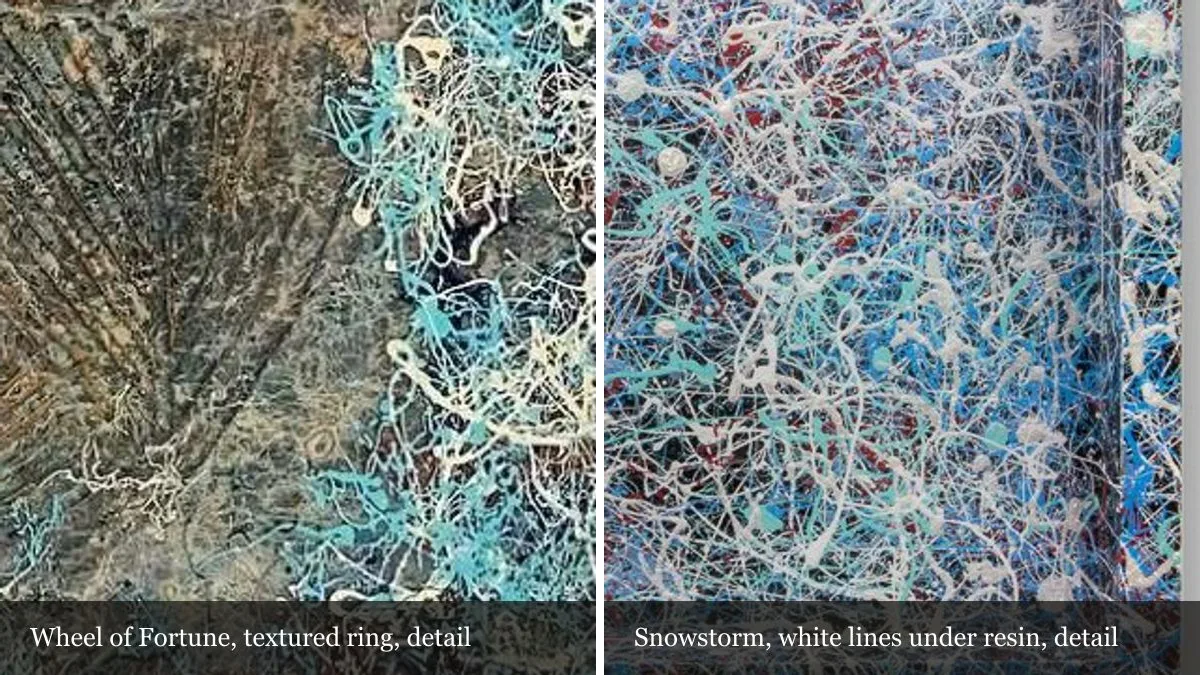
One record that fits one painting, one record that fits eight
Our catalogue keeps sold works on the site, marked Sold, with the year, the medium, the size and, where there is one, the artist's own note. We counted the 61 artwork pages this week. Two of them show the whole range of what an heir meets when matching an object to a record.
Wheel of Fortune: the written record nearly does it alone
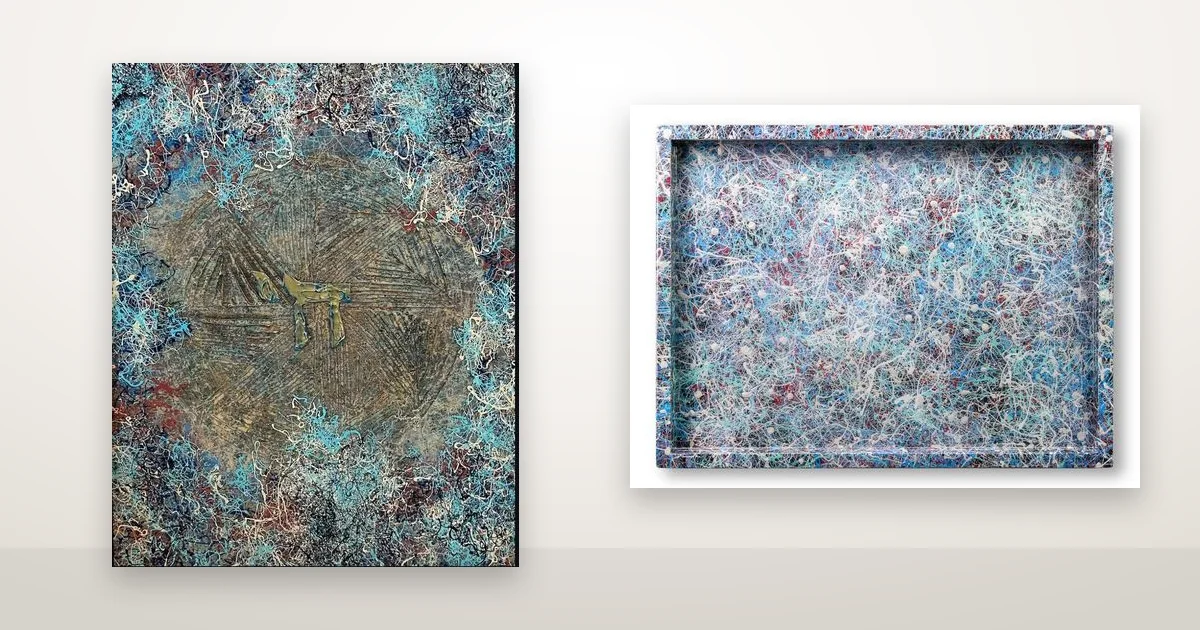
Wheel of Fortune is acrylic on canvas, 18 × 20 inches, from 2024, and sold. No other work in the catalogue has that size. Its note names the thing at its centre: the Hebrew word for "Life" standing in the middle of a spinning wheel. In its catalogue photograph that word sits in a gold-coloured mark at the centre of a disc of fine rays, ringed with tangled blue and cream line. If you have an 18 by 20 inch canvas that looks like that, the record and the object agree on every point.
Snowstorm: the written record narrows, the picture decides
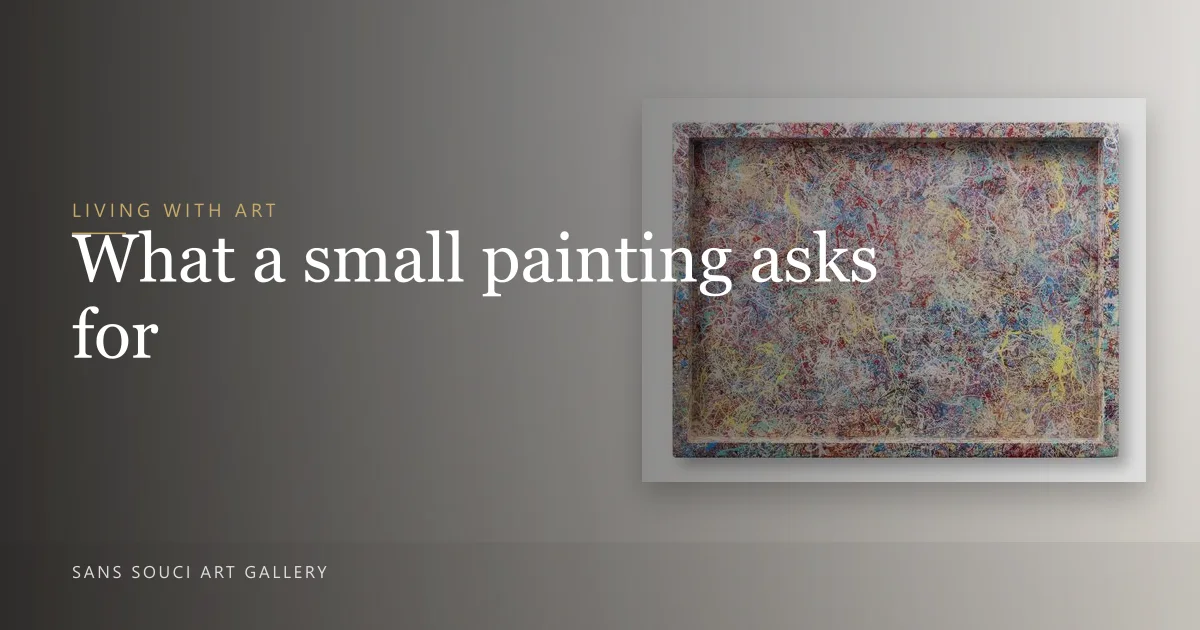
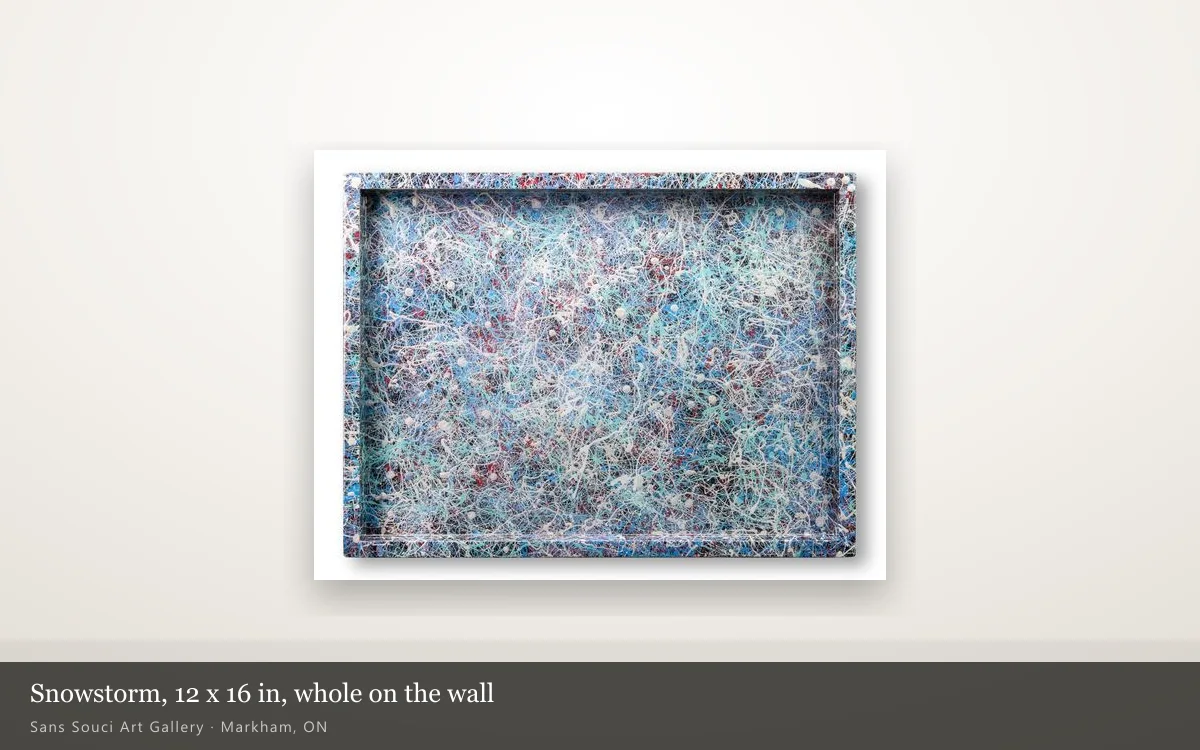
Snowstorm is acrylic on a wooden board sealed with resin, 12 × 16 inches, from 2020, and sold. Eight works in the catalogue share that same size, year and medium. Six of the eight carry nearly the same note from the artist about lines, days of work and layers of clear epoxy, and three of them, including Golden Night, add that both sides of the board are painted.
So a 12 by 16 inch resin board from 2020 points to a short list, not a single title. What separates them is the photograph on each page: in its catalogue photograph Snowstorm is a dense web of white, pale blue and red line over blue, inside a raised rim covered in the same line. Put your own photograph next to each of the eight and the match is usually obvious in a few seconds. Then check the back and the edges, because a board that is painted on both faces has already told you which three to compare first.
Write it down before anything changes
Once you know, or think you know, what the painting is, make a record of it while it is still in the state you found it. The International Council of Museums built its Object ID standard for exactly this. Its categories translate well to a home:
- what the object is, its title and its maker, as far as you know them
- materials and technique, copied from the record you matched, not guessed
- measurements, with the side you took as the top
- inscriptions and markings, front and back, written out as they appear
- distinguishing features: a chip in the rim, a label, a mark on the frame
- the subject and the date
The same standard asks you to photograph the object, write a short description and keep the file somewhere safe. CCI's note on condition reporting for paintings adds the reason to do it now: a first record with written notes and photographs becomes the baseline that later examinations are compared against. If a crack or a stain appears after a move, the photographs from this week show whether it was there before.
Worth is a separate question
A record of what the painting is does not tell you its price, and the paper that came with it is not a valuation. For insurance, Canada's Financial Consumer Agency suggests a list of your possessions with the cost to replace each item, pictures and receipts for the larger ones. Our note on insuring an original you own goes through what that list looks like for a painting. For an estate or a sale, ask an independent appraiser, and give them the identification and the photographs you have already made: it saves their time and yours.
Keeping a painting is also a decision about where it lives. If it is going on a new wall, hang it away from direct sun and heating vents before you decide anything else.
If the work in your hands may be one of Sergei Troshin's, look through the artworks catalogue, sold pieces included, and compare. If you are still unsure, send us your photographs of the front, the back and the edges with the measurements, and ask.