
Yes, resin art can turn yellow. The clear epoxy coat on a painting is a plastic, and like most plastics it slowly takes on a warm tint as it ages. How fast that happens depends mostly on three things you control at home: how much ultraviolet light reaches it, how warm the wall gets, and how many years pass. On a work kept out of the sun and away from heat, the change is slow. On a sunny wall it can be quick.
This matters for anyone looking at our catalogue. Of the 61 works on our artworks page, 36 name resin or epoxy in their medium line, and 24 of those are available. The available ones were finished between 2019 and 2026, so resin faces of quite different ages can be seen side by side. Below is what moves a coat towards yellow, where on a painting you would see it first, and how to check for it yourself before you buy.
What pushes a clear coat towards yellow
Conservators have studied this for decades, much of it on epoxy used as an adhesive to mend glass, where a yellowed joint is easy to spot. Their findings line up with what owners of resin paintings report.
| Cause | What happens to the coat | Where it is written down |
|---|---|---|
| Ultraviolet light | The main cause. UV breaks the plastic down and leaves yellow by-products. Window glass stops only part of it. | Canadian Conservation Institute, light and UV |
| Visible light | Can do some of the same, in a few materials, and far more slowly than UV. | Canadian Conservation Institute, light and UV |
| Heat | Speeds up every slow chemical change. Direct sun can warm a surface 40 °C above the room. | Canadian Conservation Institute, light and UV |
| Time alone | Epoxy also yellows in the dark, more slowly. | Down, 1984, on epoxy kept in the dark |
The first three rows come from the Canadian Conservation Institute’s page on light, ultraviolet and infrared. It states plainly that UV causes “yellowing, chalking, weakening, and/or disintegration of materials”, that ordinary light does some of this only very slowly by comparison, and that window glass filters shortwave UV “but not enough for museums”. The same page notes that sunlight can raise a surface 40 °C above the air around it, which speeds up thermal decay twenty times or more.
The last row is the one most people do not expect. A 1993 paper in the Journal of the American Institute for Conservation, on epoxy adhesives with acceptable yellowing after aging, measures yellowing by a method taken from Jane Down’s 1984 study, titled “The yellowing of epoxy resin adhesives: report on natural dark aging”. The title says it: even an epoxy that never sees daylight changes colour over the years. So no maker of epoxy can promise a coat that stays clear forever. What an owner can do is keep the change slow.
Where you would see it first
A faint warm tint is almost invisible over dark colours and plain to see over white. That decides which parts of a resin painting to watch.

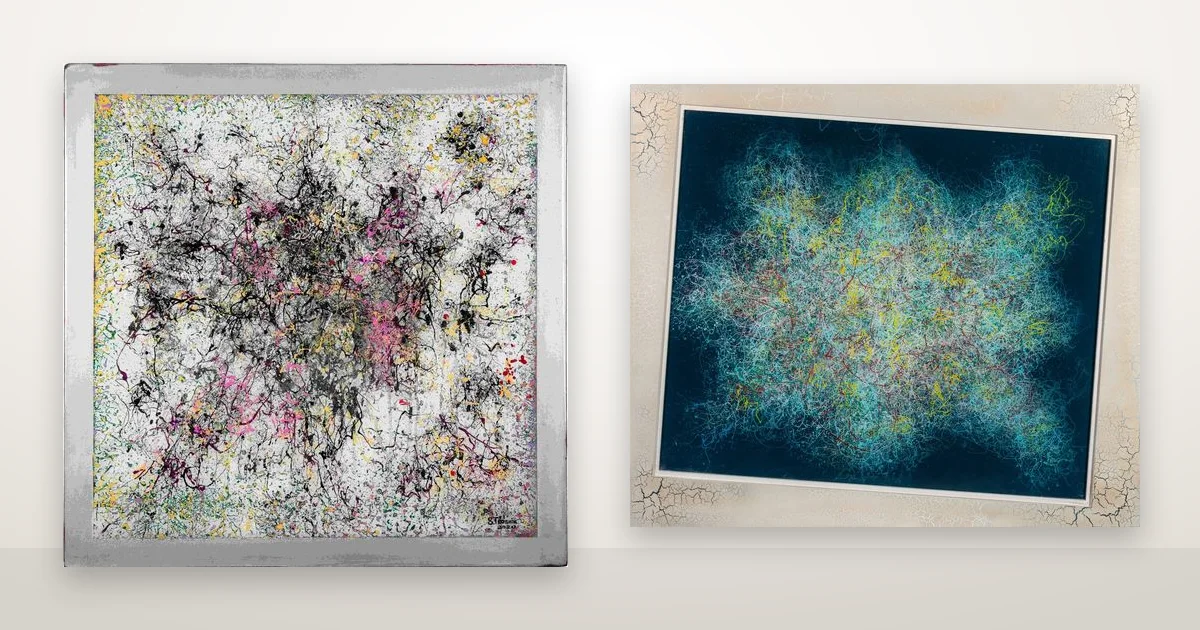
White Night (2020, acrylic and resin on fibreboard, 24 by 24 inches) is mostly white between its black and pink lines. On a work like this the white ground is the gauge: it is where a tint in the coat would show first, long before anyone could see it in the black. The artist’s own note for it asks whether you have ever seen the White Nights, when all the colours of early summer show, so the white is the subject, not a background.
Dream Ocean (2022, acrylic on fibreboard sealed with resin, 32 by 34 inches) carries both cases in one piece. Its centre is a dark navy field full of turquoise, white, yellow and red threads. Around it runs a wide cream border with a crackled texture. A coat that has warmed a little would barely touch the navy and would show in the cream.
One thing to keep apart: both works already contain yellow paint. Yellow lines are part of the drawing. What you are looking for is a tint over everything, most visible in the palest areas, and not the yellow the artist put there.
A viewing is the best test
A photograph cannot show you a faint tint, because the camera and the screen both adjust white on their own. Standing in front of the work can. When you come to see a resin piece, these checks take a few minutes.
- Ask to see it in daylight near a window, not only under warm gallery bulbs. Warm light makes every white look creamy and hides a real tint.
- Bring a sheet of plain white printer paper and hold it next to the palest part of the painting. A coat that has started to warm shows up against the paper at once.
- Look at a 2020 resin work and a 2022 or later one side by side in the same light. Among the available works, 11 resin pieces are dated 2020 and eight are dated 2022 or later, so this comparison is possible here.
- Look along the surface at an angle as well as straight on. You will see the gloss of the coat and any place where it is thicker, and a tint looks stronger through more resin.
- Ask us which resin was used on the piece you like and how it has been kept since it was finished.
Keeping a resin face clear at home
The same CCI page that names UV as the cause also gives the cure: keep it off the work. Direct sun is the one exposure that does the most harm in the least time, both through UV and through heat. We covered the fading side of this in what direct sun costs a painting; for a resin piece, the coat yellows and the colours under it fade at the same time.
Sunlight, or intense incandescent lighting, can warm surfaces 40 °C above ambient, or more.
Canadian Conservation Institute
In practice that rules out a few places in most homes:
- a wall that gets a patch of sun at any hour of the day, even through a closed window;
- the chimney breast above a working fireplace, which we measured out in a painting above a fireplace;
- a spot right above a radiator, heat vent or baseboard heater;
- a picture light or spotlight close to the surface that runs for hours with a hot bulb.
A wall across the room from the window, lit by daylight that bounces around rather than falling straight on it, is the right place for a resin painting. It also happens to be the light in which a glossy coat shows its depth best, which we wrote about in what a resin finish does in a room.
If a coat has already changed
Craft websites suggest sanding a yellowed coat down and pouring a new one. That is advice for a coaster or a tabletop. On a painting, the paint sits directly under the resin, and sanding through an uneven coat can reach it. Solvents and household cleaners carry their own risk to the surface. If a resin painting you own has warmed in colour, leave the surface alone, move the work out of the light, and ask a professional conservator before anyone touches it.

If you would like to look at a resin piece in daylight, with a sheet of white paper in your hand, you are welcome to book a viewing at the gallery in Markham.