Hanging art on a staircase works when you measure from the stair, not from the floor below it. Put the centre of each work about 57 to 60 inches above the line that runs along the front edges of the steps, keep its lower edge clear of the handrail, and save raised or delicate surfaces for the landing. A stair is the one wall in a house where nobody stands still and nobody stands far away, and the choice of painting should follow from that.
Draw the line from the nosings, not the floor
The front edge of each step is called the nosing. Wikipedia's entry on stairs calls the imaginary line through all those edges the pitch line, and gives the slope of a stair as its rise divided by its going (the horizontal depth of one step). That line is the stair's own floor. Measure up from it and the centre of a picture sits where it would sit on a flat wall, at every step.
- Measure one rise (the height of a step) and one going (front edge to front edge, level). Take them at the wall, where you will hang.
- Divide the rise by the going. Say your stair rises 7½ inches and goes 10 inches: the slope is 0.75, so your line climbs 3 inches for every 4 inches it travels.
- At two steps far apart, measure 57 to 60 inches straight up from the nosing and mark the wall lightly with a pencil or a scrap of low-tack tape.
- Join the two marks with a strip of tape. Check it from the foot of the stair and from the top, because you will see the wall from both.
- Cut paper to the size of each work and tape it on, with its centre on the line. Live with it for a day before anything goes into the wall.
With the example stair, a work centred three steps further up sits 22½ inches higher than the one below it, which is exactly the climb your eye makes as you walk. A single painting needs only one point on the line. A pair or a row follows it the whole way up, and the spacing questions are the ones we went through in hanging two or three works together.
Three places on a stair wall, three ways of being seen
The stair decides how far away you can be and whether you stop. That matters more than the colour of the wall.
| Place | How far you stand | How you see the work | What suits it |
|---|---|---|---|
| Beside the flight | No further than the stair is wide | Close and moving, from below going up and from above coming down | A flat or sealed face that reads at arm's length, hung above the handrail |
| The landing | Across the landing, where you stop to turn | Straight on, for a moment, with room to step back | A raised surface, or a work that needs a little distance |
| High wall of a two-storey stairwell | Across the open well, from the hall below or the floor above | From a distance first, then close as you climb past it | A large work that changes as you come near |
Two works and the walls they would want
The detail above comes from two works in our catalogue that sit at opposite ends of that table.
Under Media Cobweb, for the tall wall
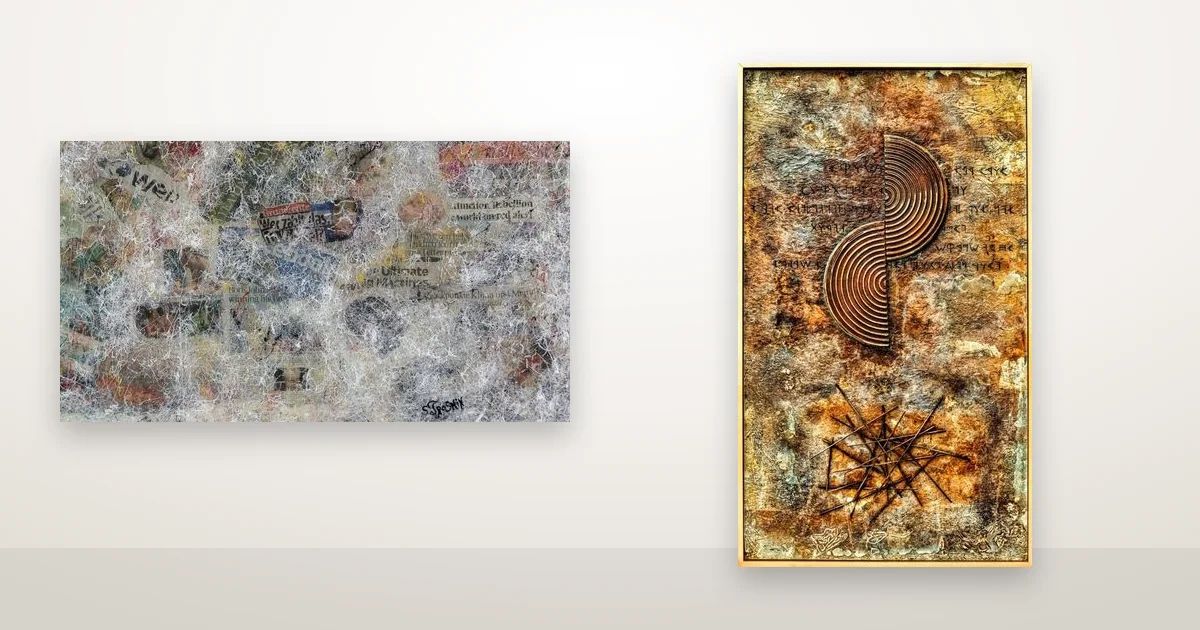
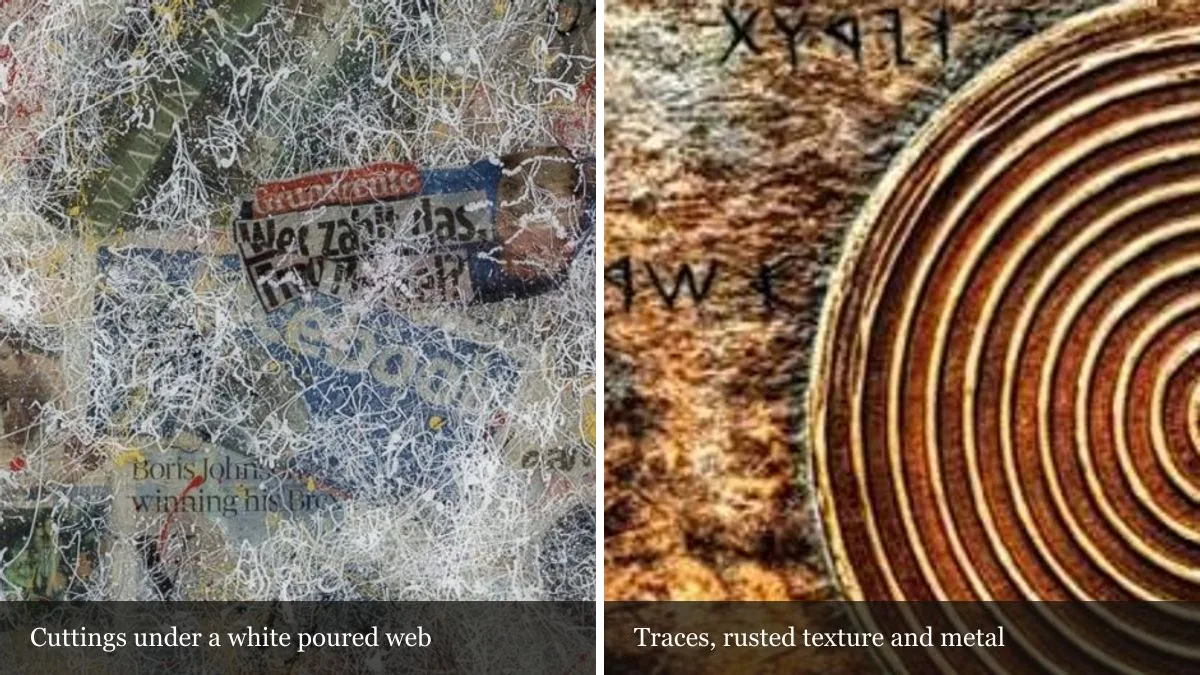
Under Media Cobweb (2019) measures 60 by 80 inches, about 1.5 by 2 metres. Newspaper and magazine cuttings in English and German are collaged across it, and headlines such as “Wer zahlt das” can still be read. A fine white web of poured acrylic lies over them, sealed under resin. Its page puts the effect plainly: from across a room it looks like a pale, cloudy field, and the print only comes through as you approach.
That is how a two-storey stairwell already works. From the hall you see the whole pale field, and as you climb past it the words surface one by one at arm's length. The resin face is smooth, so a sleeve brushing past meets a hard, even surface rather than loose paper edges. Only a tall wall takes a work this size, and getting it there is a job for several people. The Canadian Conservation Institute's note on basic handling says most paintings need two handlers and a spotter, larger ones more, and lists stair railings among the hazards the spotter has to call out.
Traces of the Forgotten, for the landing
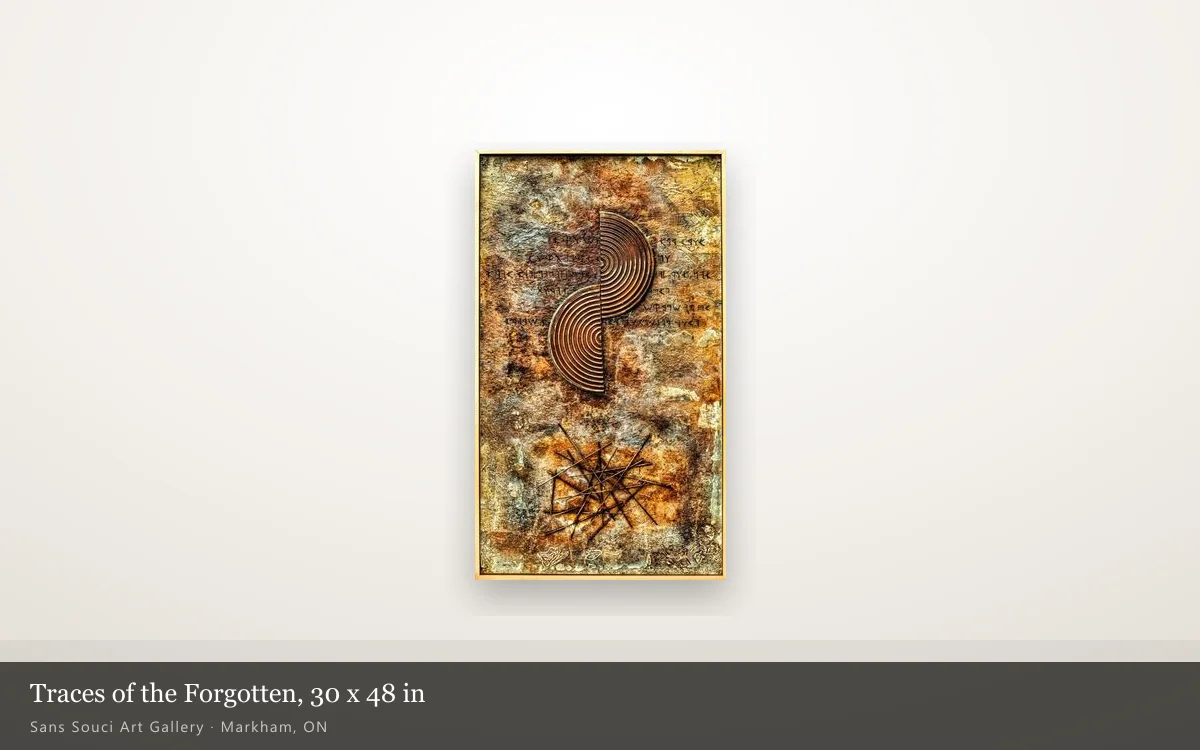
Traces of the Forgotten (2025) is 30 by 48 inches, mixed media. Sergei Troshin describes it on its page:
“A fractured circle, rusted textures, and scattered metallic remnants evoke lost wholeness and the erosion of cherished values.”
Sergei Troshin, on Traces of the Forgotten
In its catalogue photograph, two half circles of raised rings and a cluster of crossed rods stand out from the surface. A surface like that wants to be looked at from a step or two back, under light coming from the side, and it doesn't want a shoulder, a laundry basket or a moving box passing an inch away. On a landing you stop, you have room, and the work is out of the line of traffic. The same handling note puts it simply: the more a painting is moved or touched, the greater the risk of damage. Our routine for a surface without a poured coat is in how to look after an original.
The stair is where paintings get knocked
More things are carried up and down a stair than past any other wall, so a few habits protect whatever hangs there.
- Hang anything of size on two hooks set apart, not one. A work on two points stays level when someone brushes it and can't swing off a single nail. The fixings themselves are covered in how to hang a heavy painting.
- Take paintings off the stair wall before furniture, mattresses or boxes go up or down, and put them back afterwards.
- Leave the corner at the top of the flight empty. That is where people turn with their arms full.
- Keep the lower edge above the handrail, so a hand sliding up the rail never meets the surface.
Both works are listed as available, and viewings are by appointment. To ask about either one, or about the size of your own stair wall, write to us.